‘India’s social support system marker of self-sufficiency’
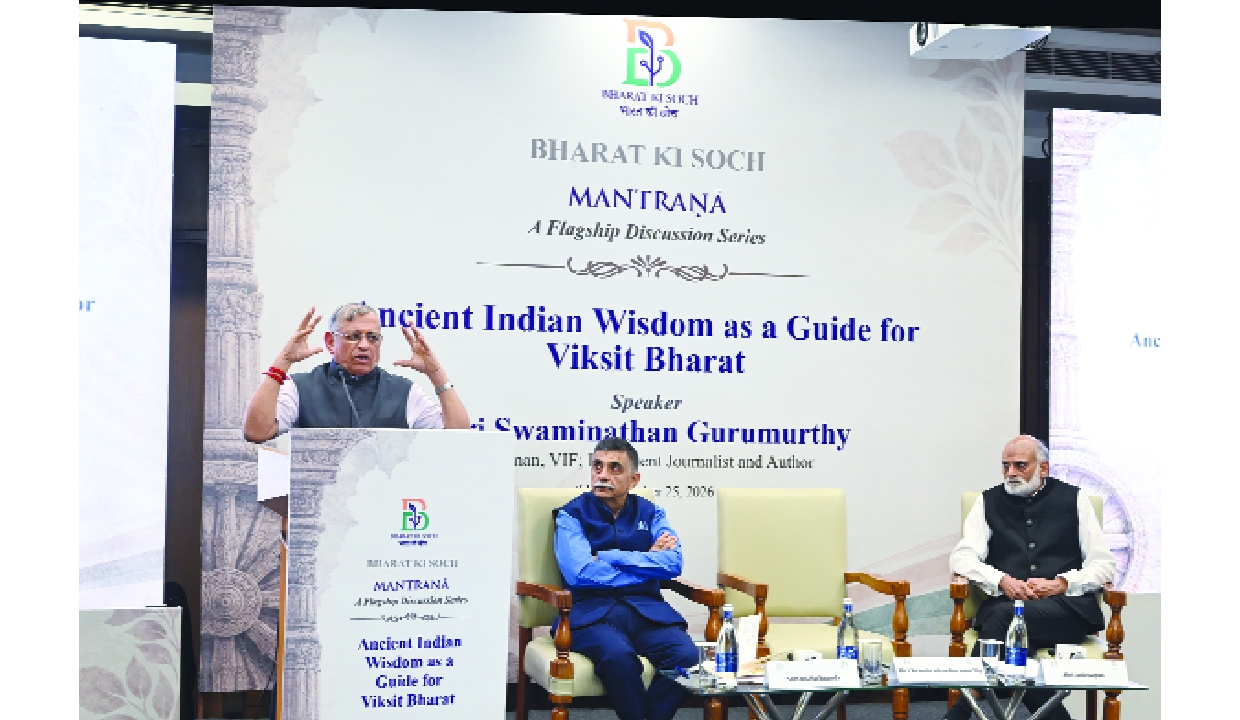
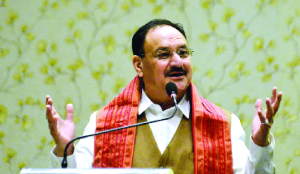
Prominent journalist, auditor and author S Gurumurthy, Chairman of the Vivekananda International Foundation (VIF), argued that India’s ancient dietary and social traditions hold answers to some of the world’s most pressing challenges, speaking at a panel discussion on “Ancient Indian Wisdom as a Guide for Viksit Bharat” held at the India International Centre here on Friday.
The event was organised under “Bharat Ki Soch Mantrana,” a flagship discussion series, in media partnership with The Pioneer.
Making his central argument, Gurumurthy said India’s predominantly vegetarian food culture has allowed the country to sustain the world’s largest human population on a comparatively small landmass.
“If all Indians shift to the American way of eating, we will need six times the land we have today. But if the whole world shifted to the Indian way of eating, we would need only 40 per cent of the land currently being farmed,” he said, citing data from Our World in Data to argue that vegetarian diets deliver far greater caloric efficiency than meat-based ones. At the same time, meat production generates significantly higher carbon emissions.
Gurumurthy credited India’s ancient physicians and scholars, including the authors of texts such as the Charaka Samhita, with arriving at sophisticated nutritional and medical conclusions through systematic observation, centuries before the advent of modern laboratory science.
He said this knowledge was transmitted across generations not only through formal institutions, but through oral traditions, proverbs, and structured teacher-student relay systems such as the Gurukul, embedding scientific understanding directly into everyday cultural habits.
He also contrasted India’s family-based social support systems with the Western welfare model, citing a National Bureau of Economic Research study warning of a mounting deficit in America’s social security system by the 2030s.
Gurumurthy said Indian households, where extended families routinely live and care for one another without Government intervention, represent a form of social security that predates and, in his view, outperforms state-run welfare systems, citing India’s homeownership rate of around 85 per cent as one marker of this self-sufficiency.
Turning to more abstract territory, Gurumurthy invoked the Nasadiya Sukta from the Rig Veda and drew parallels between ancient descriptions of primordial sound and creation and modern cosmological research into the acoustic signatures of the early universe, arguing that Vedic recitation traditions had preserved complex knowledge with mathematical precision across three millennia through rigorously structured oral transmission.
The panel also featured R K Pachnanda, Director of Bharat Ki Soch, and Anil Rajput, Secretary of the Cuisine India Society, who joined Gurumurthy to discuss how India’s traditional knowledge systems could inform the country’s path toward becoming a developed nation by 2047.