India AI summit: Narendra Modi’s blueprint for governing intelligence
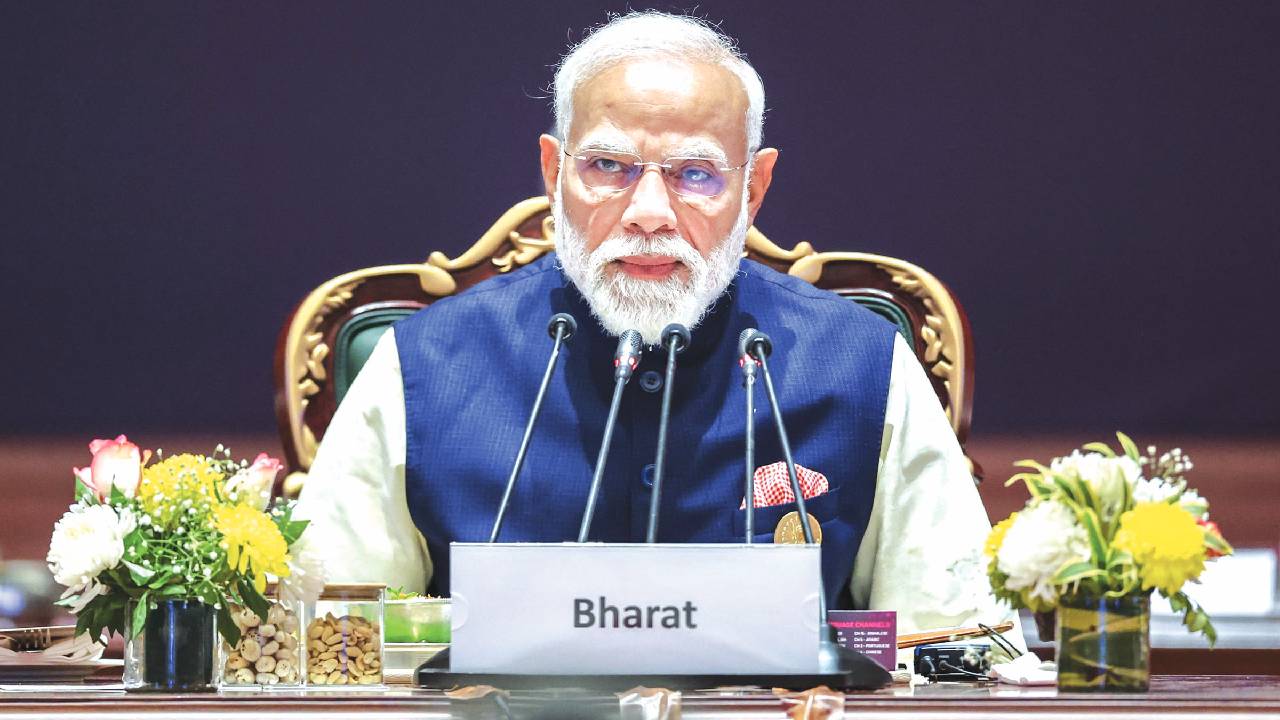
With the India AI Summit kicking off with much anticipation, the gathering carries the unmistakable imprint of Prime Minister Narendra Modi’s decade-long mission: to ensure that technology serves people rather than rules them.
The Summit attempts something ambitious: to define how artificial intelligence should be governed before it governs us.
For Prime Minister Narendra Modi, this moment is not sudden. It is the logical extension of a decade-long digital experiment that has already reshaped daily life for 1.4 billion people.
Consider the scale:
- Over 10 billion UPI transactions every month power everything from vegetable carts to multinational supply chains.
- Aadhaar provides biometric identity to more than 1.3 billion residents, enabling direct benefit transfers that have saved billions in leakage.
- CoWIN coordinated nearly two billion vaccine doses during the pandemic, with real-time dashboards accessible from district headquarters to the Union Cabinet.
These are not merely technological platforms. They are governance systems. And now, with artificial intelligence accelerating globally, India is asking a harder question: not just how fast can we build, but how wisely can we deploy?
From figital infrastructure to AI governance
Most nations entered the AI race through private-sector innovation. India arrives with something different: Digital Public Infrastructure (DPI). UPI, Aadhaar, DigiLocker, CoWIN, and the Open Network for Digital Commerce form a state-backed yet interoperable ecosystem.
They are public rails upon which private innovation rides. This model is now being studied by countries from Africa to Southeast Asia. AI is the next layer atop this stack. The Rs 10,000 crore IndiaAI Mission aims to build:
- Sovereign compute capacity (including GPU clusters accessible to startups and researchers).
- Curated, India-relevant datasets.
- Indigenous foundation models.
- Skilling initiatives targeting millions of youth.
The difference is not only economic ambition-it is regulatory design. Explainability requirements, bias audits, and human oversight are being embedded early, rather than retrofitted after scandal.
A civilisational frame: Technology with purpose
Modi frequently frames technological policy in civilisational language. At the G20 Digital Economy Ministers’ Meeting in 2023, he cautioned:”AI’s potential is immense, but without ethical governance, it risks becoming a tool of exclusion.”
That warning reflects a deeper philosophical view: tools are powerful, but purpose determines legitimacy. Ancient Indian texts repeatedly separate instrument from agency. The Bhagavad Gita describes the body as a yantra-a machine-steered by consciousness. Applied to AI, the analogy is striking: no matter how sophisticated the model, it remains an instrument.0020
Moral authority resides with the human operator. This perspective helps explain India’s policy stance: AI systems may recommend, but humans must decide.
- In healthcare, AI flags anomalies in radiology scans; doctors confirm diagnoses.
- In courts, algorithms map case backlogs; judges issue rulings.
- In welfare systems, machine learning detects fraud; administrators retain accountability.
The line between augmentation and automation is deliberately guarded.
AI at population scale
What makes India uniquely interesting in the AI debate is scale.
Agriculture
Over 140 million farmers operate on thin margins. AI tools now integrate satellite imagery, weather modelling, and soil data to provide crop advisories in multiple Indian languages through voice interfaces. Pilot programs report yield improvements of 15-20 per cent. But the technology is advisory, not prescriptive. Farmers retain final choice.
Healthcare
Under Ayushman Bharat’s digital architecture, electronic health records are gradually integrating predictive analytics. AI assists in early tuberculosis detection and diabetic retinopathy screening in rural clinics where specialists are scarce. In a country with vast doctor shortages, AI becomes a force multiplier-without replacing the human practitioner.
Education
On platforms like DIKSHA, machine learning identifies students struggling with specific competencies. Teachers receive alerts and tailored content recommendations, shifting classrooms from one-size-fits-all instruction to targeted support.
Competing models: America, China and India
Globally, AI governance has begun to polarise.
- The United States emphasises market-driven innovation, with regulation emerging incrementally.
- China integrates AI tightly with state planning, including expansive surveillance capabilities.
- The European Union prioritises precaution through regulatory frameworks like the AI Act.
India is attempting a hybrid path: innovation at scale, public digital rails, democratic oversight, and a strong emphasis on inclusion. It is not racing to dominate frontier large language models at any cost. Instead, it is investing in vernacular AI for 22 official languages, low-bandwidth solutions for rural areas, and open-source ecosystems.
This is strategic. Nearly 3 billion people globally still lack reliable digital access. If AI only works in English, on high-end devices, with expensive cloud subscriptions, it excludes most of humanity. India’s bet is that inclusive design will define the next wave of global adoption.
The legitimacy question
As AI systems move toward autonomy-approving loans, recommending parole, selecting military targets-the defining issue becomes legitimacy. Who is accountable when a model discriminates? Who audits training data? Who owns the data of a billion citizens? India’s Digital Personal Data Protection Act asserts citizen rights over personal data.
The National Strategy on AI emphasises transparency in high-risk sectors. The language is consistent: AI must remain explainable, contestable, and accountable. This approach reflects an older philosophical insight from the Isha Upanishad: knowledge without wisdom leads to peril. Capability alone does not justify deployment.
The global south Is watching
India’s G20 presidency placed Digital Public Infrastructure at the centre of global development discussions. Over 100 countries endorsed a call to collaborate on DPI frameworks. Now AI extends that conversation. For emerging economies, the question is existential: will AI deepen digital colonialism-where data flows outward and value accrues elsewhere-or will it empower local innovation?
India positions itself as a bridge. Through partnerships in Africa and Southeast Asia, it shares UPI-like systems and digital identity frameworks. In AI forums such as the Global Partnership on Artificial Intelligence (GPAI), it advocates capacity-building for developing nations. The message: AI should not widen global inequality.
Beyond efficiency: A moral architecture
The Bhagavad Gita defines true knowledge not merely as information, but as humility, restraint, and self-discipline. This moral vocabulary increasingly enters India’s AI rhetoric. An AI model may process billions of parameters. But it cannot weigh dignity. It cannot grasp social nuance. It cannot assume responsibility.
Only human institutions can do that. Modi’s recurring formulation-”Sabka Saath, Sabka Vikas, Sabka Vishwas” (Together with all, development for all, trust of all)-translates in AI terms to inclusion, growth, and trustworthiness. Trust, ultimately, is the currency of governance.
A defining moment
The India AI Summit signals that the country sees itself not merely as a technology adopter, but as a rule-shaper. The prime minister who once championed Digital India now frames AI as the next frontier of statecraft.
His approach rejects both techno-utopian exuberance and reactionary fear. Instead, it proposes stewardship: power balanced by responsibility. Artificial intelligence will transform economies. That is no longer debated. The deeper question is whether intelligence-artificial or human-will remain subordinate to wisdom. India is making a case that it can.
Sandeep Joshi (Freelance Journalist) and Dr Vinay Pathak (Prof at IIIT Sonepat)