How to start a business in India: Registration, Licenses, GST & Costs explained
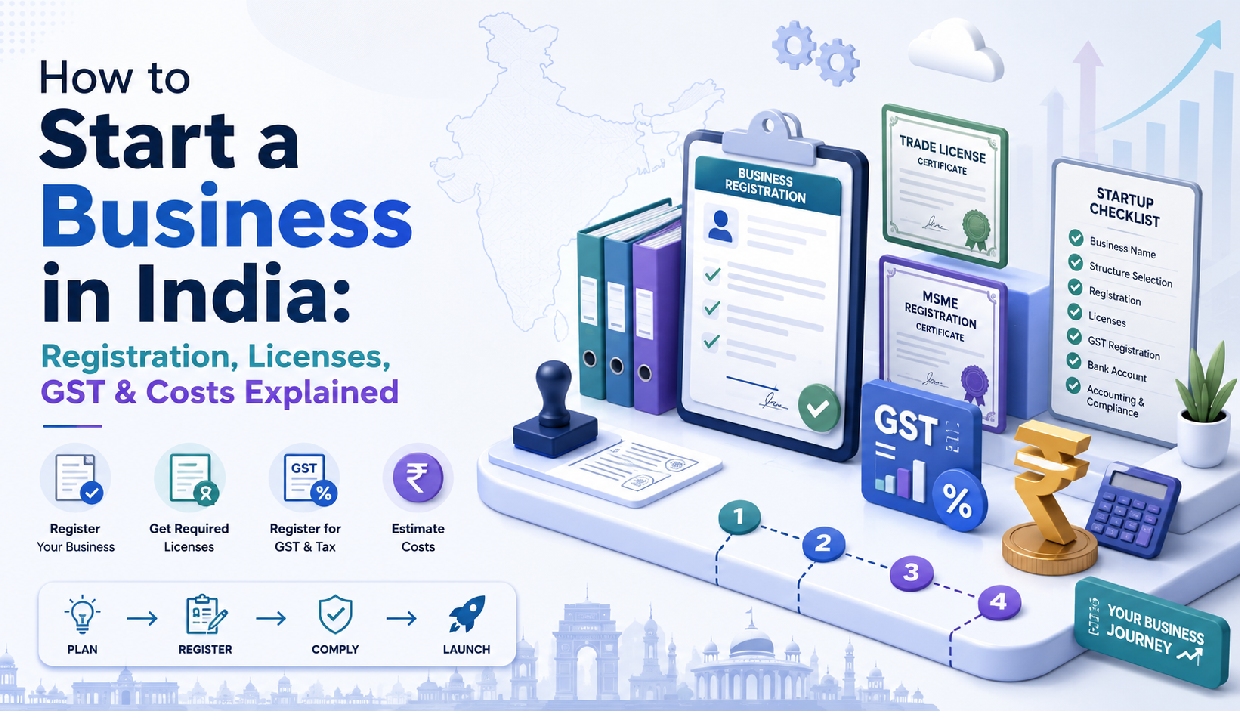
Starting a business in India has never been more exciting. With a growing digital economy, a thriving startup ecosystem, and easier access to online government services, entrepreneurs today have more opportunities than ever to turn their ideas into successful ventures.
Whether you're launching a tech startup, an online brand, a consulting firm, or a local business, understanding these requirements can help you avoid delays and build a strong foundation from day one.
In this guide, we walk you through the key steps involved in starting a business in India, including choosing the right business structure, completing registrations, understanding GST requirements, obtaining necessary licenses, and estimating the costs involved in getting your business up and running.
Step 1: Select the Right Legal Structure
Your choice of business structure defines your legal identity, tax rates, and personal liability. In India, founders generally choose from the following popular options:
Private Limited Company (Pvt Ltd)
This is the gold standard for high-growth startups and tech ventures. It requires a minimum of 2 directors and 2 shareholders.
- Best For: Ventures aiming to raise institutional venture capital, issue equity shares, or offer ESOPs to key talent.
- Key Process: You must undergo a formal private limited company registration through the Ministry of Corporate Affairs (MCA).
Limited Liability Partnership (LLP)
A hybrid model combining the operational freedom of a traditional partnership with the limited liability benefits of a corporation.
- Best For: Service providers, consulting agencies, and bootstrapped businesses owned by multiple co-founders.
One Person Company (OPC) or Sole Proprietorship
- OPC: A registered corporate entity for a single founder who wants limited liability.
- Sole Proprietorship: The simplest, unincorporated setup where the business and owner are legally identical. Best for independent creators and low-risk micro-merchants.
Step 2: Navigate the Company Registration Process
For corporate setups (Pvt Ltd, LLP, and OPC), the registration process is completely digitised through the MCA's V3 portal. If you are pursuing a private limited company registration, the process generally involves:
- Securing Digital Signature Certificates (DSC): Required for all proposed directors and shareholders to sign electronic filing forms securely.
- Name Approval: Reserving a unique, trademark-compliant name through the SPICe+ Part A form.
- Filing for Incorporation (SPICe+ Part B): This single-window form simultaneously processes your:
- Certificate of Incorporation (CoI)
- Director Identification Numbers (DIN)
- Permanent Account Number (PAN)
- Tax Deduction and Collection Account Number (TAN)
- EPFO and ESIC registrations
Step 3: Understand GST and Tax Registrations
The Goods and Services Tax (GST) is India’s unified indirect tax system. Registering for GST is mandatory if your business meets any of the following triggers:
- Turnover Thresholds: Your annual aggregate turnover exceeds ₹40 Lakh for goods (₹20 Lakh in special category Hill/North-Eastern states) or ₹20 Lakh for service providers (₹10 Lakh in special category states).
- Inter-State Transactions: You sell products or provide services across state boundaries.
- E-commerce Operations: You operate as or list your goods on an e-commerce platform.
Even if you don’t meet these thresholds, obtaining a voluntary GST registration is highly recommended. It allows you to claim Input Tax Credit (ITC) on business purchases and establishes greater corporate trust with enterprise clients.
Step 4: Obtain Essential Municipal and Operational Licenses
Beyond basic corporate registration, your business must comply with local, state, and industry-specific regulations:
- Shops and Establishment License: Issued by your state's labour department, this is mandatory for any commercial office, shop, or physical work premise.
- Udyam (MSME) Registration: A free, self-declared portal registration that officially classifies your venture as a Micro, Small, or Medium Enterprise, unlocking access to cheaper bank credit, government tenders, and delay-payment protections.
- Professional Tax (PT) Registration: Required in states that levy a tax on salaried employees and professionals.
- Industry-Specific Licenses:
- FSSAI License: Mandatory for food-related processing, delivery, or retail businesses.
- Import-Export Code (IEC): Required if your business imports goods or exports products/services out of India.
Step 5: Startup Incorporation and Compliance Costs Explained
Starting a business involves both one-time setup fees and recurring compliance costs. Here is a realistic cost estimate for a private limited structure:
|
Cost Category |
Setup Element |
Estimated One-Time Cost |
Recurring Annual Cost |
|
Corporate Identity |
Private limited company registration (DSC, DIN, MCA Fees, Stamp Duty) |
₹6,000 to ₹15,000 (depends on capital) |
Nil |
|
Local Compliances |
GST, Udyam, & Shops & Establishment Setup |
₹2,000 to ₹5,000 |
Nil |
|
Financial Operations |
Corporate Bank Account Opening & Auditor Appointment |
Nil |
₹5,000 to ₹10,000 |
|
Tax & Audit |
Mandatory Statutory Audit & IT Filing |
Nil |
₹15,000 to ₹30,000 (annually) |
Note: Government fees for registration vary depending on your authorised share capital and the state in which your registered office resides.
Conclusion
Laying the proper legal foundation is the first true victory for any new business owner. Taking the time to execute your private limited company registration correctly, secure your local operational licenses, and organise your initial compliance structures ensures your startup is built to scale safely.
Rather than coordinating with multiple fragmented legal intermediaries, modern founders utilise unified digital platforms. Platforms like Razorpay Rize simplify your launch by coordinating your company registration and compliance documentation in one seamless flow, helping you build your venture on an airtight, growth-ready foundation right from day one.