High turnout fuels speculation in Assam, Kerala, Puducherry
A healthy voter turnout averaging 80 per cent on Thursday in three States, including Assam, Kerala and Puducherry, has triggered speculation whether the incumbent party retains power or a new dispensation emerges victorious. Political pundits and those in the electoral fray are analyzing the voting pattern to gauge the electorate’s decision now sealed in the poll box. While some believe heavy voting signals that people want a change, others opine that the citizens are happy with the performance of the ruling party or combine.
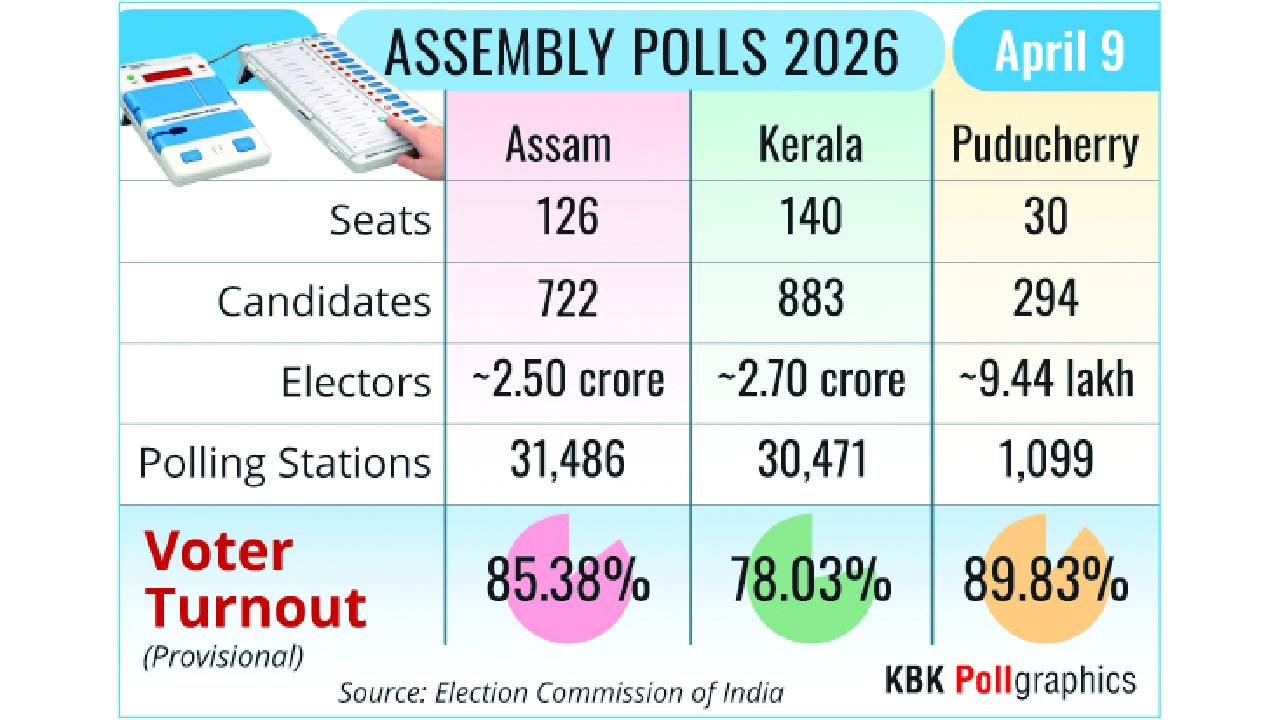
According to the latest figures from the Election Commission, an estimated 85.38 per cent voter turnout was recorded as polling ended at 6 PM on Thursday in all 126 assembly constituencies of Assam, surpassing the previous 84.67 per cent voting in the 2016 elections. Keralam saw 77.38 per cent of the 2.71 crore voters had cast their vote, surpassing the previous 74.06 percent in 2021. The State has seen 80.5 per cent in the 1987 Assembly elections. Puducherry recorded 89.83 percent polling, surpassing the previous highest 86.19 percent in 2011. Most political leaders from various parties voted early in the day.
A total of 1,906 candidates are in the fray - 722 in Assam, 890 in Kerala and 294 in Puducherry. The total electorate exceeds 5.3 crore.
Poll-related violence in Assam leaves around 30 injured and seven arrested amid clashes between Congress and BJP supporters. The polling process was largely peaceful, with only minor technical issues reported at a few locations.
In Assam, the contest is primarily bipolar for the 126 seats, with the BJP-led NDA seeking a third consecutive term under Chief Minister Himanta Biswa Sarma, while the Congress led by Gaurav Gogoi is striving to reclaim a State it lost a decade ago. The regional players such as AIUDF, Raijor Dal, and Assam Jatiya Parishad are also hoping influence outcomes in select constituencies.
The poll percentage in 16 constituencies, mostly in minority-dominated areas, have already crossed the 90-per cent mark, while 83 constituencies are in the range of 80-89 per cent and the remainder in the 70-79 per cent category.
Dalgaon recorded the highest voting at 94.57 per cent, while the lowest turnout was in Amri at 70.40 per cent.
Reacting on the high turn out, Assam Chief Minister Himanta Biswa Sarma said the high turnout in Thursday’s assembly election was not “ordinary but historic”.Sarma said the result of this election is “already visible - in the hope, pride, and happiness on the faces of our people”.”What we set out to do was not merely fight an election, but to turn it into a movement - a movement to protect our civilisational values, our culture, and our land,” Sarma said in a post on X. “Today, for the first time, our people have come out in unprecedented numbers - voting shoulder to shoulder, matching and even surpassing our opponents in turnout. In many polling booths, participation is crossing 95 per cent. This is not ordinary. This is historic,” he asserted.
Kerala’s 140 constituencies feature a battle between continuity and comeback. The crucial elections will decide whether the ruling Left Democratic Front, led by chief minister Pinarayi Vijayan, will get a straight third term, or if the Congress-led United Democratic Front, which is campaigning on anti-incumbency, governance concerns, and past electoral setbacks makes a comeback or if BJP springs a surprise in an otherwise bipolar battle. In the 2021 Kerala Assembly polls, a turnout of 74.06 per cent was recorded and the highest polling the state has seen is 80.5 per cent which was in the 1987 Assembly elections. The ruling LDF is fighting to retain power, banking on Chief Minister Pinarayi Vijayan’s model of governance and welfare.
The Congress-led UDF is vying to regain power, seeking to end a decade of Left rule in the state. Amidst this traditionally bipolar contest, the BJP-led NDA is looking to disrupt the duopoly of LDF and UDF and aims to translate its growing vote share into a decisive presence in the state assembly. The figures also showed that Kozhikode district recorded the highest polling percentage of 77.63 per cent and pushed Ernakulam, which had been in the front since morning, to second place with 77.25 per cent at 5 pm. Constituency-wise, Kunnathunad topped with 81.99 per cent. The lowest turnout came in Kaduthuruthy with 66.81 per cent (all 5 pm data).
Officials said the final turnout is expected to rise further as late voters in queues are counted. If the trend continues, the overall turnout could cross 80.54 per cent registered in 1987. Chief Minister Pinarayi Vijayan cast his vote along with his family at a polling station in Kannur district. Describing the election as decisive, he said it would determine the direction of Kerala’s development.”We have been able to achieve development and it should continue. It should not be disrupted and people desire its continuation,” he told reporters. Leaders across Kerala’s three main political fronts offered differing explanations for the high voter turnout, with each linking the trend to factors that could shape the election outcome. CPI(M) leader C N Mohanan attributed the rise to the revision of electoral rolls. Congress leader Deepthi Mary Varghese said the trend needs closer study. BJP leader K S Shaiju linked the rise to voter behaviour on the ground.
In the 30 assembly constituencies in Puducherry, the election sees a direct contest between the AINRC-BJP-led NDA headed by chief minister N Rangasamy and the Congress-DMK alliance. A key contest is in Thattanchavady, where Rangasamy is up against former chief minister V Vaithilingam.Key issues include the long-pending demand for statehood, unemployment and water contamination. The entry of Tamilaga Vettri Kazhagam is also being seen as a factor that could influence outcomes.