High alert in Capital amid credible threats
The national Capital has been placed under high alert ahead of the Babri demolition anniversary on December 6 and the Parliament attack anniversary on December 13.
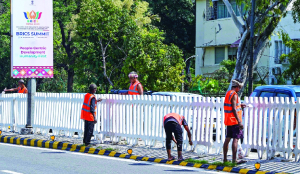
The enhanced alert level has also been declared on December 4-5 in the wake of Russian President Vladimir Putin’s visit. A multi-layered security grid has also been formed with SWAT teams, anti-terror units, snipers and quick-reaction teams stationed at sensitive points.
Anti-drone systems have been put in place and special teams deployed for aerial and signal-level monitoring of the Russian delegation. The Delhi Police have also intensified surveillance in sensitive areas. This means a multi-layer security system has been implemented in Delhi. Under this, strict surveillance is being maintained from street level to airspace.
Delhi Police, central agencies, and other security teams, along with SWAT teams, snipers, and anti-terror units, are coordinating with each other minute-to-minute to ensure immediate action can be taken in any situation.
Of the first few inner cordons, Russian forces will manage the first two layers, followed by the National Security Guard and defence personnel. The hotels in Lutyens’ zone where the dignitaries are staying have been sanitised, and advanced cameras with motion detection installed.
Senior police officers said that from Putin’s arrival to his departure, every movement will be tracked by multiple security units operating jointly. “Minute-to-minute coordination is underway, and all concerned agencies have been instructed to maintain maximum vigilance throughout. Over 5,000 police personnel will be deployed to maintain strict vigil,” the officer said.
Top-ranking Delhi Police officers are supervising route security, traffic arrangements and area sanitisation around locations likely to feature in the Russian president’s schedule. “All routes mapped for VVIP movement have been secured in advance. Traffic advisories will be issued from time to time to minimise inconvenience to commuters. Anti-drone systems will be in place,” another official said.
Traffic is likely to be affected with restrictions and diversions in place on Thursday and Friday. Fuelling the tension, terror group Sikhs for Justice (SFJ) on Wednesday called to “strike the Indian Parliament” on Dec 13. SFJ chief Gurpatwant Singh Pannun stated that the group intended to celebrate Dec 13 as “Kashmir-Khalistan Freedom Day”. SFJ also called on parliamentarians Amritpal Singh and Sarabjit Singh to raise the question directly in Parliament and “internationalise the liberation of Punjab from India”.
The Capital has been experiencing enhanced surveillance since November 10, following a powerful explosion in a car near the Red Fort. The agencies and Delhi Police are scrambling to find any missing links that may lead to another similar tragedy.
Police have subsequently intensified security measures across major markets and metro hubs, with senior personnel joining patrol teams.
The focus has been on ensuring anti-sabotage measures and CCTV surveillance to thwart any potential threat. The number of CCTV cameras has also increased at multiple places. The police brass is closely coordinating with the intelligence agencies to develop and verify every input and is issuing alerts accordingly, officers said. “The focus is on maintaining high visibility, public confidence and robust policing at all major markets, malls, religious places and crowded areas,” said a senior officer.
The officer said that diversions and congestion on major routes could be expected as soon as Putin lands at the Indira Gandhi International Airport. The Russian President will then head to the Sardar Patel Marg. Commuters should expect congestion on the NH8 stretch, Dhaula Kuan, and Delhi Cantonment regions, along with the Sardar Patel Road, the officer said. During evening hours, Panchseel Marg and Shanti Path might also see diversions due to congestion, he added.
The traffic snarls are likely to persist on Friday, as the cavalcade is scheduled to begin moving early in the morning towards Raj Ghat, leading to congestion in that area and on roads around India Gate, Delhi Gate, and ITO.