Gujarat municipal poll candidates must disclose spouses’ assets too: SC
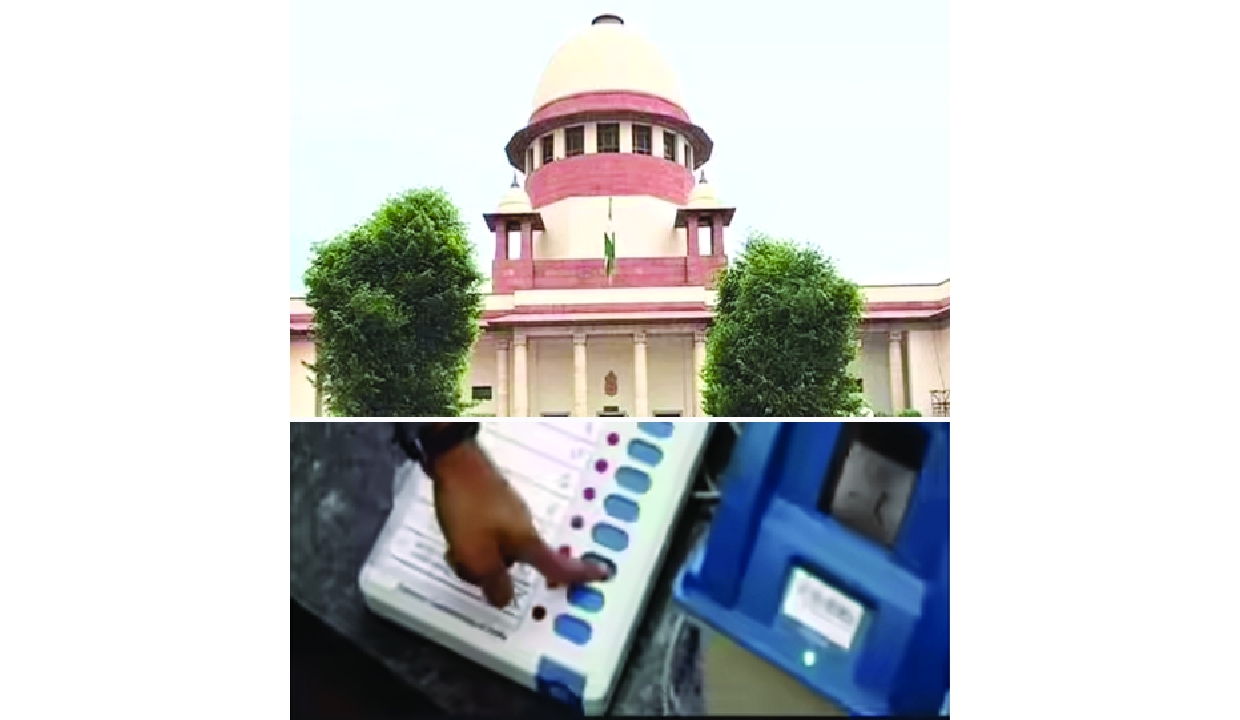
The Supreme Court on Wednesday held that candidates contesting Gujarat municipal polls are required to disclose not only their own assets but also those owned by their spouses in election affidavits.
The top court also ruled that an error by a magistrate in invoking the wrong statutory provision at the stage of taking cognisance is a curable defect and does not automatically vitiate criminal proceedings.
A bench of justices Sanjay Karol and NK Singh passed the directives while partly allowing an appeal filed by Chandrikaben Kishor Dafda, a former municipal councillor from Gujarat, who had challenged criminal proceedings initiated against her over alleged non-disclosure of certain immovable properties owned by her husband in her nomination affidavit for the 2015 Gujarat municipal elections.
The court, however, did not quash the criminal case.
Instead, it set aside the magistrate’s order taking cognisance under Section 125A of the Representation of the People Act, 1951 (RPA), and remanded the matter to the trial court for taking fresh cognisance under the appropriate legal provisions and proceeding in accordance with law.
Writing the judgement for the bench, Justice Karol said he had expressed no opinion on the merits of the allegations.
The bench referred to the Gujarat Municipalities (Conduct of Elections) Rules, 1994, as amended in 2005, and said, “The appellant (Dafda), in view of the above, had to have disclosed the properties owned by her spouse too”.
The case arose from a private complaint alleging that the appellant had failed to disclose several parcels of land standing exclusively in the name of her husband while filing the mandatory affidavit accompanying her nomination papers.
The magistrate had issued summons in 2017 under Section 125A of the RPA, a provision dealing with false affidavits by election candidates, and the Gujarat High Court declined to interfere with the proceedings.
Before the top court, it was argued that the RPA applies only to elections to Parliament and State Legislatures and not to municipal elections, which are governed by the Gujarat Municipalities Act and the Gujarat Municipalities (Conduct of Elections) Rules.
She further contended that the election rules required disclosure only of jointly owned properties and not those exclusively owned by the spouse. Rejecting this interpretation, the bench examined Rule 7A of the Gujarat Municipalities (Conduct of Elections) Rules, 1994, as amended in 2005.
“The candidate/declarant is to give details of the property held by them, their spouse and their dependents, including what is held by them jointly. It does not say, in any manner whatsoever, that the property held solely by the spouse is not to be mentioned therein,” it held.
On the question of cognisance, however, the bench accepted the appellant’s contention that Section 125A of the RPA could not be invoked for municipal elections because the definition of “election” under the Act is confined to elections to Parliament and state legislatures.
Nevertheless, the court held that the magistrate’s error in invoking the wrong statutory provision did not render the proceedings void.
“The well-settled position of law is that the error in taking cognizance under the wrong section is, in fact a curable defect so long as the court that has taken cognizance has the power to take cognizance of the other sections also,” it said.
“The taking of cognizance itself, even if it was taken under a singular section and that too was erroneous, for it is a well settled principle of law that cognizance is taken of the offence and not people. If the issue is that a false affidavit has been filed in the electoral process, that is an offence against society at large and has to be investigated,” it said.
Consequently, the bench remitted the matter to the jurisdictional magistrate to reconsider the issue of cognisance under the appropriate provisions of law and proceed thereafter in accordance with law.