Friday manoeuvres may see women’s bill pass?
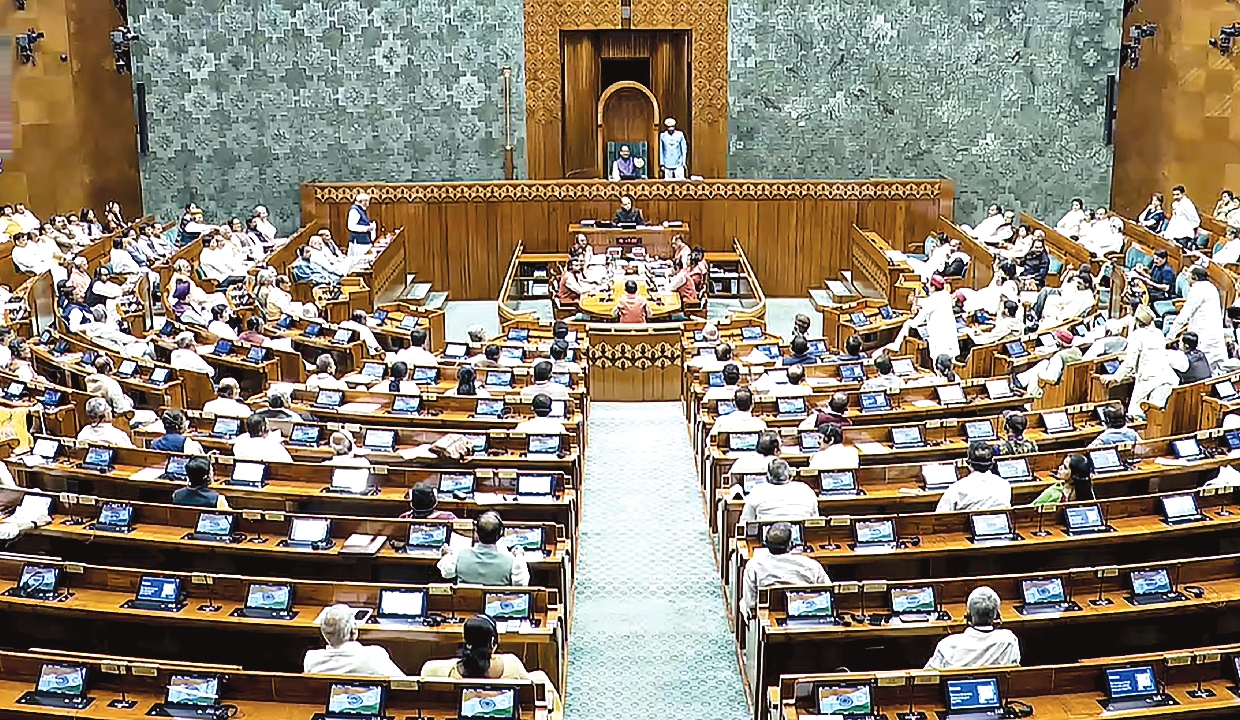
The Women’s Reservation Bill may not get Parliament’s approval, as the ruling NDA, on its own, does not have the required numbers to get the constitutional amendments passed.
Given this scenario, the bill can pass only if the ruling dispensation can garner support from other parties or persuade some of them to abstain. Voting will take place on Friday in the Lok Sabha at 4 pm.
And in another scenario, if the Bill is not passed, BJP leaders said that the opportunity may be exploited by the ruling dispensation to ‘expose’ the Opposition that they are against women’s reservation. “The party strategist might have taken a very calculated risk in this matter, hence they convened the three-day additional sittings of the Budget session just ahead of the crucial assembly elections in West Bengal and Kerala,” said a BJP Parliamentarian.
A point to ponder is that if the numbers are stacked against the NDA, why did it risk introducing the bills now? Whether the ruling BJP has an ace up its sleeve or it goes all out to corner the Opposition, branding them anti-women if the bill is defeated, will only be known on Friday evening.
However, there are certain options under which the bills can be passed in the Lok Sabha. The bills, including the Constitutional Amendment Bill, could get approval from the Lok Sabha if at least two main opposition parties, such as the Samajwadi Party, the Trinamool Congress, or the DMK, abstain from voting.
The other scenario indicated cross-party backing, meaning some Opposition or independent members cross-vote in favour of the NDA, for the bill to go through.
The introduction of three Bills aimed at advancing women’s reservation to 2029 — the Constitution (One Hundred and Thirty-First Amendment) Bill, 2026; the Union Territories Laws (Amendment) Bill, 2026; and the Delimitation Bill, 2026-was taken up on Thursday in the lower house following a simple division of votes.
The exercise indicated how the numbers may stack up when the key legislation to amend the Constitution is taken up for a special division at 4 pm on Friday.
Coming to the rules, any Bill to amend the Constitution must be passed by both Houses of Parliament with a special majority (two-thirds) of over 50 per cent members present in the House. By demanding a division of votes to ascertain whether the Lok Sabha approved the introduction of the three Bills, the Opposition appeared to be testing waters on its numerical strength. The bill was later introduced with 251 members supporting it and 185 members voting against.
As regards the nitty-gritty of voting on Friday to pass the bills, the NDA has the support of 293 members in the Lok Sabha, which is 54 per cent of the house, and the opposition has 233 MPs.
While seven MPs are independents, seven belong to parties such as YSRCP, AIMIM, and Shiromani Akali Dal, which have yet to support the bills openly.
The rules require 360 MPs to support the bills, including the Constitution amendment bill, which comes to two-thirds of those present and voting.
For the bills to get approval from the Lok Sabha, at least two main opposition parties, namely the Samajwadi Party (37 MPs), the Trinamool Congress (28 MPs), or the DMK (22 MPs), would have to abstain. The Congress has 98 MPs in the Lok Sabha.
On the other hand, the BJP has 240 MPs, TDP 16 and JDU 12 in the Lok Sabha from the NDA. If the bills do not get the Lok Sabha nod, they will not be taken up in the Rajya Sabha.
In the Rajya Sabha, the NDA has 141 members in their favour, which is 58 per cent of the upper house, and the opposition has 83 MPs in support.
Parties such as the BRS, YSRCP, BJD, BSP and independents have 20 MPs in the Upper house, and their votes may help swing the decision.
For the Constitution amendment bill to get through the Upper house, the ruling alliance needs the support of 163 MPs present and voting, which is two-thirds majority of the house. While the BJP has 107 MPs in the Rajya Sabha, the Congress has 28, the TMC 13, the AAP 10, and the DMK 8.
Amending the Constitution requires a special majority in both houses of Parliament: a majority of the total membership (more than 50 per cent) and a two-thirds majority of members present and voting. So if all 540 members currently in the house are present and voting, the two-thirds majority would be 360.