Delhi Police goes kuchu-puchu to warn against deadly manjha
There is something mildly surreal about a police force going kuchu-puchu. That particular term, scraped from the bottom of the internet’s affection jar, has in recent weeks been deployed against politicians, bureaucrats, and anyone else the algorithm decides deserves a soft verbal prod. Delhi Police, watching all of this, apparently decided that if the nation was already talking in this register, there was no reason it could not too.
So it did. “Dear Kuchu Puchu,” the post began, “Patang udao but say NO to Chinese manjha. Samjhe?” The tone was nothing like what Delhi Police usually sounds like when it wants you to stop doing something. It was lighter. It was almost fond. It had the texture of an older relative who has finally, after years of resistance, figured out what a meme is and is now deploying one with slightly too much enthusiasm.
The internet, as it does, took notice. “Gen-Z mode of Delhi Police,” one commenter wrote. “They are updating,” said another. Both were correct. And the smile that the post invited is, in a way, the point. Because the thing behind the joke is not funny at all.
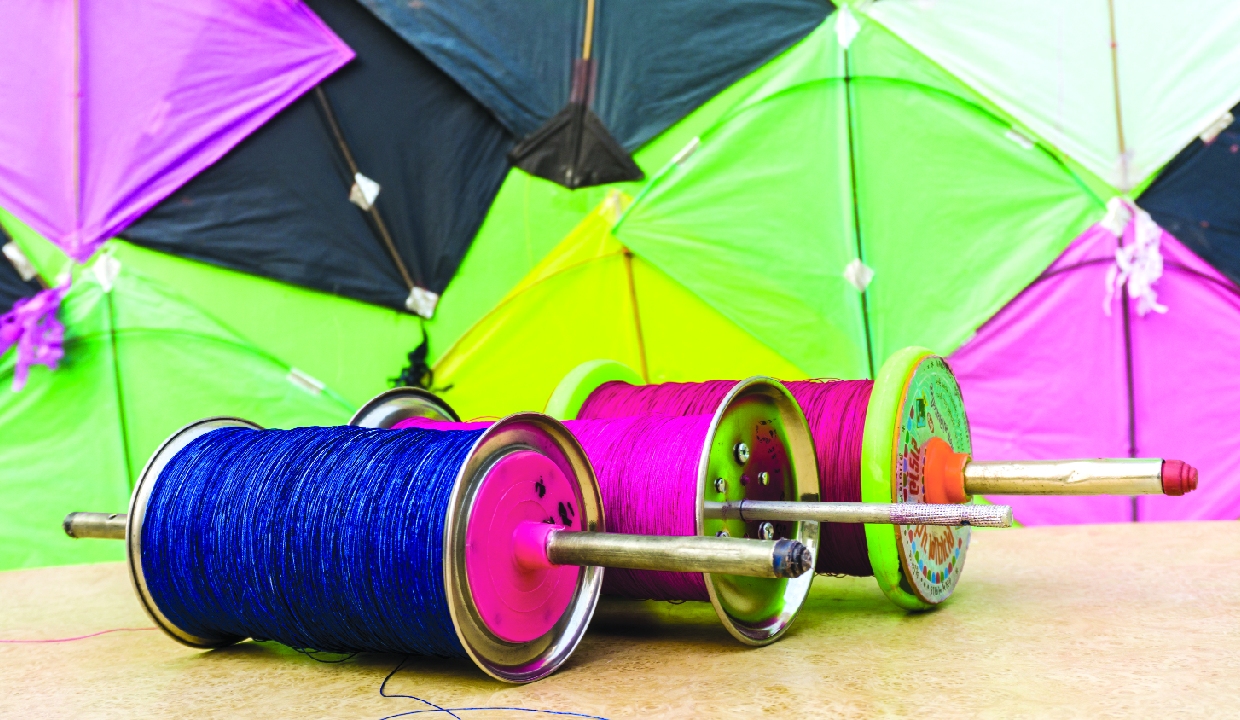
Chinese manjha, which is made from synthetic or plastic material and coated with abrasive substances, does not behave like the cotton string it has largely replaced in kite markets across the country. Cotton string breaks. It yields. It does not hold an edge. Chinese manjha does not break easily, and it does hold an edge, a wire-thin line of cutting capacity that remains taut in the air long after the kite has flown. When it falls across a road, and a person on a two-wheeler ride through it at speed, the string does not give way. The neck does.
In Uttam Nagar in southwest Delhi, a 32-year-old man sustained a cut to his neck from Chinese manjha when he was on his way to Mundka for work. He survived. A seven-year-old girl in Paschim Vihar in west Delhi in 2023 did not. She was on a scooter with her father, going to a market, when the string found her. She was seven.
These are not accidents in the way a slipped step is an accident. They are the predictable consequence of a product designed to cut, deployed in an uncontrolled airspace, by people who have not always understood what happens when a kite string made of glass-coated plastic meets a human throat at the speed of a commute.
Delhi Police has not been treating this lightly despite the playful post. The Crime Branch recently seized more than 1,300 rolls of Chinese manjha in an enforcement operation. Central Delhi Police recovered around 120 rolls separately. The banned string is not difficult to find in the capital’s kite markets, which means the bans have not been followed by the kind of enforcement that makes bans meaningful. The social media post and the seizures are two ends of the same policy problem: how do you make people understand that a thing they associate with festivity is also capable of killing a child on her way to buy vegetables with her father.
The kuchu puchu post is one answer to that. Not the entire answer. Not even most of the answer. But in a city where public attention is fought for in three-second windows, a police force that can make you smile before it makes you think has at least solved the first half of the problem.
The second half is the string still for sale around the corner.