Crude and mysterious oil story
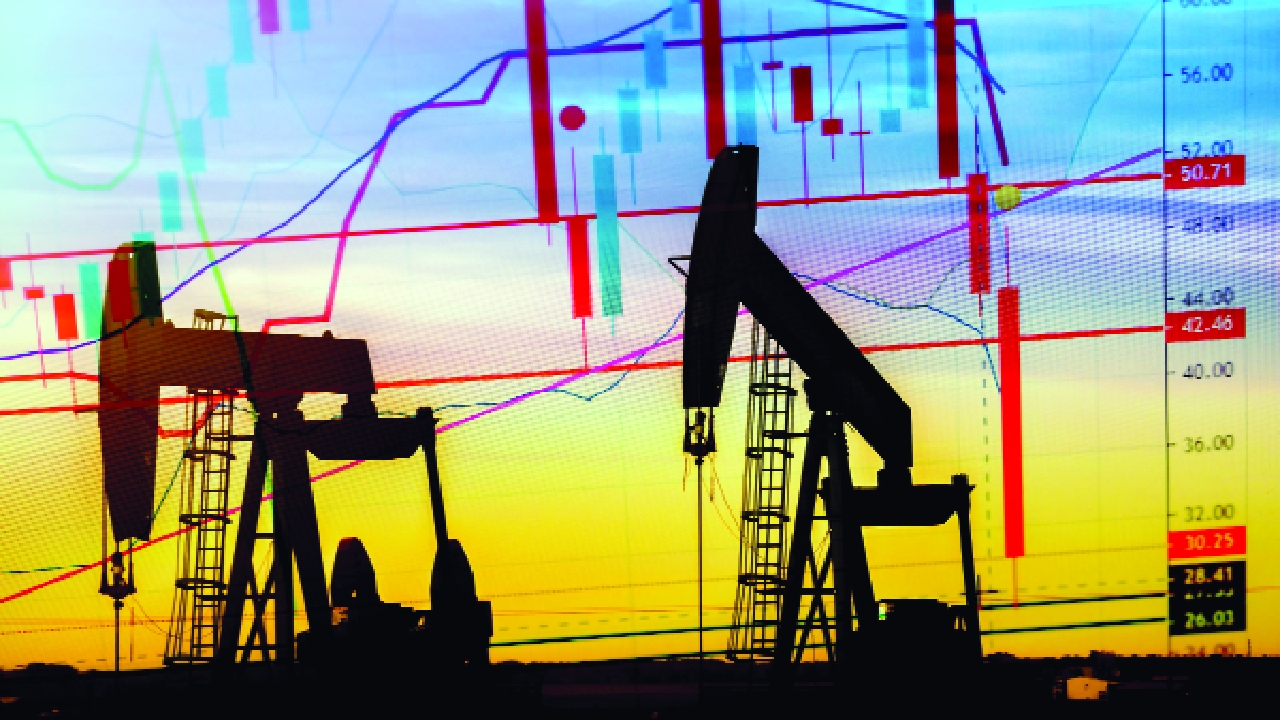
The visual, or the part-graphic, with this article may not make sense to most people. It may not gel with any reader. With the current global crude oil prices hovering around $100 a barrel, after reaching a peak of $120, as Iran and Middle East conflict continues unabated despite voices of calm and end from the western leaders, the graphic that shows a decline in crude prices may seem irrelevant. But if past experiences, including what happened since 2022, is considered, the significance will be clear. It will lead us to a mysterious narrative and logic about how global prices affect those of the petrol, diesel, and LPG.
There are two points that we wish to make. The first is both intuitive, and counterintuitive. Whenever global prices shoot up, as they did several times since the early 1970s, they tumble down within months or years, and then stabilise at much lower levels. This happens even if the trigger for the original rise, like the Russia-Ukraine war in early 2022, continues, and the fears do not reduce. Thus, even if the Iran war lingers on, and is not over for another month or so, there will come a time, either this year, or early next year, when crude oil will be down.
Let us consider the Russia-Ukraine war, which will drill some sense into the graphics. Immediately after the war started, crude prices jumped to $120, as they did in the aftermath of the Iran war. Over time, the prices declined by half, even a third, as the Russian war became the new normal, producers and consumers adjusted to the massive disruption, Russian oil entered the market, both legally and surreptitiously, and large consumers shifted their sources and alliances. The prices were down to just over $40, and then crept up to $60 or so before the beginning of a new war in the Middle East.
For our readers, the second point is more pertinent. Unlike the western nations, where the local prices of crude-based downstream products, such as petrol, diesel, and LPG, are linked to the market, and hence go up or come down with a slight lag compared to global crude, this does not happen in India. Over the past few days, Indian officials admitted this proudly and confidently. They averred that in India the prices of the petroproducts remain stable during the upward trend, and do not come down during the downward curve. Prices are adjusted during the non-crisis periods by the mostly state-owned oil marketing firms.
According to the officials, this prevents the consumers, i.e., the car owners, entrepreneurs who run transport firms, and normal households from the external ‘crude shocks.’ During the present crisis, petrol and diesel prices remain stable, and that of household LPG was hiked incrementally. It is the commercial users, like restaurants, who need to pay a much higher amount per cylinder. Thus, the losses incurred by the oil firms when the global crude prices are high, are subsidised by the super profits they earn when the latter are down. In the interim, the Government supports the firms through funds.
But according to some experts, this mindset creates a distortion in the local oil markets. Since the benefits of the lower global crude prices do not reach the Indian consumers, and oil firms earn windfall profits, there is a redistribution of wealth. A large chunk of these profits is indeed appropriated by the Government in the form of taxes, which remain unusually high. Of course, the oil ministry uses a part of these funds during the bad days, when global crude prices are high, to partly compensate the oil firms to stabilise the local retail prices. At present, the marketing firms pay less-than-global rates to refiners.
Let us take the example of the Russia-Ukraine war, which enabled India to source a third of its crude oil imports from Russia at discounted prices, almost $10-15 a barrel lower. “For the Indian refiners, the discounts created a powerful arbitrage opportunity. For policy-makers, they offered fiscal breathing room…. But for the ordinary consumers, the benefits were less visible. Retail fuel prices remained largely stable…. LPG… remains a significant household expense,” states a media analysis. The money was used by the Government to fund subsidies, cash transfers, and welfare schemes.
Of course, the opposite happened after the beginning of the Iran war. The local retail prices of petrol and diesel remained stable, essentially the same, despite a massive hike in global crude prices, and that of household LPG was increased by INR 60 per cylinder to just over INR 900, or just under seven per cent. The oil ministry announced that it would pass on funds to the oil firms to make up for the current losses due to lower retail prices. The former allows the firms to make money when crude is low, and partially absorb the losses when it is up.
Hence, over the past few years, India’s oil bounty due to the Russia-Ukraine war was increasingly used by the Centre and states to finance grander and more impressive welfare schemes, which included cash doles. They were timed before the elections to woo voters. In a sense, one can assume that this was a way to redistribute wealth, from the refiners to the state, and from the state to the poor, at the expense of the rich and middle class, which owns the cars, and uses LPG. The implications were economic, even if the intentions were political.
On the positive side, oil acts as a socio-economic cushion, rather a valve to let out the steam that is accumulated at the mass level due to declining or plateauing incomes, price rises, less jobs, and dented aspirations. The money that is made by the refiners and the state when global crude prices are low, and retail prices of petroproducts remain high, is redistributed, and reduces inequality even if the motive is to garner votes, and win elections. Left-leaning economists may dub it the duty of the Government. Right-bending ones may see it as a nuisance.
On the negative side, the cash doles and welfare schemes may indicate the money that is not spent on roads, ports, airports, healthcare, and education. More importantly, the fiscal cushion of lower global crude prices is available temporarily. It vanishes at regular intervals. But possibly, the governments have realised that the benefits far exceed the disadvantages. More money is made than is lost. In any case, it is the refiners who bear the brunt during a crisis, not the state.