Creative Economy, Soft Power and India's Cultural Narrative
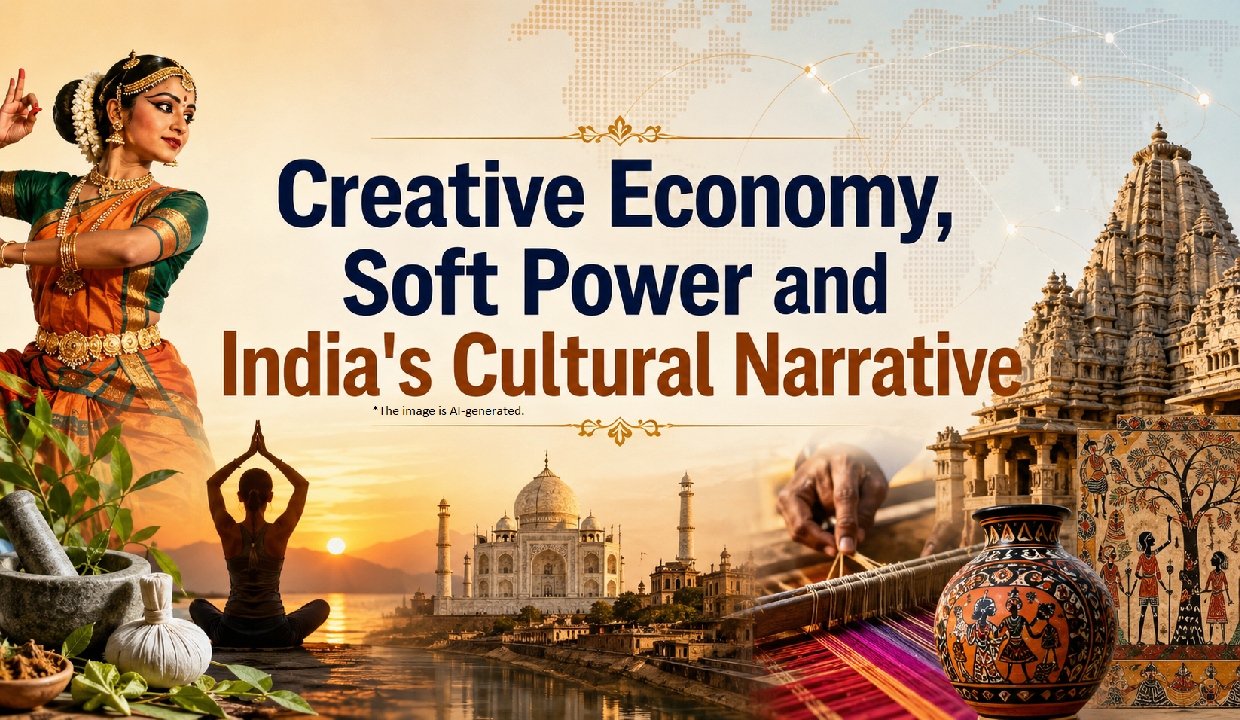
In an era where a single social media trend can shift global perceptions, the creative economy has emerged as one of the most potent instruments of soft power. The twenty-first century belongs not merely to the strongest economies or largest armies, but to the stories that define their purpose and the values they protect. This is the domain of the creative economy, where knowledge and culture become currency and universal traditions become quiet instruments of global influence.
For India, this is not unfamiliar territory. Long before the term "soft power" was coined, ancient courts understood that knowledge, art and wisdom travel where armies cannot. Today, as the world searches for authenticity amidst digital noise, India's knowledge systems and living traditions such as meditation, yoga, classical dance, Ayurveda and folk arts are emerging as strategic assets. The question is no longer whether India has soft power, but whether it can wield it with the same sophistication as its Mauryan, Gupta and Chola predecessors.
The Ancient Blueprint of Cultural Diplomacy
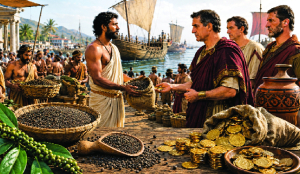
Indian knowledge systems travelled abroad through the spice trade, but Ashoka used narrative building on peace with telling effect. His rock edicts name Hellenistic rulers including Antiochus of Syria, Ptolemy of Egypt and Magas of Cyrene, with whom he exchanged ambassadors and ideas. Medicinal herbs and the Charaka Samhita travelled east and north. The Sassanian emperor Khosrow I (Anushirvan, reigned 531-579 CE) sent his physician Burzuya to India to acquire scientific texts. Burzuya returned with the Panchatantra, translated into Middle Persian, initiating a chain of translations that carried Indian narratives to Arabia and Europe.
The Gupta period continued this legacy. Chess (Chaturanga) travelled to Persia and became Shatranj. Indian musicians performed in Sassanian courts. When the Smithsonian notes that "manuscripts, paintings and painters circulated throughout north and central Indian courts," it describes a pre-modern creative economy where cultural production was inseparable from political relationships.
The lesson is profound. Reciprocity matters. Cambodia's Angkor Wat, the largest temple in the world, carries the imprint of Vedic philosophy and testifies to technology exchange that remains unsurpassed. Vedic philosophy, Ayurveda and various cults permeated Tibet, Central Asia and Southeast Asia. In return, India received Greek astronomy, Arabian numerals and Persian wisdom. Artisans, physicians and musicians were the original cultural diplomats. Trade and commerce rode on these exchanges, as did technology transfer, especially in construction. State patronage was peripheral; it was the spirit of venturing out and sea-faring that permeated Indian knowledge systems into distant lands. The Guptas and Cholas provided homeland security and allowed diverse expressions of thought. Classical exchanges between 'Advait' and 'Dwait' are a prime example.
The Contemporary Landscape
Today, India's creative economy, spanning performing arts, wellness, design and digital creativity, is valued at approximately $30 billion, employing nearly 8 percent of the national workforce. With the world's largest youth population and a median age of 28, India stands at a demographic and cultural crossroads.
Yet India holds only 2 percent of the global media and entertainment market. Policy observers note that as a rising economic power, India's stories must be heard and seen worldwide. The wellness market, valued at $4.5 trillion globally, remains under-leveraged despite yoga's universal appeal. India's 40 UNESCO heritage sites and rich intangible heritage draw millions of tourists, contributing 9 percent to GDP.
Recent policy discourse has underscored the creative economy as an essential lever for India's future growth, innovation and inclusive development. The Indian Institute of Creative Technology (IICT) is a welcome step, but the soft power dividend will not come from infrastructure alone.
Why Living Traditions Are the Invisible Asset
India's classical and folk traditions such as 'Odissi and Bhangra', 'Kathakali and Warli', 'Ayurveda and folk medicine' offer something mass-produced global culture cannot: Authenticity. In a world weary of algorithms, a genuine Gond painting, a Mohiniyattam recitation or an Eri silk shawl from Meghalaya carries the story of a specific community, place and way of life.
The Indian Council for Cultural Relations (ICCR) has long sent cultural troupes abroad, imagine every embassy hosting weekly yoga sessions, classical music gatherings or Ayurveda workshops, not as occasional events but as sustained practice. Imagine diplomats gifting handcrafted moonj baskets instead of mass-produced memorabilia. These are invitations to experience India's wisdom first-hand.
Strategic Recommendation
Ancient India excelled at systematizing knowledge through Vedanta, classic epics, Panini's grammar and Sushruta's surgical compendium, making it transmissible and scalable. Living traditions today remain largely undocumented, existing in muscle memory and oral transmission, vulnerable to disappearance. The challenge is preservation and access. Digitizing these practices into an open platform would transform dispersed knowledge into a global public good, positioning India as a curator of living heritage.
A National Living Traditions Digital Commons would serve this purpose. Featuring high-resolution documentation, downloadable workshop curricula for global educators and blockchain authentication for artisan products, the platform would turn ancient systematization into contemporary global access. A student in Brazil learning Gond painting from a curriculum co-created with a Madhya Pradesh master artist, or a buyer in London verifying a Meghalaya shawl's origin, are moments of cultural connection. They transform living heritage from a closed archive into an open, dynamic resource, generating creative economic value and deepening India's cultural influence worldwide.
Soft Power as Narrative Capital
Ultimately, soft power is about what others say about us. India's ancient courts understood that cultural exchange requires deliberate statecraft. It happens when the Indian diaspora learns its own language and understands its cultural heritage. They are the perfect ambassadors, as those thousands of years before them.
Today, the scale has changed, but the principle has not. India's creative economy, from its classical arts to its digital future. It is a strategic asset for a nation coming into its own. The gap between India's 2 percent share of global cultural markets and its civilizational wealth is not a failure. It is an invitation. That invitation is to bridge ancient wisdom with contemporary practice and to give the world stories that only India can tell.
Atanu Chakrabarty, Former Economic Affairs Secretary of India; Dr Sophia Lisam, Senior Research Fellow, Bharat Ki Soch; Views presented are personal.