Chhattisgarh Budget 2026–27: A visionary step toward inclusive prosperity
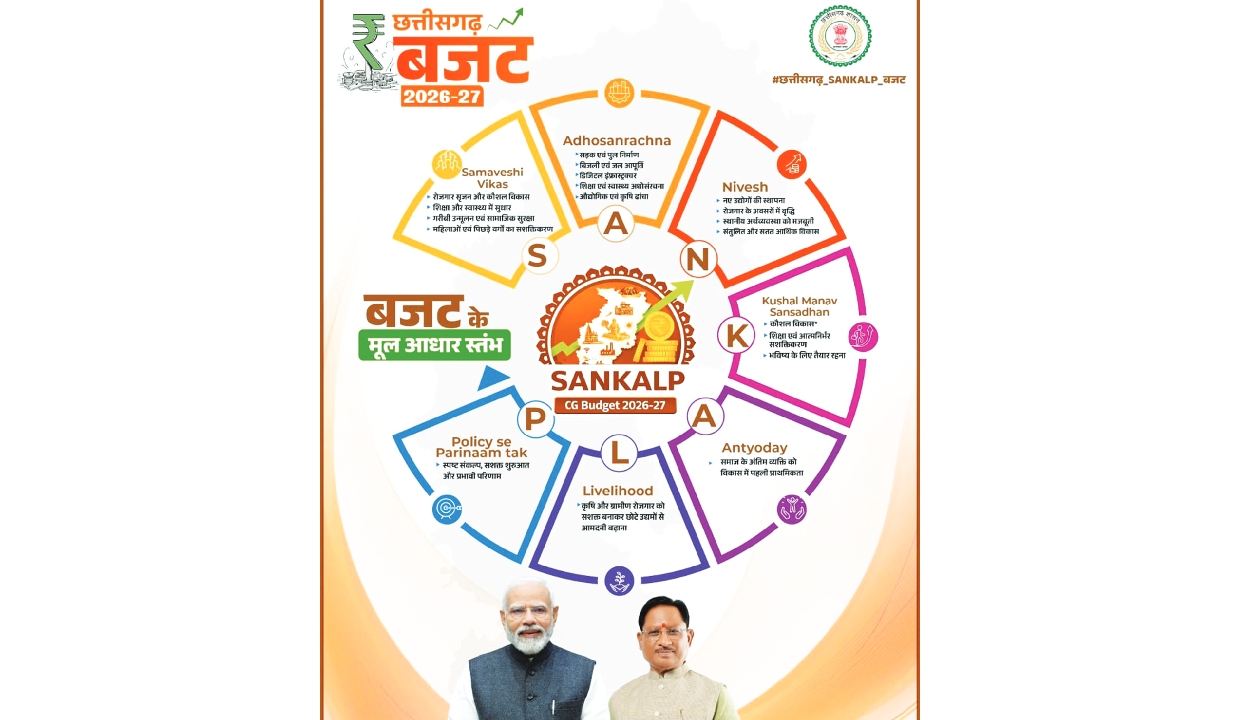
The Chhattisgarh Government’s 2026–27 budget represents a bold and visionary roadmap for the state’s future. With a total outlay of Rs 1.72 lakh crore, the budget reflects a clear commitment to inclusive growth, rapid infrastructure expansion, and sustainable economic transformation. It demonstrates a governance model that seeks not only to accelerate development but to ensure that progress reaches every citizen, every region, and every sector of society.
A defining strength of the budget is its people-centric orientation. Allocating 40 per cent of total expenditure to the social sector underscores the Government’s strong commitment to welfare-driven growth. Policies aimed at empowering women, supporting youth, strengthening education, and expanding healthcare services reveal a holistic approach to development.
The Rani Durgavati Scheme, which provides financial support to girls upon attaining adulthood, is a transformative initiative that promotes dignity, financial security, and long-term social equality. Similarly, incentives encouraging property ownership among women reflect progressive policymaking designed to strengthen their economic participation. Education and skill development form another cornerstone of the Government’s strategy.
The establishment of Education Cities in previously underserved regions marks a historic intervention in expanding access to quality learning. By investing in new medical colleges, student hostels, and competitive exam assistance programs, the state is creating pathways for youth to achieve academic and professional excellence. These initiatives reflect a forward-looking understanding that human capital is the foundation of sustainable progress.
One of the most commendable aspects of the budget is its focused attention on regions that historically faced developmental challenges. Through targeted infrastructure, digital connectivity, cultural promotion, and employment-oriented industries, the Government is transforming once-neglected areas into emerging growth centers.
By integrating economic opportunity with social stability, the state is advancing a development-first model that promotes peace, inclusion, and long-term regional balance. The economic architecture of the budget is equally robust. Significant allocations for irrigation infrastructure, industrial parks, agriculture modernisation, and rural employment programs are designed to strengthen productivity across sectors.
The substantial investment in agricultural advancement recognises the central role of farmers in the state’s economy and seeks to equip them with modern technology, improved inputs, and diversified opportunities.
Such measures promise to enhance income security while contributing to overall economic resilience. Infrastructure development receives strategic priority, reflecting the Government’s understanding that connectivity drives growth. Investments in roads, water resources, digital networks, and aviation expansion will improve mobility, facilitate trade, and enhance service delivery.
These initiatives are expected to create multiplier effects across industries, boost private investment, and generate employment opportunities at scale. A particularly forward-thinking feature of the budget is the adoption of mission-mode governance.
By launching dedicated missions in artificial intelligence, tourism, sports excellence, infrastructure, and startup development, the Government has embraced a structured, long-term approach to transformation. These missions aim to position the State at the forefront of emerging technologies, nurture entrepreneurial talent, strengthen the tourism economy, and build world-class infrastructure.
The emphasis on innovation and skills reflects a strategic vision that prepares the state for the demands of a rapidly evolving global economy. Fiscal discipline further strengthens the credibility of the budget. Despite substantial investments in welfare and infrastructure, the Government has maintained fiscal parameters within responsible limits.
Projected economic growth, rising per capita income, and controlled deficit levels indicate prudent financial management alongside ambitious development goals. This balance between expansion and stability enhances investor confidence and ensures sustainable progress. The budget also reinforces grassroots governance by empowering local institutions in development implementation. By enabling community-level decision-making and supporting rural infrastructure, the Government is deepening democratic participation while improving service delivery outcomes.
Such an approach ensures that development is not imposed from above but shaped by local needs and priorities. Importantly, the 2026–27 budget reflects continuity in policy vision alongside innovation in execution. Building on previous governance frameworks centered on welfare, infrastructure, and technology, the current roadmap advances these priorities through sharper focus and mission-driven implementation.
It signals a shift from incremental progress toward transformative change. Overall, the Chhattisgarh Budget 2026–27 stands as a comprehensive and progressive blueprint for the state’s future. It harmonises social welfare with economic expansion, regional equity with infrastructure development, and technological advancement with human empowerment. By prioritising both growth and inclusion, the Government has laid a strong foundation for long-term prosperity.
The true measure of any budget lies in its impact on people’s lives. With its emphasis on empowerment, opportunity, and sustainable development, this budget offers a promising pathway toward a stronger, more resilient, and more prosperous Chhattisgarh. It is not merely a financial document—it is a declaration of intent to build a future defined by equity, innovation, and shared progress.
The author is Editor, The Pioneer (Raipur edition); Views presented are personal.