Chadha, six MPs quit AAP, merge with BJP
AAP chief Arvind Kejriwal slams BJP, calling it betrayal of Punjab, as party faces one of its biggest parliamentary setbacks
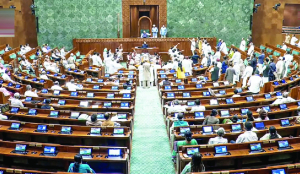
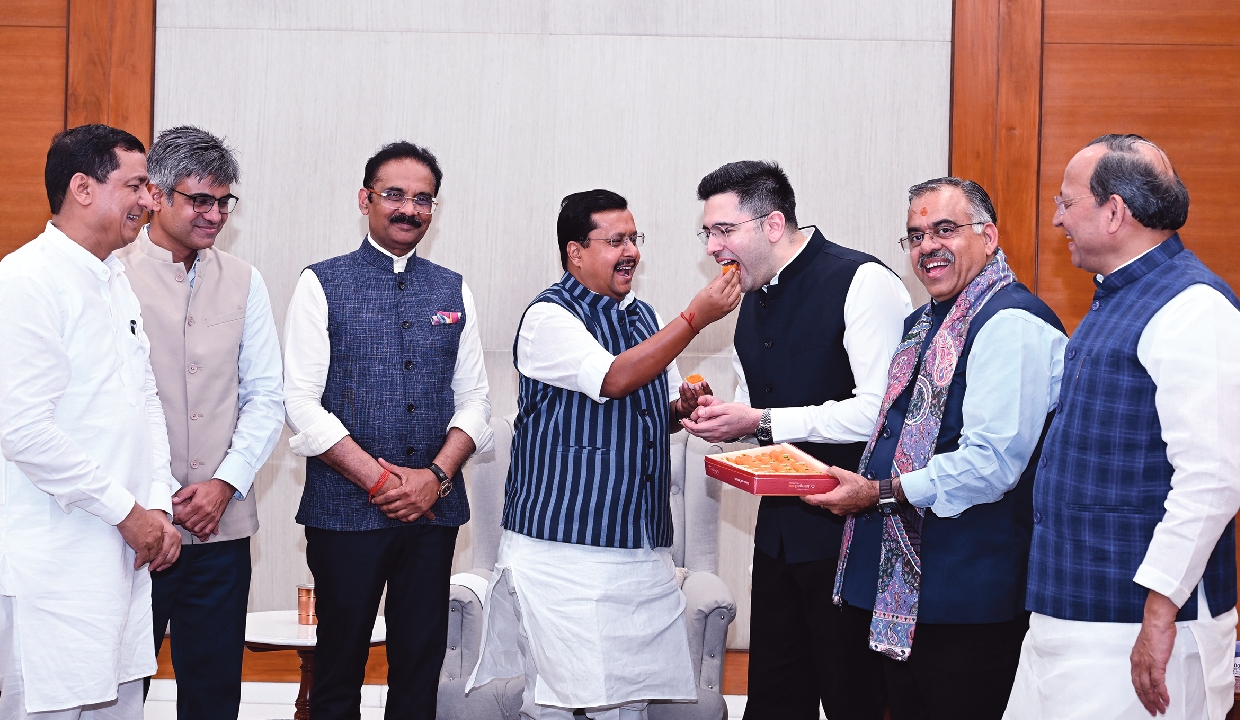
The Aam Aadmi Party (AAP) on Friday suffered a big jolt with seven of its ten Rajya Sabha (RS) MPs led by Raghav Chadha joining the BJP. This development came days after Chadha was removed as deputy leader of the party in the Upper House of Parliament. His replacement in RS by AAP, Ashok Mittal, too switch sides on Friday. Mittal, founder and chancellor of Lovely Professional University, was raided by the ED on April 15. The five other MPs to join the BJP included cricketer Harbhajan Singh, Swati Maliwal, Rajinder Gupta, Vikram Singh Sawhney and Sandeep Pathak.
“I am the right man in the wrong party. Therefore, today I announce that I am distancing myself from the AAP and going to the people,” Chadha said before leaving for BJP headquarters to meet party chief Nitin Nabin.
Chadha had been with the AAP since its inception in 2012, working as a trusted lieutenant to Kejriwal, who stormed into power in Delhi in 2015 riding the wave that followed the anti-corruption movement. Pathak, who addressed the presser alongside Chadha, said he had been thinking about resigning from the AAP for the past six-seven months.
Explaining the reason behind distancing himself from party activities, Chadha said, “I did not want to be a part of their crimes. I was not eligible for their friendship because I was not a part of their crime. We had just two options — either quit politics, give up our public work in the last 15-16 years or we do positive politics with our energy and experience. So, we have decided that we, the 2/3rd members belonging to the AAP in RS, exercise the provisions of the Constitution of India and merge ourselves with the BJP”.
“As per the Constitution, two-thirds of the total MPs of a party can merge with another party. We have submitted a letter to RS Chairman CP Radhakrishnan in this regard today along with all the documents required,” he added.
Reacting to this development, AAP national convener Arvind Kejriwal said the BJP had once again betrayed the people of Punjab after seven RS MPs quit the party. “BJP ne phir se Punjabiyon ke saath kiya dhakka (The BJP has once again given Punjabis a shove),” Kejriwal wrote on social media platform X.
Chadha’s merger with the BJP wasn’t unexpected. It follows nearly a month after the AAP acted against him in the Upper House of Parliament. The party had also requested the RS Chairman that Chadha should not be allotted time from the party’s quota to speak in the House. The young leader confronted the move in video messages, calling it a “scripted campaign” and “coordinated action” against him.
Chadha and the six others are unlikely to face action under the anti-defection law as it clearly stipulates that an RS member is not disqualified if their original political party merges with another party, and they either join the new party formed after the merger or choose to function as a separate group.
Crucially, such a merger is legally recognised only if at least two-thirds of the members of the legislature party agree to it.
The anti-defection law, introduced through the 52nd Constitutional Amendment in 1985, was designed to curb political defections motivated by office or power. It sets out conditions under which legislators can be disqualified for switching parties. The Tenth Schedule of the Constitution states explicitly that a merger is deemed valid “if, and only if, not less than two-thirds of the members of the legislature party concerned have agreed to such merger.”
In the present instance, if Chadha resigned alone — or even as part of a small group — he would have been immediately liable for disqualification under the anti-defection law. His RS membership would have been at risk.
Instead, by ensuring that at least two-thirds of AAP’s RS MPs acted in cohesion, the group effectively shielded itself from disqualification. In constitutional terms, their move qualifies not as defection, but as a merger or split recognised under the Tenth Schedule.
Chadha, addressing a press conference stated that the leadership of Prime Minister Narendra Modi, the Government has taken several strong decisions that earlier leaders were perhaps hesitant to take, whether it is uprooting terrorism or bringing India among the top global economies. “The people have endorsed this leadership not once, not twice, but three times. We all feel fortunate to work under the leadership of Prime Minister Narendra Modi and with the determination of Home Minister Amit Shah, and we will continue to work tirelessly for the nation,” Chadha said.
“To those who felt disappointed that, as a Member of Parliament, I might not be able to raise the issues of ordinary citizens because my own party had silenced my voice, I want to assure them not to worry. I will continue to raise all your issues with the same commitment, enthusiasm, and energy,” he added.