Centre forms committee to draft "Permanent Political Solution" for Gorkha identity issue
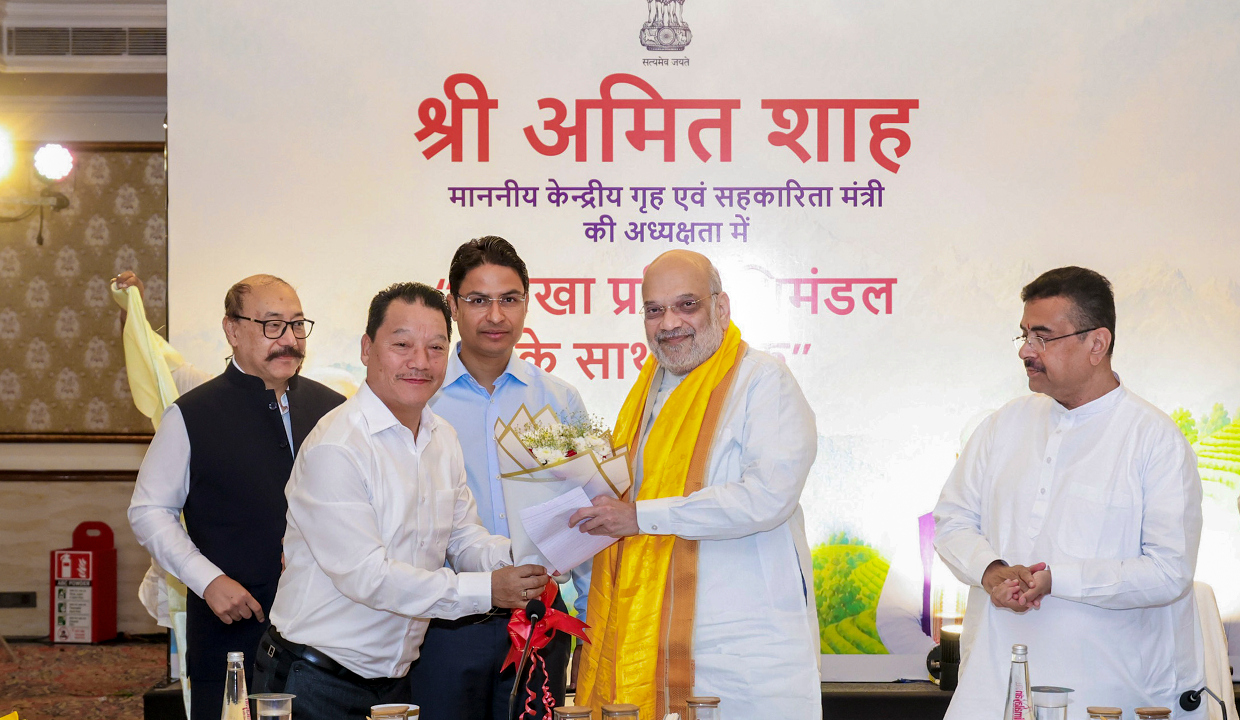
The Centre on Saturday set up a committee to draft an agreement and work out the modalities for a "permanent political solution" within the constitutional framework to the Gorkha identity issue in the Darjeeling hills and surrounding areas, officials said, following a key tripartite meeting involving Union Home Minister Amit Shah, Gorkha leaders and the West Bengal government.
The move comes amid a long-standing demand for greater political recognition, autonomy and protection of the region's distinct linguistic, cultural and ethnic identity, which is predominantly Gorkha.
"All issues relating to the hill population of West Bengal were discussed in detail. Their demands pertaining to a distinct identity, a permanent political solution and recognition under the Constitution of India were taken up. The Union Home Minister promised a permanent political solution soon under the umbrella of the Constitution," a statement from the Ministry of Home Affairs (MHA) said.
"To finalise modalities, it was decided to form a committee under Shri Pankaj Kumar Singh, former deputy national security advisor and current interlocutor, to finalise the details regarding the final agreement that will be drafted towards a permanent political solution for the people of the hill areas of West Bengal under the Constitution of India," the statement added.
The release noted that Shah also pledged to sympathetically consider all other demands raised by the community.
"He said adequate funding from the Centre will ensure all pending issues are taken care of," it added.
The meeting took place at a hotel in Sukna in the Darjeeling foothills on the third and final day of Shah's visit to the state, chaired by the Union Home Minister and attended by Chief Minister Suvendu Adhikari, along with leaders of various hill political parties and other regional stakeholders.
Among those present were Gorkha Janmukti Morcha (GJM) chief Bimal Gurung, the party's senior leader Roshan Giri, Gorkha National Liberation Front (GNLF) chief Mann Ghisingh, several state ministers, BJP MLAs from the hills, and senior state government officials.
BJP MPs Raju Bista and Harshvardhan Singla, MoS Hill Affairs Bishal Lama, and MLAs Bharat Chettri, Sonam Lama and Noman Rai were also among the attendees.
In October 2025, the MHA had appointed Pankaj Kumar Singh — a retired IPS officer and former BSF director general who served as deputy national security adviser from 2023 to 2025 — as the government's interlocutor for matters concerning the Darjeeling hills, Dooars and Terai. His mandate centres on leading political dialogue and addressing the Gorkha community's long-pending demands.
BJP's Darjeeling MP Raju Bista noted that Saturday's meeting fell on a historically significant date, coinciding with the anniversary of the signing of the Gorkha accord in 1988.
That accord, signed between the Centre, the West Bengal government and the GNLF, led to the formation of the Darjeeling Gorkha Hill Council (DGHC) as an autonomous administrative body, following a prolonged and often violent agitation for a separate state of Gorkhaland during the 1980s.
The demand resurfaced in later decades, notably through the Gorkhaland movement led by the GJM, leading to repeated rounds of tripartite talks involving the Centre, the state government and Gorkha representatives.
In 2011, a tripartite agreement resulted in the creation of the Gorkhaland Territorial Administration (GTA), though several core political and identity-related demands remained unaddressed.
The Centre restarted formal tripartite talks in 2021 and has since maintained that hill-related issues, including those concerning Darjeeling, Terai and Dooars should be resolved within the constitutional framework and in coordination with the state government.
"The history of struggle of the hill communities spans over four decades, during which the previous Left and TMC government trampled over the aspirations of the hill people. The sacrifice made by our people involves nearly 2,000 people who were martyred, over 5,000 people displaced and women tortured and raped," the Darjeeling MP alleged.
Bista said that while representatives from various communities raised their concerns and expectations during the meeting, Adhikari also outlined his approach to addressing the hill population's issues.
"After hearing out all stakeholders, Shah summed up the meeting by elucidating how a permanent solution to the issues could be reached in the days ahead," the MP said.
GJM leader Roshan Giri said the Gorkha leadership remained committed to pursuing a solution through constitutional means and would collaborate with the Centre in this process.
"Shah has clearly said that whatever solution is reached to address the issue will have to be under the constitutional framework. I am in favour of a constitutional solution and have put forward my suggestions in accordance with that," Giri told reporters.
Earlier efforts by previous state governments to resolve the Gorkha identity issue through arrangements such as the DGHC and the GTA have arguably failed to bring about lasting peace, economic development and political stability in the region.
Against this backdrop, stakeholders said the Centre's move to set up a committee to work toward a final agreement and modalities for a "permanent political solution" reflects an effort to address the unresolved questions around Gorkha identity and political aspirations through a negotiated constitutional process. (with inputs from PTI)