Blasé Capital M&A JUNCTION
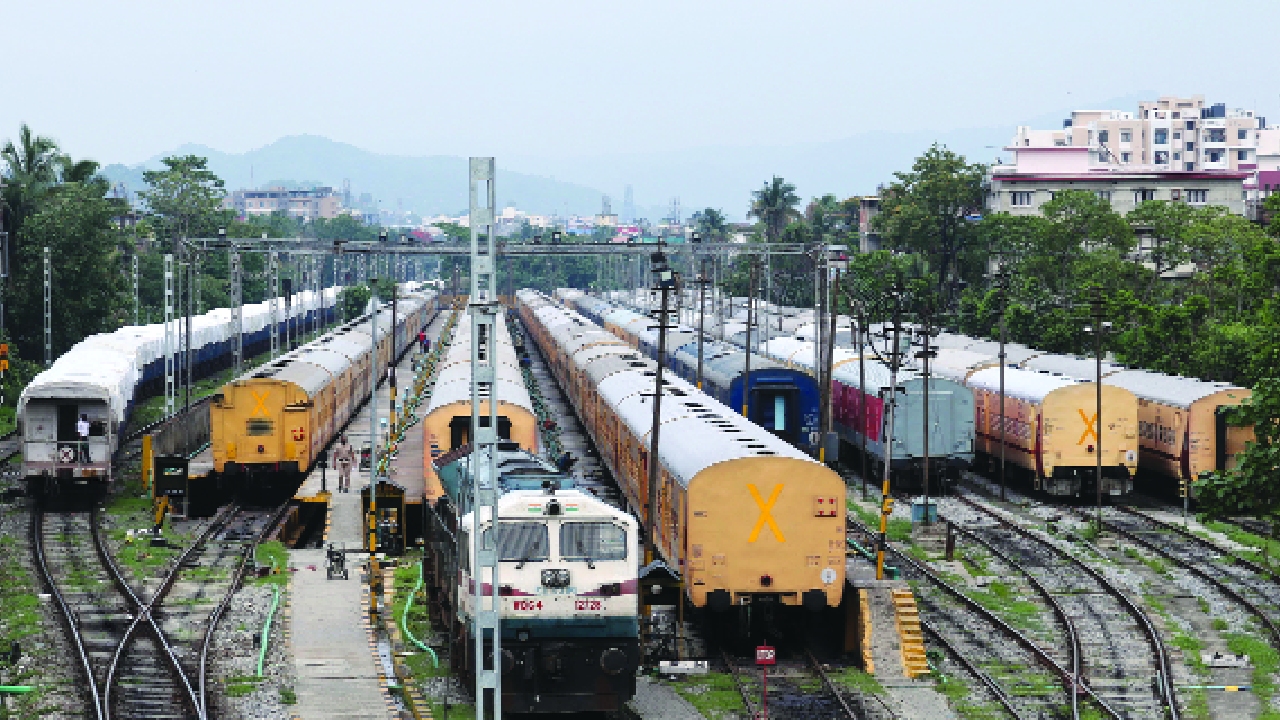
The ways of the stock markets can be weird. On a day when the Sensex, the Bombay Stock Exchange Index, lost more than 1,000 points, and after it slumped by nearly 3,000 points over the past five trading sessions, the railway stocks, both private and public sector, jumped almost unexpectedly. A private sector share rallied by 13 per cent, and another public sector one by 12 per cent. A few others gained by 2-7 per cent each. The ostensible reason was a media report, which was slightly speculative, that the railways ministry had started a “formal proposal” to merge two state-owned heavyweights, Ircon and RVNL. The sudden spurt seems out of sync as both these shares, along with the others, were down in the dumps in the past few days, as were most stocks listed on the Indian exchanges. The earlier falls were backed by the fears that the two railway firms will be impacted by the Middle East war.
While one can assume that a mega-merger between two large state-owned firms can be positive, there may be too many slips between the cup and lips in this case. The first is that the merger idea is just floated by the nodal ministry. It will go through a long-drawn-out review process, and will need several approvals from the finance ministry, department of public enterprises, and cabinet committee on economic affairs. After this, the two relevant firms will need board affirmations, and discussions about valuations since it will involve share swaps. Both the railway entities are listed on the Indian exchanges. Given the current state of the stock markets, there is unlikely to be an
urgency. If the Middle East war intensifies, Indian and other global equities may be depressed for months. So, the chances of a merger, despite it being a share swap, is unlikely to be announced soon due to valuations.
At the same time, the logic behind the merger seems a bit vague. According to a media report, the merger will create a larger entity that will combine special expertise, and enhance execution capacity by “leveraging RVNL’s project management strengths, and Ircon’s expertise in turnkey projects and railway construction, as well as increase international presence, and operational efficiency.” If one cuts through the jargon, it will seem as if the latter firm that executes large turnkey projects does not have enough management strengths that RVNL possesses. As if one can complete huge projects with the strategic efficiency, inputs, and efficacy. RVNL is involved in rail infrastructure such as new tracks, gauge conversion, and electrification. Ircon focuses on global projects largely related to complex electrification. Hence, there is convergence in operations, even duplication, rather than synergies that can be leveraged by either side. In effect, it may achieve size but little else if both firms continue to operate separately.
Let us consider the case of another merger in the public sector, which was announced in this year’s union budget. The purpose behind the PFC-REC merger was to “streamline operations, reduce duplication, and enhance scale for India’s growing energy financing needs.” What needs to be remembered is that REC was a subsidiary of PFC since 2019, with the latter holding more than 50 per cent stake. Post-merger, PFC will hold 100 per cent in REC, which will become a 100 per cent subsidiary. One fails to understand the major differences between a majority and wholly-owned subsidiary. One fails to grasp that if the stated synergies were not achieved in the majority-subsidiary relation, as it seems they were not, how can the same become true in a wholly-owned one. The fact remains that there are several underlying and unexplained issues behind the official aims. Even more strange is the fact that investors unduly get excited by a merger without trying to figure out the real reasons, or benefits and gains. A merger per say is not beneficial.
Over the past one week, the RVNL stock is down by more than seven per cent, although it shot up by nearly a similar margin yesterday. In this calendar year, it fell by 19 per cent. Although Ircon gained by three per cent in the past one week, thanks to the 12 per cent upside yesterday, it has shed 17 per cent in this calendar year. In both the firms, the existing government stakes are relatively high, 65 per cent in Ircon, and 73 per cent in RVNL. A stock swap will not ensure any money inflows, either for the firms or their shareholders. One needs to figure out the ratio to determine whose investors will gain more than the other. Hence, the valuations will be critical, but the future calculations can be upset by the ongoing global wars. In many cases, there is a tussle between the shareholders to push up individual valuations to get a better deal at the expense of the others.
In the merger mania and madness, one is still not sure about the benefits that may accrue to the other railway firms. For example, one cannot fathom why a wagon-maker, Jupiter Wagons, gained more than 13 per cent yesterday, and why a state-owned container firm, CONCOR, and another finance firm, IRFC, went up by two per cent each.