Blasé Capital DEFICIT TRADE
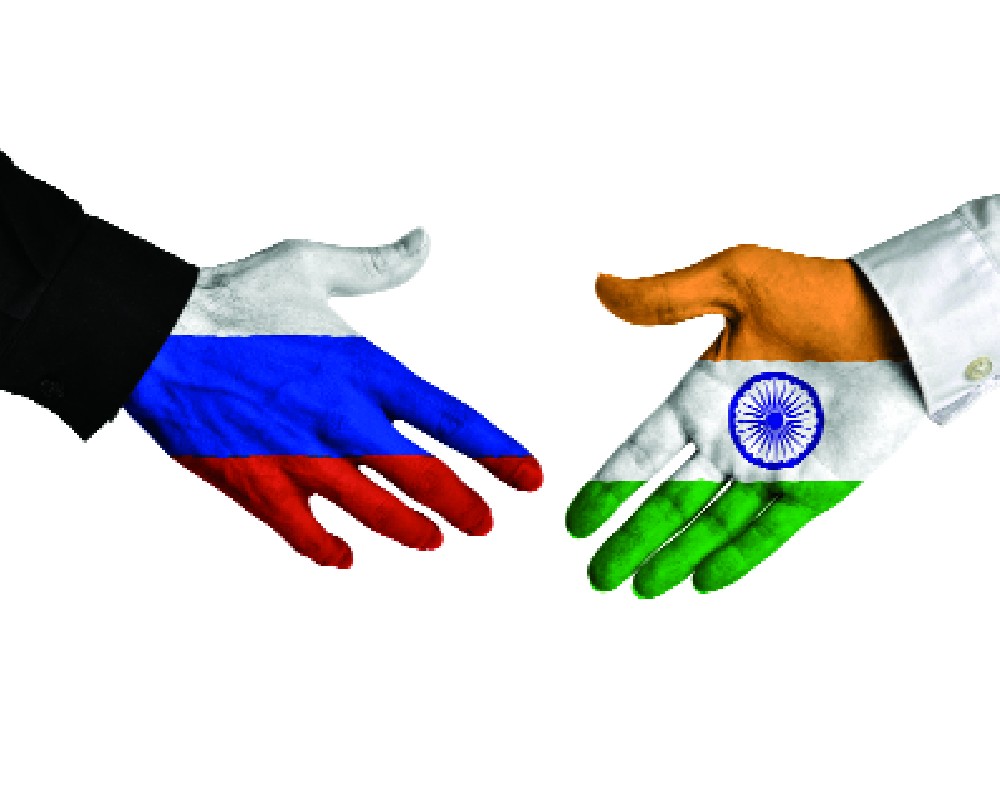
As Russia's powerful Vladimir Putin lands in India, there is huge excitement about the potential and possibilities to further concretise the trade, cultural, social, and business links between the two nations. Media reports talk about massive deals in areas such as energy, defence, and other areas. A few days before his visit, there were reports that despite the new US and European sanctions, crude oil imports from Russia went up after a brief drop. Indians, it seems, have mastered the art and science to use grey ships, or illegal smuggling shipments to import oil. Since the global sanctions are against the exports of petrochemicals that use Russian crude, Indian refiners can use the latter to make petroproducts to cater to domestic demand. Thus, in both legal and grey areas, the partnership and friendship between the two nations is on the rise.
Yet, there are a few issues that India needs to contend with in its seemingly-blind pursuit of Putin’s pacts. The first is that even as the two nations talk about increasing the annual trade between them by more than 40 per cent to $100 billion within five years, the current balance is clearly lopsided. Of the nearly $70 billion trade now, Indian exports constitute a mere seven per cent of the total. The large proportion of the value is about the goods that India imports. Indeed, most of its defence needs, despite purchases from non-Russia suppliers in the recent past, is focused on Russia. The industry and commerce minister, Piyush Goyal rightly analysed the situation, although in a slightly-garbled way, as one where “we cannot rest, we need to grow, we need to balance that.” What he means is that India needs to export more goods and services to Russia.
Of course, on paper, there are several areas where India can emerge as an attractive supplier of world-class products. According to Goyal, in manufacturing, there are huge opportunities to expand the trade, and reduce the huge deficit. These include consumer goods, food products, automobiles, tractors, heavy commercial vehicles, consumer electronics, industrial components, and textiles. Similarly, there is a latent potential to push services exports. If India can sell services to the US, and Europe, and the rest of the world, why not Russia? The Russian side seconded Goyal’s assessment, and talked about India can increase its current two per cent share in Russia’s overall imports. However, there are several problems which, as the Indian commerce secretary, pointed out includes process simplification. The policy-makers on both sides need to sit together to ferret out solutions, which are not likely to be easy, or simple.
Let us start with agriculture and food products. This is a contentious issue, both for exports and imports. Indian policy-makers have articulated the need to increase exports to push up farm incomes. However, exports rarely help the farmers. They mostly benefit the middlemen, and industry, who buy cheap, and sell dear. The second is that as soon as India enters the market, global prices swing wildly. If India is a purchaser, prices zoom. If it is a seller, prices dip, and both happen because of the high volumes in question. Thus, the full benefit of global prices, either high or low, do not accrue to Indians. Finally, there is a strong industry lobby against exports, which invariably sways the other way for cheaper imports. In addition, the current atmosphere, where India is being pushed by America to import higher farm products, is not conducive.
Now, let us move to consumer electronics, and telecom equipment. One of the biggest exports in this area is of the smartphones, especially the iPhones. But, as most of us know, the iPhones are being shipped to the US by Apple, which is under pressure to make more of them in the US.
Obviously, while Apple will continue to ‘Make in India,’ it will surely not export to Russia from India, given the current stalemate between Putin and America’s Donald Trump. Unless Russia agrees to a ceasefire in Ukraine, the US, and other global sanctions, prevent American and European firms from trading directly with Russia. So, essentially, iPhones are out of the India-Russia trade equation, especially over the next two years. India makes some components, and assembles the Chinese phones. But China may not wish to export to Russia from India. It will want to use the factories in its country for this purpose.
Despite the cultural affinities, and cultural exchanges between India and Russia, language is a huge barrier in the services sector. Indian IT and outsourcing firms have performed well in nations that are either fluent in English, or comfortable with it. In the case of, say, Russia, and China, one needs to know the local language. Decades ago, we had several Russian-speaking Indians but the tribe has slowly vanished. Russian, since the age of economic reforms, has not been a top priority for the Indians, who wanted to acquire English skills. If the services firms wish to expand in Russia, they need to focus on the language, as well as soft skills that are specific to the Russian culture. The soft-skill training that they impart to fresh hires need to be expanded to include possible entry into Russia.