AI rewiring India’s roads for a safer tomorrow
From real-time data to smarter enforcement, AI is reshaping how India prevents road accidents
The National Road Safety Hackathon 2026, organised by the Indian Institute of Technology Madras, marks an important shift in India’s approach to one of its most pressing public safety challenges. Officially launched at the India AI Impact Summit 2026, the initiative positions road safety firmly within the country’s broader AI transformation agenda. Open to students, engineers, and technology enthusiasts, it reflects a growing recognition that innovative, technology—led solutions are essential to address India’s alarming road accident crisis. Yet, beyond such promising initiatives, a larger question persists: are we leveraging AI at scale to make our roads truly safer?
The scale of India’s road safety crisis
India records over 1.7 lakh road fatalities every year-more than 450 deaths daily. Behind each statistic lies a shattered family, a lost livelihood, and an irreversible social cost. Despite improvements in infrastructure and stricter laws, safer roads have not kept pace with faster roads. Recent incidents underscore a hard truth: human behaviour alone cannot be relied upon to ensure safety. This is where AI can become a game-changer.
Implementing road safety programmes in India presents unique challenges. The country continues to grapple with a weak safety culture, low levels of formal training among commercial vehicle drivers, and an ageing vehicle fleet with poor maintenance. While traffic laws are stringent, enforcement remains inconsistent—allowing rash driving and unfit vehicles to persist on the roads.
Despite these constraints, India is witnessing the beginnings of a quiet transformation in road safety culture. With improving infrastructure and increasing use of technology, there is reason for cautious optimism that road crashes and fatalities can be reduced in the years ahead.
Paradigm shift from Reactive to Predictive Analytics
AI has the potential to fundamentally reshape road safety by shifting the paradigm from reactive response to proactive prevention. Through real-time data processing, predictive analytics, and pattern recognition, AI systems can monitor, detect, and even anticipate unsafe conditions before accidents occur.
In an interaction with this author, Dr Venkatesh Balasubramanian, Professor in the Engineering Design Department and Head of Centre of Excellence for Road Safety (CoERS)at IIT Madras, emphasised that “the application I am most optimistic about in the long run is predictive and prescriptive analytics—the ability to anticipate where crashes will occur, who is most at risk, and what intervention will prevent them, before a single life is lost.”
Power of data: ‘Battlefield actionable intelligence’
Launched in 2020, India’s iRAD (Integrated Road Accident Database) created a unified, real—time national database of road accidents. The eDAR (Electronic Detailed Accident Report) module, introduced by MoRTH in 2021 and scaled nationwide by 2022, extends this framework to enable end-to-end digital accident reporting and claims processing. With over two million crashes recorded, eDAR is generating AI-enabled insights for prevention and safer road design. Supporting this ecosystem is the Sanjaya platform, which ensures seamless data exchange across stakeholders, providing what Dr Venkatesh describes as “battlefield actionable intelligence to policymakers.” He adds that “we are now at the point where the AI layer can begin to deliver on its promise.” According to Dr Venkatesh, “computer vision and sensor-based AI are also showing significant promise in driver behaviour monitoring-detecting fatigue, distraction, and risk-prone driving patterns in real time.”
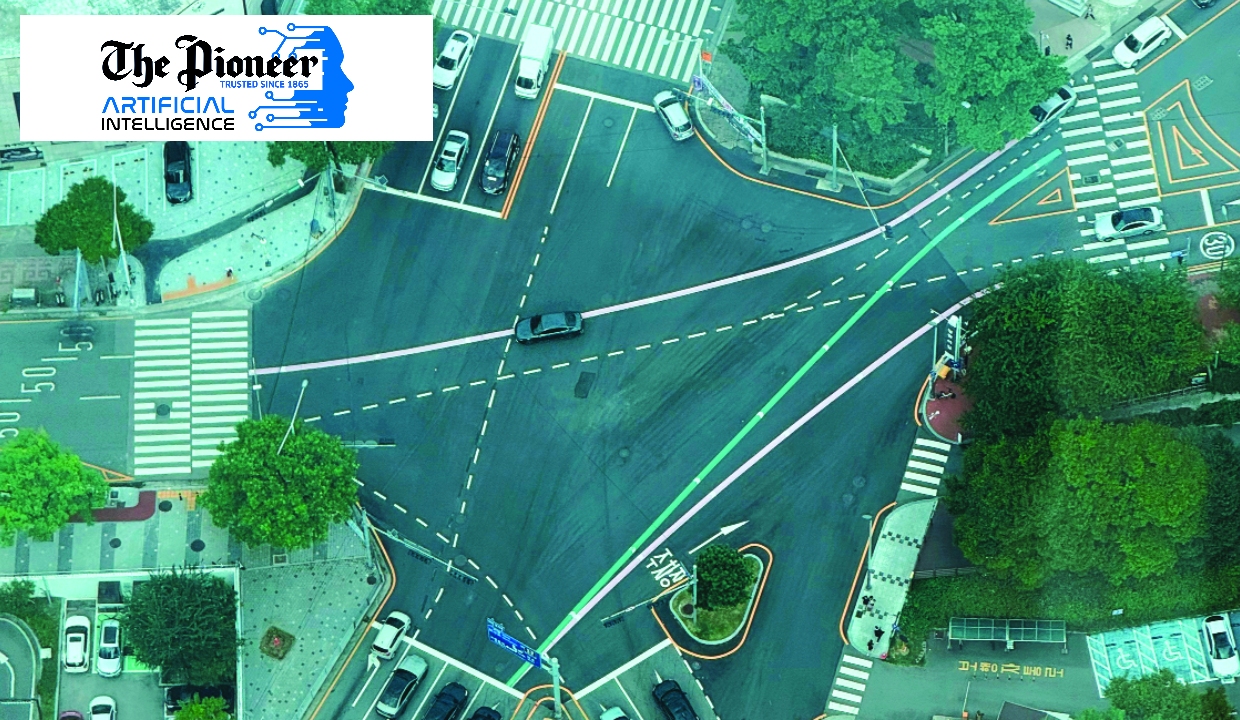
AI-powered traffic management systems can optimise signal timings, detect congestion build-ups, and dynamically reroute traffic. Smart cameras, combined with AI, can identify violations such as red-light jumping, illegal turns, and non-compliance with helmet and seatbelt rules. For instance, AI-enabled traffic cameras are being deployed in Delhi NCR to detect violations like speeding, red-light jumping, and helmet non-compliance in real time, demonstrating how data-driven enforcement can improve compliance at scale.
The irreplaceable human factor
However, as Dr Rohit Baluja, President of the Institute of Road Traffic Education (IRTE), told this author, “The biggest mistake we make is believing that technology alone is the answer. AI and technology are enablers—they cannot replace human understanding, training, discipline, and scientific management.” He emphasises that road safety depends on a combination of safe roads, safe vehicles, trained drivers, effective enforcement, and responsible behaviour-areas where significant gaps remain.
Dr Venkatesh echoes this caution, noting that “India’s road safety challenge will not be solved by importing Western solutions wholesale. Our road environment, traffic mix, urban morphology, and enforcement capacity are distinct. We need solutions designed for Indian conditions, tested on Indian data, and deployable within Indian constraints.”
Dr Baluja further argues that the more relevant question is: how can AI strengthen a scientific traffic management system? “Road safety,” he says, “is ultimately a product of such a system.” This distinction is critical. In India, the use of AI has largely been concentrated on enforcement. Yet, as he points out, “while challans have multiplied, fatalities have not reduced proportionately,” highlighting the limitations of a purely technology-first approach.
AI for pedestrian and two-wheeler riders’ safety
Interacting with this author, Dr Geetam Tiwari, Emeritus Professor at the Transportation Research and Injury Prevention (TRIP) Centre, IIT Delhi, points to AI’s potential in improving compliance, particularly among vulnerable road users. “Given the high risk to pedestrians and two-wheeler riders, AI can improve compliance — especially helmet usage and speed regulation near schools — through automated ANPR (Automatic Number Plate Recognition) systems that generate penalties,” she notes. She also highlights AI’s role in proactive infrastructure management, where data can be used to identify “greyspots” and zones with repeated speed violations requiring engineering interventions.
Complementing these systems are the VAHAN and SARATHI databases, India’s unified digital registries for vehicles and driving licences, respectively. Together, they provide critical backbone data for enforcement, analytics, and road safety governance. As Dr Geetam notes, effective implementation will require overcoming challenges such as integrating these databases with AI-enabled enforcement systems and strengthening existing enforcement mechanisms.
India is uniquely positioned to leverage AI for road safety, given its strong digital ecosystem, expanding startup base, and policy push under initiatives such as Digital India and Smart Cities. However, adoption remains fragmented and limited in scale. There is an urgent need to move from isolated deployments to a coordinated, mission-mode approach.
Data governance, policy architecture and Innovation-to-deployment pipeline
Dr Venkatesh suggests that “Accelerating AI-driven road safety in India requires simultaneous action at three levels — data governance, policy architecture, and the innovation-to-deployment pipeline. We need a legislative mandate requiring stakeholders to contribute to and draw from a unified data ecosystem. MoRTH, NHAI, and state transport departments must embed AI-generated insights into planning and enforcement workflows. We also need an institutional architecture to connect ideas, technology, and data.” Key areas for action include AI-enabled fleet safety, smart highways and expressways, urban traffic intelligence, data integration and analytics, and driver training and behavioural change. For AI to truly transform road safety, coordinated action is required across stakeholders — government agencies, urban planners, highway authorities, corporates, and technology providers.
Institutions such as highway authorities and city planning bodies must integrate safety as a core design principle, not an afterthought. AI deployment should be embedded into infrastructure projects from the outset. Public — private partnerships can play a crucial role in accelerating innovation and implementation.
Equally important is the need for robust regulatory frameworks and standards to ensure data privacy, system reliability, and interoperability.
As India builds faster roads and expands its transport networks, safety must keep pace with speed. AI offers an unprecedented opportunity to enable this shift — not incrementally, but transformationally. Road safety cannot remain a peripheral concern; it must become a national priority, backed by technology, policy, and collective will.
Collaboration as the force multiplier
Reflecting on the role of initiatives such as the hackathon, Dr Venkatesh observes that “A hackathon is an ecosystem event, not just a competition. It creates a rare space where academia, Government, and industry engage with the same problem and are compelled to think beyond their individual mandates.”
Ultimately, the success of such efforts depends on sustained collaboration. These stakeholders must remain aligned, committed, and driven by a shared belief that safer roads are not an aspirational ideal but an achievable reality. Safety is not a cost — it is an imperative. And above all, it is priceless.
The writer is Professor of Practice at IILM University, Gurugram, and has led large-scale logistics and road safety initiatives across India’s transport ecosystem; Views presented are personal.