Agriculture, Knowledge and Society: Insights from Medieval Bengali Literary Sources
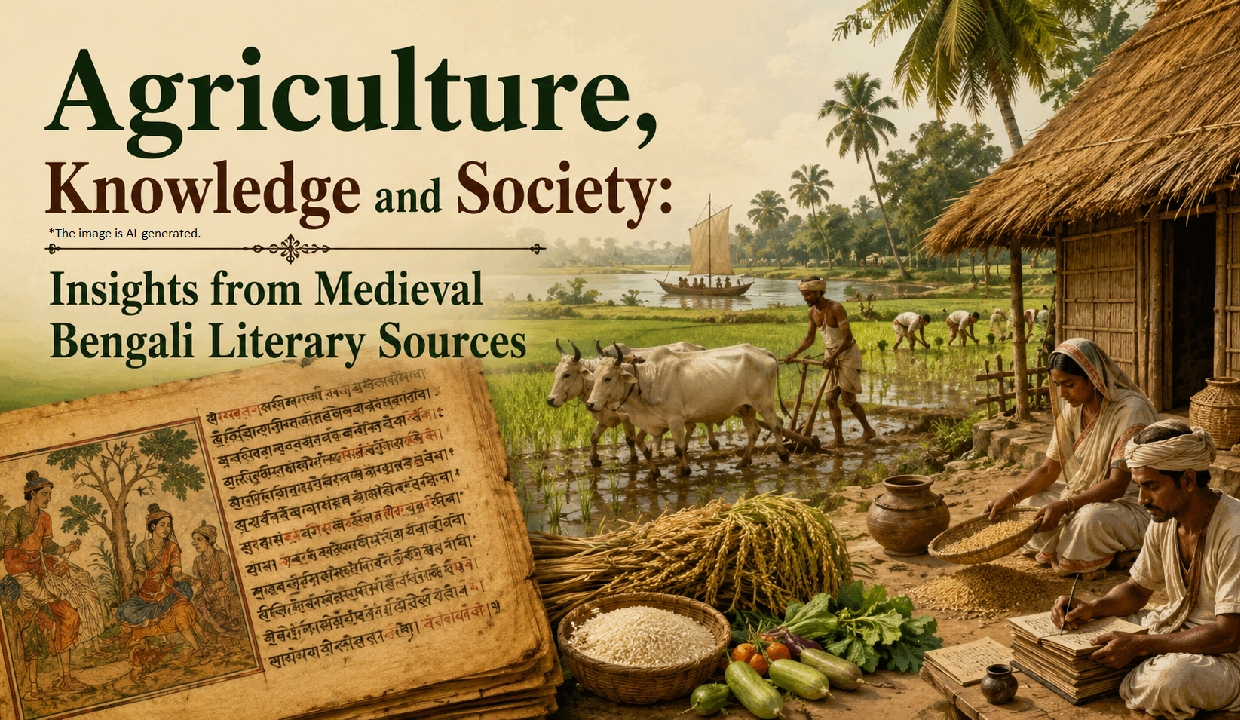
The history of agriculture is often narrated through the language of economics, state policy, and technological changes. Yet, some of the most revealing insights into agrarian societies emerge not from administrative records or royal chronicles, but from literary sources. In Bengal, medieval literary traditions from Chandimangal and Shivayan to the Maimansingha Gitika and Charjapada preserve a remarkably detailed account of agricultural life. Beneath stories of gods, merchants, heroes, and romance lies another narrative: the story of farmers, crops, irrigation systems, seasonal rhythms, and rural communities that sustained one of South Asia's most fertile regions.
Bengal's geographical setting played a decisive role in shaping its agrarian civilisation. The fertile alluvial plains formed by the Ganga River system provided favourable conditions for intensive cultivation, while seasonal cycles governed agricultural activities and rural life. In the text Maimansingha Gitika's Malua part repeatedly emphasises this close relationship between nature and farming.
"Agan masete hoiba khete Kartika shail,
Sakal koira khete yai amar Yadumani.." P. 46-47
This verse reflects the close relationship between agricultural labour, seasonal time, and everyday rural life in medieval Bengal.
Medieval Bengali literature is embedded with the rich agricultural knowledge. Literary sources describe diverse crops, including varieties of rice including Shali and Binni, mustard, sesame, sugarcane, cotton, fruits, vegetables, and spices, reflecting a highly diversified agricultural system adapted to local ecological conditions rather than a narrow range of cultivation. The richness of Bengal's agricultural landscape is reflected in literary descriptions of diverse crops like "dhana, calu, masa, muga, chola, arahara, masuradi, barabati, batula, matara " (Manshingha-Bhabananda Upakhyan, pp. 59-60). Such references demonstrate that medieval Bengal possessed a remarkably diversified agrarian economy long before the emergence of modern agricultural science.
Sunyapurana, Chandimangal, Shivayan, and Mymensingh Geetika describe agricultural implements such as the plough, ploughshare, yoke, harrow, and sickle. Chandimangal portrays the Hindu God Shiva as an ideal cultivator, highlighting agriculture as a respected household, social, and religious duty. Sunyapurana further celebrates the plough as a symbol of agricultural prosperity, reflecting Bengal's rich tradition of indigenous farming technologies.
Shivmangala also preserve descriptions of farming implements "gacha kati garaiba langala joyali" (pp.216) mentions the preparation and use of the plough and other cultivation tools, demonstrating the technological foundations of agriculture. The significance of these descriptions
challenges a persistent misconception that scientific and technical innovation is exclusively an urban phenomenon. Medieval Bengal's villages functioned as centres of environmental knowledge where farmers continuously adapted cultivation practices to changing circumstances. The ability to select crops, regulate water, preserve seeds, and manage soil reflected sophisticated indigenous knowledge that anticipated modern principles of sustainable agriculture.
Medieval literature also records the uncertainties of agrarian life such as floods, crop failures, debt, food shortages, and land disputes. Farmers are portrayed as living within a delicate balance between productivity and uncertainty. A failed harvest could force families to sell livestock, mortgage land, or depend upon moneylenders. Such experiences reveal a reality that remains familiar across many agrarian societies even today. In Dosshu Kenaram pala Maimansingha Gitika also records the hardships faced by cultivators during times of scarcity.
eka musti dhanya nahi grihasther ghare,
anahare pathe ghate yata loka mare. pp. 195-96
Above verse describes a time when not a handful of grain remained in households and people suffered from hunger. These poignant lines remind us that agricultural abundance and vulnerability often coexisted within the same rural landscape. The social position of farmers further illustrates the complexities of medieval Bengal. While agriculture sustained the entire economy, cultivators did not always enjoy corresponding social status. Literary evidence suggests the coexistence of wealthy landholders, independent farmers, and landless sharecroppers. Many cultivators struggled to secure economic stability despite their central role in food production. This paradox the dependence of society upon farmers combined with the marginalisation of many agricultural communities continues to resonate in contemporary debates about rural development and agrarian justice.as well as William Dalrymple's The Anarchy provides valuable insights into the lives of farmers and the Bengal Famine of 1770, highlighting how the East India Company's exploitative revenue policies intensified the crisis. In the context of later colonial famines, William Digby estimated that nearly 19 million Indians died between 1891 and 1900, a comparison later cited by Shashi Tharoor in An Era of Darkness to emphasize the devastating human cost of colonial rule.
Medieval Bengali literature also describes the rhythms of everyday rural life. This literature gives details about food habits, housing, hospitality, clothing, festivals, and entertainment. Rice, fish, milk, and seasonal produce formed the basis of everyday life, while festivals and hospitality reflected the central role of agriculture in Bengal's culture. Literary narratives frequently connect agricultural prosperity with food and hospitality:
Ghore chhilo sachi pan chun khoyar diya. Bhaiyer lagya boine dil pan banaiya.
Uttam shailer chira gishtete bandhilo.
Ghore chhilo shabari kola tao songe dil.
Maimansingha Gitika's Malua, p.50
The verse illustrates how agricultural prosperity shaped social customs, hospitality, and everyday consumption in rural Bengal. Literary descriptions of hospitality further illustrate the agricultural abundance of rural Bengal. One account describes an elaborate feast comprising fish preparations, pitha, payesh and numerous seasonal delicacies, revealing both agricultural prosperity and the cultural importance of hospitality. "chatrisha prakara byanjana, puli pitha, pata pitha, citai pitha, chandrapuli, ksira o payesa." (Maimansingha Gitika, Malua, p.103) This verse describes thirty-six types of food dishes, as well as pata pitha, chandrapuli, kheer and payesh, different homemade sweet dishes.
In an era of climate change and ecological uncertainty, medieval Bengali literature preserves valuable indigenous agricultural knowledge. As reflected in "Krsi utpadaner bahu paddhati, bibhinna krsi prajukti o seca-byabasthar byabahar," an integral part of Bengal's agrarian heritage, highlighting their continuing value for understanding traditional knowledge systems.
Why should focus
Traditional agricultural wisdom reminds us that sustainable farming rests on ecological balance, crop diversity, and a deep understanding of the land lessons that remain vital for building climate resilience. This study suggests that agricultural policy and research can benefit from treating literary texts as repositories of long-term social memory. Medieval Bengali literature records not only farming practices but also how communities perceived risk, organised labour, negotiated scarcity, and adapted to changing circumstances. Many regional traditional farming systems are preserved in diverse forms, including literary texts, ritual practices, and oral traditions. Critical engagement with these historical knowledge systems can provide scholars and policymakers with valuable insights for developing sustainable agricultural strategies as well as society.
Meenakshi Lekhi, Former Minister of State for External Affairs, Govt. of India; Dr. Manashi Ghosh, Junior Research Fellow, Bharat Ki Soch; Views presented are personal.