Adhikari pushes to secure border
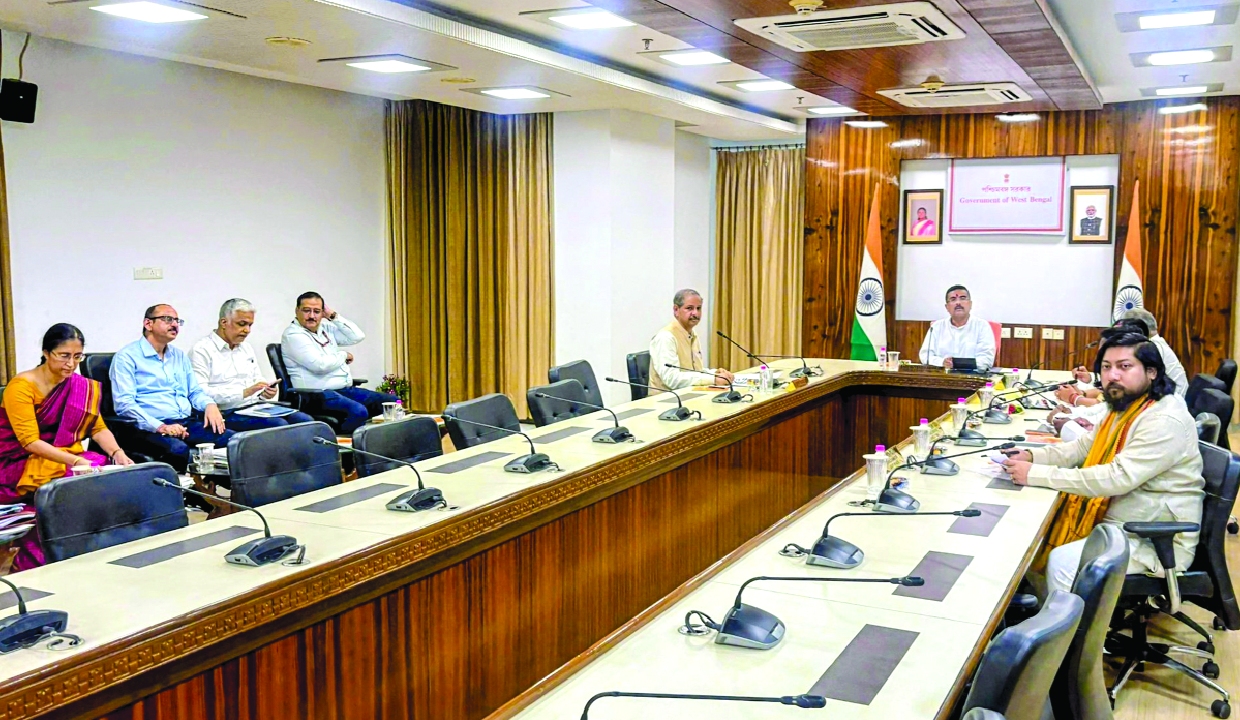
In its first move after assuming power, the new West Bengal Government under Chief Minister Suvendu Adhikari has approved the transfer of land to the Border Security Force (BSF) for completing fencing along the India-Bangladesh border. The Cabinet decision calls for a full handover of land to the Ministry of Home Affairs (MHA) within 45 days.
“We started the land transfer process with the BSF to secure the borders. The land will be handed over within 45 days,” CM said. The Chief Secretary and the Land Reforms department have been directed to complete the process.
The issue of border fencing has been a flashpoint for years under the Trinamool Congress (TMC) Government led by Mamata Banerjee. The State shares approximately 2,216.7 km of the 4,096 km India-Bangladesh border. While other States such as Tripura, Assam, and Meghalaya achieved near-100 per cent fencing on their feasible portions, as of mid-2025, data from the MHA indicate that about 456 km stretch in West Bengal remains unfenced.
The core bottleneck was land acquisition and handover to the BSF.
The Union Government had already acquired and paid compensation for substantial stretches, but the State Government repeatedly delayed physical transfer.
Union Home Minister Amit Shah and CM Adhikari had accused the Mamata of prioritising alleged vote bank politics linked to illegal immigration and cross-border smuggling over national security. The move fulfils a pre-poll promise by Shah, who had highlighted the need to secure the porous border and curb infiltration and smuggling. Reports indicate that around 600 acres of land are involved in the expedited process.
BSF requests for land had been pending for years despite multiple letters and central funding.
Terrain challenges, riverine stretches, marshes and local resistance compounded the issue, but judicial interventions repeatedly pointed to state-level inaction as the primary hurdle. As of early 2026, hundreds of kilometres remained unfenced in key districts such as Malda, Murshidabad, and Nadia, areas long identified as vulnerable to infiltration.
After the Cabinet meeting, Adhikari said that the new journey of good governance, security, and a double-engine Government in West Bengal would move forward on the same path of development as in other BJP-ruled states across the country. He reaffirmed the Government’s commitment to the ideals of Dr Babasaheb Ambedkar and the principle of “For the People, By the People, of the People.”
The BJP Government’s swift cabinet approval signals a sharp policy shift toward full cooperation with the Centre. By committing to transferring the pending land, including the court-mandated stretches and additional areas totalling 600 acres, within 45 days, it aims to enable the rapid completion of fencing.
West Bengal fast-tracks welfare plans
Kolkata: West Bengal’s first BJP Chief Minister, Suvendu Adhikari, chaired his inaugural Cabinet meeting at Nabanna on Monday and announced six decisive measures that signal a sharp break from the previous regime. The decisions, framed under the campaign slogan “Bhoy out, Bharosa in” (Fear out, trust in), focus on national security, welfare alignment with the Centre, administrative reform, and youth employment. They mark the swift implementation of the BJP’s manifesto promises following the party’s victory in the April 2026 Assembly elections.
Addressing the media after the meeting, Adhikari described the session as the beginning of a “people-first administration” that would deliver on the “double-engine” model of governance promised by Prime Minister Narendra Modi and Union Home Minister Amit Shah. “Bengal saw a deathless, intimidation-free election for the first time,” he said, paying tribute to voters, officials, and the Election Commission of India. He also remembered the 321 families of BJP workers killed in political violence over the past decade, assuring them of state support.
On Monday, the West Bengal Government formally joined the Union Government’s flagship Ayushman Bharat-PM Jan Arogya Yojana, providing health cover to families previously excluded from the scheme. Several other welfare programmes, such as PM Vishwakarma, Beti Bachao Beti Padhao, PM Ujjwala, and PM Fasal Bima Yojana, will also be implemented without delay. Officials added that existing state schemes would continue, but with a transparency drive to remove “illegal beneficiaries” and ensure genuine targeting. The Cabinet also decided to roll out the Bharatiya Nyaya Sanhita (BNS) in the State.
Reversing the previous regime’s policy, the Government cleared IAS, IPS, and State public service commission officers to participate in training programmes in other States and at Central institutions.
Fulfilling a key election promise made by Shah, the Cabinet extended the upper age limit for Government job applications, particularly school service recruitment, by five years. The decision is designed to benefit thousands of educated youth who missed opportunities during the TMC years.
The Government also issued orders to begin the nationwide Census operations immediately, ending what Adhikari called a year-long delay under the previous administration. Accurate data, he said, would form the foundation for targeted development and welfare.
Political observers see these early decisions as a combination of symbolism and substance. By prioritising border security and central schemes, the Adhikari Government has signalled its intent to end West Bengal’s political isolation from Delhi. The focus on jobs and transparency directly addresses two major voter grievances, unemployment and alleged corruption in welfare distribution.