A new economic moment for India: The Modi-economics behind India’s muscular growth
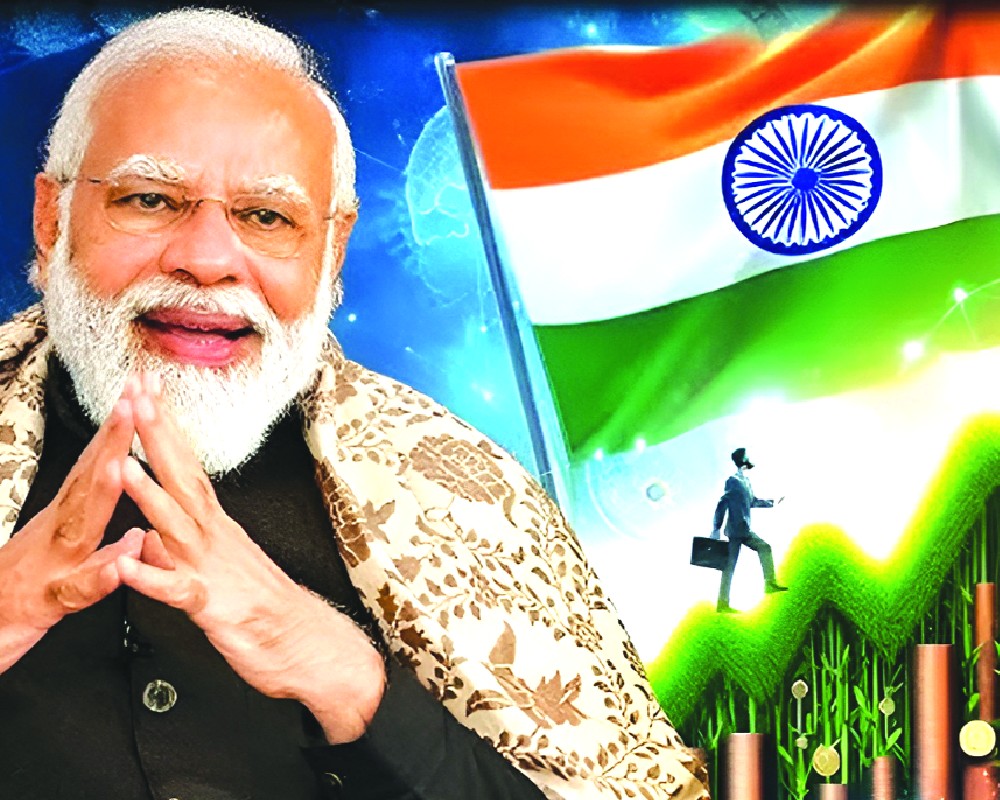
India stands at a remarkable moment in its economic journey — one marked by high growth, macroeconomic stability and structural depth that had long eluded its economy.
Official estimates place GDP growth at over 8 per cent in Q2 FY26, one of the strongest performances among major economies. Manufacturing has expanded robustly, services have remained buoyant, construction has strengthened and private consumption continues to revive steadily. Inflation — which destabilised advanced economies in the post-pandemic period — has remained largely within the RBI’s tolerance band for most of the past two years.
Domestic consumption reinforces this momentum. Passenger-vehicle sales crossed 4.3 million units in FY25, while two-wheeler sales approached nearly 20 million units. Urban housing transactions reached their highest levels in more than a decade. Festive-season retail spending surged past expectations, reflecting spirited household
confidence. These indicators confirm that India’s growth trajectory is anchored in broad-based demand rather than a statistical rebound.
India’s evolving socio-economic profile further strengthens this shift. According to the World Bank’s Spring 2025 Poverty and Equity Brief, India lifted 171 million people out of extreme poverty between 2011-12 and 2022-23. Extreme poverty fell from 16.2 per cent to just 2.3 per cent, one of the steepest declines recorded globally. This expanding middle class is increasingly driving consumption across automobiles, housing, electronics and digital services.
The architecture of Modi-economics
This transformation is not the result of favourable global conditions but of a decade of purposeful and, at times, politically difficult reforms under Prime Minister Narendra Modi — the Modi-Economics. It rests on fiscal discipline, institutional strengthening, manufacturing-led growth, digital governance and strategic continuity. Few democracies of India’s scale have pursued reforms with such consistency.
The rollout of the Goods and Services Tax (GST) marked a landmark shift. After years of debate, Modi delivered a unified indirect tax structure that replaced a maze of State-level levies with a national market. Subsequent rate rationalisations — often termed GST 2.0 — lowered compliance burdens and simplified the structure for MSMEs and manufacturers. Institutions such as NCAER note that GST has significantly improved logistics efficiency and reduced costs across value chains.
Modi’s call for Vocal for Local and a renewed emphasis on Swadeshi further reinforced this architecture. These initiatives encouraged consumers to support made in India brands and strengthened domestic supply chains. Local products across electronics, textiles, coir, home appliances and processed foods have gained substantial market share, while MSME clusters report stronger output and wider market access.
Reforming the financial backbone
Sustained high growth is impossible without a stable and well-capitalised financial system. When Modi took office, public-sector banks were saddled with high NPAs and stalled projects. The Government opted for structural repair rather than temporary fixes. The Insolvency and Bankruptcy Code brought credit discipline. Bank mergers created stronger institutions. Recapitalisation bolstered balance sheets. An asset-reconstruction mechanism addressed legacy stress.
The clean-up has been transformative. As NPAs fell to their lowest levels in many years, credit to infrastructure, MSMEs and manufacturing revived decisively. A healthier banking sector now provides the foundation for the next phase of investment-driven growth — a long-standing aspiration finally materialising.
Turning crisis into opportunity
The Covid-19 crisis tested leadership globally, and Modi’s economic instincts were evident in how India navigated the shock. The world’s largest vaccination drive, a phased reopening and the use of digital public infrastructure enabled a swift recovery. More significantly, Modi used the crisis to accelerate India’s manufacturing transition through the Production—Linked Incentive (PLI) schemes — the largest and most targeted industrial-policy initiative in India’s history. PLI spans 14 strategic sectors including electronics, pharmaceuticals, medical devices, EVs and solar modules. It incentivises incremental domestic production and has attracted global supply chains to shift capacity to India.
The outcomes are spectacular. According to official data reported by The Economic Times, Apple exported nearly $10 billion worth of iPhones in the first half of FY25 - a 75 per cent year-on-year increase. Apple produced $22 billion worth of iPhones in FY25, of which $17.5 billion were exported, and India now reportedly accounts for around 20 per cent of global iPhone production. This marks a profound shift in India’s role in global electronics manufacturing.
The automobile and electric-mobility sectors echo this momentum. India remains the world’s largest two-wheeler producer, with several companies reporting strong export growth.
EV and battery production have expanded rapidly, supported by PLI incentives and proactive state policies. India is emerging as a preferred export base for compact vehicles and electric two-wheelers across Asia, Africa and parts of Europe.
A resilient economy in a disrupted world
Rising protectionism globally including tariff uncertainties linked to political developments in the United States could have posed serious risks to emerging markets. Yet India has remained comparatively stable. Strong domestic demand, a more diversified export basket and predictable policymaking have shielded the economy from external shocks.
Manufacturing has reported consistent expansion, services remain strong and construction continues to benefit from public and private capital formation. Agriculture, too, has shown resilience, supported by improvements in irrigation, procurement digitisation and risk-mitigation schemes.
A major driver of this broader resilience has been the unprecedented expansion of infrastructure over the past decade. The national highway network has grown from about 97,000 kilometres in 2014 to over 146,000 kilometres in 2024, with daily highway construction rising from 12 kilometres to nearly 30 kilometres. The number of operational airports has doubled from 74 in 2014 to 149 today, dramatically improving regional connectivity under UDAN. Railway capital expenditure has increased almost five-fold - from Rs54,000 crore in 2013-14 to around Rs2.6 lakh crore in 2023-24 — enabling faster freight movement through dedicated corridors and modernised stations. Port capacity has expanded significantly, and India’s ranking in the World Bank’s Logistics Performance Index improved from 54 to 38. This infrastructure boom has lowered logistics costs, strengthened supply chains and enhanced India’s global competitiveness.
The International Monetary Fund (IMF) now estimates that India will cross the $4-trillion GDP milestone in FY26, reach around $4.96 trillion in FY28, and touch $5.46 trillion in FY29. The IMF projects that India will exceed $6 trillion by 2030, setting it firmly on track to remain one of the world’s fastest-growing major economies.
The Modi-economics dividend
What distinguishes India’s current moment is not the headline numbers alone, but the qualitative shift beneath them. The economy is transitioning from a consumption-heavy, import-dependent model toward one anchored in investment, manufacturing, technology and exports. Banks are healthier, inflation is better managed than in many peer economies, fiscal policy is more credible and the reform pipeline is deeper and more coherent than at any point in recent decades.
This is the essence of Modi-Economics: structural reforms delivered with political will, administrative consistency and a long-term national vision. A decade ago, India was often described as a country of untapped potential. Today, global institutions increasingly identify it as one of the world’s most reliable and resilient growth engines.
If India now has the confidence to target sustained high growth, attract global supply chains, expand domestic entrepreneurship and aspire to become a developed nation by 2047, it is because the foundations have been systematically rebuilt under Prime Minister Modi’s leadership. The momentum is real, the trajectory unmistakable. And that is why, when one reflects on India’s economic transformation, the phrase carries renewed force: Modi Hai Toh Mumkin Hai.
Author is a former IAS officer; views are personal