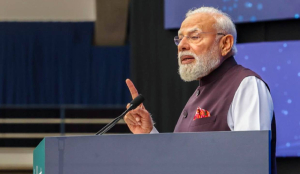
2025: A defining year of transformational reforms under visionary leadership of PM Modi

The year 2025 will be remembered as a landmark chapter in India’s economic, social and institutional history. Under the decisive and visionary leadership of Prime Minister Narendra Modi the nation demonstrated its resolve to think biggermove faster and reform deeper.
In its year end assessment, the Government clearly Stated that 2025 stood out as a period when India refused to slow down despite unprecedented challenges. These included exceptional tariffs imposed by the United States tougher visa regimes and disruptions in global supply chains. Alongside these external pressures, both the monsoon and winter
sessions of Parliament witnessed political disagreements and repeated disruptions. Yet, the Modi Government remained focused on governance reform and national interest. Guided by the Prime Minister’s clarion call from the Red Fort on August 15 to rewrite laws and regulations for twenty first century India, the Government undertook wide ranging structural reforms. These reforms covered labour laws, taxation, ease of doing business, trade, education, energy, nuclear power and rural employment marking one of the most comprehensive reform drives in independent India.
A major highlight of 2025 was the implementation of four new labour codes replacing 29 outdated labour laws. These reforms focused on wages, industrial relations, social security and workplace safety. According to the Government, nearly 10 million gig workers are now receiving annual social security support ranging between Rs5000 and Rs10,000.
Between 50 and 70 million contract workers are being brought under the Employees Provident Fund and Employees State Insurance framework. The introduction of a national minimum wage is expected to benefit 150 to 180 million low paid workers by increasing their earnings.
The Government estimates that these reforms could expand the formal workforce by 15 per cent and enable nearly 500 million working women to enter the labour force. For the industry, compliance requirements per factory are expected to reduce by 60 to 70 percent significantly improving productivity and competitiveness.
Tax reforms were another cornerstone of the Modi Government’s reform agenda in 2025. The Goods and Services Tax was simplified into a two-slab structure of 5 percent and 18 percent making taxation easier for households, MSMEs, farmers and labour intensive sectors while retaining higher rates on sin goods. This reform coincided with strong festive demand as Diwali sales touched Rs6.05 trillion.
Government estimates show that consumers experienced an average GST burden reduction of 5 per cent with some seeing relief of up to 20 per cent putting approximately Rs1 lakh crore back into the hands of the people. Reduced GST on life and health insurance led to annual savings of around Rs50,000 crore through lower premiums. Earlier in the year, the Union Budget delivered historic relief to the middle class by exempting individuals earning up to Rs12 lakhs annually from income tax. The replacement of the Income Tax Act 1961 with the new Income Tax Act 2025 simplified exemptions, reduced litigations and brought long awaited clarity ending decades of complex and outdated drafting.
Rural India received a strong push through the Viksit Bharat G RAM G Act, 2025 which replaced the earlier rural employment framework. The new law increased guaranteed rural employment from 100 to 125 days per year. According to Government estimates, this will raise annual wage entitlement by about Rs6,675 per household and add nearly Rs60,000 crores in wages every year across 86 million active job cards.
Despite repeated Opposition protests and disruptions in Parliament, the Government remained firm in prioritising rural livelihoods and social justice. To accelerate industrial growth and investment the Government eased rules for setting up manufacturing units by shifting away from a rigid 33 per cent green cover requirement to a pollution
potential based system. This reform is expected to unlock around 1.2 lakh hectares of industrial land reduce project costs by up to 20 percent and attract investments ranging from Rs20 lakh crores to Rs30 lakh crores.
Manufacturing units located within industrial parks that already have environmental clearance will generally not require separate approvals cutting delays by six to eighteen months. Additionally, 32 industries were added to the White Category reducing compliance requirements for 3000 to 5000 units each year.
Ease of Doing Business reforms were further strengthened by reviewing Quality Control Orders. Mandatory compliance was removed for 76 product categories with over 200 more slated for deregulation.
These changes are expected to boost exports, reduce manufacturing costs in sectors such as footwear and automobiles and lower prices for consumers. The Government projects the creation of 3 to 3.3 million direct jobs along with a similar number of indirect jobs. The definition of small
companies was expanded to include firms with turnover up to Rs100 crore reducing compliance costs for about 10000 companies and saving roughly Rs2 lakh per firm annually. MSME investment and turnover limits were also raised from April 1st of this year, allowing enterprises to grow without losing MSME benefits.
In a bold move to deepen financial inclusion and attract capital, the central Government permitted up to 100 percent Foreign Direct Investment (FDI) in insurance companies. This reform is expected to bring 80 to 100 million additional people under insurance coverage over the next five years and to attract 8 to 12 billion US dollars in foreign investment while easing long term fiscal pressure.
India also strengthened its global economic engagement by signing trade agreements with the United Kingdom and Oman finalising a free trade agreement with New Zealand and operationalising its pact with the European Free Trade Association comprising Switzerland, Norway, Iceland and Liechtenstein which includes a 100 billion US dollar investment commitment over 15 years.
Trade negotiations continued with the European Union, United States, Mexico, Israel, Canada and the Gulf Cooperation Council reinforcing India’s growing stature in global trade. Reforms in securities markets and business laws included the introduction of Securities Market Code Bill to bring all securities laws under a single framework. The Government estimates this could reduce compliance costs by Rs500 to 1000 crore annually and unlock new investments through fintech innovation.
Under the Jan Vishwas reforms, more than 200 minor offences were decriminalised and 71 outdated laws repealed enabling MSMEs to save between Rs65,000 and Rs85,000 annually in legal and compliance expenses. The Government also passed five maritime laws to modernise shipping and port regulations. In education, the Viksit Bharat Shiksha Adhishthan Bill replaced multiple regulators with a single body aligned with the National Education Policy 2020.
The Parliament passed the SHANTI Bill which opens select civilian nuclear projects to private and foreign participation while keeping strategic areas under Government control. According to Government estimates, this reform could attract between 100 and 150 billion US dollars in investment by 2047 strengthening India’s energy security. All these reforms were implemented during a phase of strong economic performance. India recorded 8 per cent GDP growth in the first half of FY 2025-26 surpassing analysts’ expectations and reinforcing confidence in the country’s long-term trajectory toward Viksit Bharat 2047.
The year 2025 clearly demonstrated that under Prime Minister Narendra Modi’s leadership, India no longer hesitates in the face of challenges. It decides, it reforms and it delivers. This unwavering commitment to transformation, accountability and national interest is laying the foundation of a strong self-reliant and developed India for generations to come
National Coordinator of Digital Library, Library and Documentation, BJP, Insta: Aseervatham.Achary, In:Dr. Aseervatham Achary, X:@AseerAchary
.
,