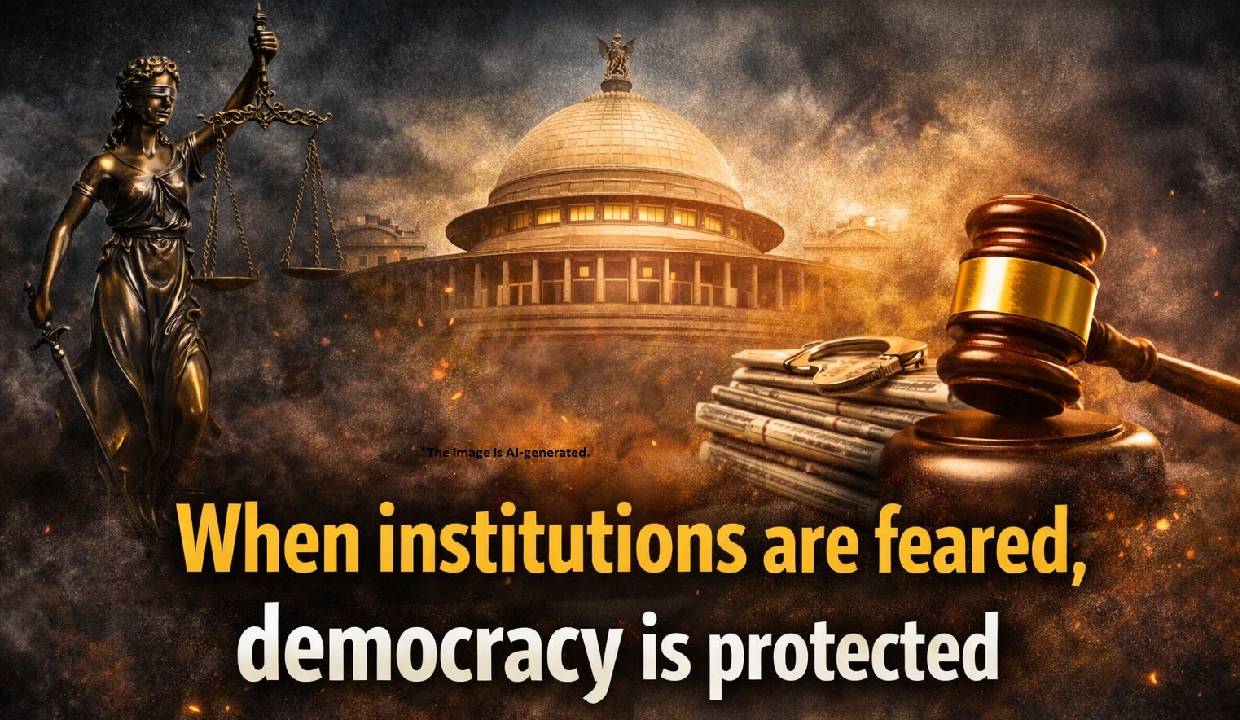
Institutional Fear Protects Democracy
Fear is a natural, universal and intense emotion rooted in human survival. The English philosopher and political theorist Thomas Hobbes opined that fear is the fundamental, organising passion of human existence, suffuses and shapes human life, is both the sole origin of civil society and the only reliable means of its preservation. The English social anthropologist David Parkin, the American historian and political theorist Corey Robin, the German sociologist Norbert Elias and the English social researcher Agnes Pearl Jephcott have also highlighted the role of fear in regulating and sustaining institutions and societies. Yet institutional scholars have often paid limited attention to the role of fear in maintaining institutional equilibrium and stability.
Parental authority, often accompanied by a sense of fear or respect, plays an important role in shaping the behaviour of toddlers. At an early stage of life, children lack the maturity to fully understand the consequences of their actions. Therefore, parental guidance, sometimes reinforced through caution or fear, becomes a mechanism to instil discipline, responsibility, and respect for boundaries. This psychological framework helps a child develop self-control and accountability, guiding him toward behaviour that serves both personal well-being and the broader interests of family and society.
In a similar manner, independent institutions in a democratic society perform a comparable function at the collective level. Institutions such as the judiciary, the legislature, the bureaucracy, and the media act as structural guardians that guide public conduct and governance. Their independence ensures that authority is exercised responsibly and that citizens, leaders, and administrators remain conscious of legal and ethical boundaries.
A functional democracy is sustained not merely by laws and elections but by the strength, credibility, and authority of its institutions. In a country with a vast landmass and an enormous population such as India, governance cannot rely solely on personal authority or individual charisma. Instead, it depends on the enduring power of institutions. One of the less discussed yet important elements of this system is institutional fear: the psychological respect and restraint that institutions inspire among individuals and public authorities.
Institutional fear does not merely imply authoritarian intimidation or suppression of liberty. Rather, it reflects the recognition that institutions are larger than individuals and that the authority of the system must prevail over personal interests. All the world’s a stage and politicians, bureaucrats, judges, and journalists are mere temporary players, while institutions remain permanent guardians of constitutional order.
In a democracy, such fear ensures discipline within governance structures. When individuals recognise that institutional norms and rules are supreme, they are less likely to misuse power. The absence of such restraint can lead to institutional erosion, where personal ambition begins to override constitutional responsibility. The democratic framework rests on four core pillars: parliament, the judiciary, the bureaucracy, and the media. Parliament represents the sovereign will of the people through legislation and debate. The judiciary, particularly the Supreme Court of India, functions as the guardian of the Constitution and ensures that constitutional principles are upheld. The bureaucracy provides administrative continuity and policy implementation, while the media acts as a watchdog by scrutinising Government actions and informing the public.
In this framework, institutional fear acts as a psychological safeguard of democratic order. Citizens respect laws because they believe institutions will enforce them, and public officials adhere to rules because institutional scrutiny and sanctions exist.
Recent developments illustrate the sensitivity surrounding institutional credibility. A controversy arose over a textbook prepared by the National Council of Educational Research and Training that referenced corruption in the judiciary in a Class 8 social science chapter. The Supreme Court of India expressed serious and alarming concern that such portrayals, if presented without a broader context, could undermine public confidence in an essential constitutional institution. The Court observed that the material appeared selective because it focused on alleged corruption in the judiciary while omitting discussion of corruption in other areas, such as politics or administration.
The episode highlights an important dimension of institutional fear: public discourse must balance accountability with respect for institutional integrity. Criticism of institutions is a legitimate feature of democracy, but selective, uncontextualised, pejorative and paroxysmal criticism can weaken public trust in institutional credibility. Institutional fear therefore, operates alongside institutional accountability. Excessive fear without accountability can lead to authoritarianism, while accountability without reciprocal respect for institutions is bound to create instability. The challenge lies in maintaining symmetry between these forces. India’s constitutional architecture was designed to maintain such a balance through the separation of powers. Parliament makes the laws, the judiciary interprets them, the executive implements them, and the media informs the public. Each institution checks and moderates the others, creating a system of mutual accountability.
In the Indian context, particularly as the world’s most populous nation, the role of strong and independent institutions is indispensable for effective and inclusive governance. Institutions such as the Election Commission of India preserve the integrity of democratic elections, while financial accountability is maintained by the Comptroller and Auditor General of India.
Merit-based recruitment to civil services is ensured by the Union Public Service Commission, and fiscal federalism is guided by the Finance Commission of India. Complementing these bodies are institutions like the Central Bureau of Investigation, the Lokpal of India, and the Prime Minister’s Office, which strengthen oversight and coordination in governance.
Ultimately, the survival of democracy depends not merely on constitutional provisions but on the collective belief that institutions matter far more than individuals. Leaders may wax and wane, Governments may change, and political narratives may shift, but it is imperative that institutions must remain stable. When citizens internalise the principle that institutions are greater than individuals, democracy acquires strength and resilience. In this sense, institutional fear is not a threat to democracy but one of its essential safeguards. The well-known American novelist and short story writer Veronica Roth aptly penned, “Fear doesn’t shut you down; it wakes you up.”
Writer is a public policy expert and columnist; *The image is AI-generated.