Urban life seen through living forms
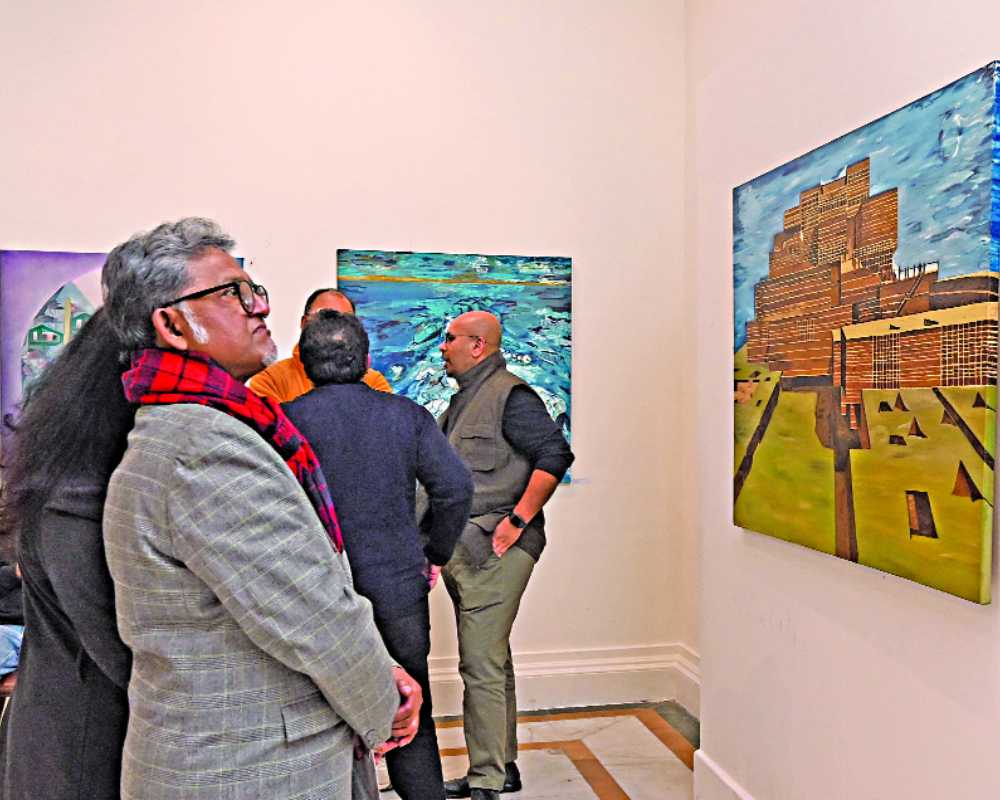
A quiet seriousness defines this exhibition, where painting and sculpture are used to reflect on urban life, nature and human experience. The works engage with space, memory and movement through carefully shaped forms and thoughtful visual decisions. Ashoka Sarkar’s paintings focus on interiors, architecture and the passage of time. Her compositions bring together furniture, textiles and built structures, allowing surfaces to reveal age and use.
Light falls gently across wood and fabric, giving depth to everyday objects. In her cityscapes, architectural forms stand with clarity, shaped by lines, angles and subtle tonal shifts. The city appears as a place of layered experience, where stillness and activity coexist within the same visual frame. Her colour choices strengthen this sense of balance between inner spaces and the external world.
Rekha Jaggi’s work examines urbanisation and its effect on both landscape and mind. Her paintings explore the space between what remains visible and what slowly disappears in expanding cities. A restrained range of greys, interrupted by quiet colour accents, shapes images of glaciers, lakes, bridges, stairs and urban structures. Straight lines and sharp angles suggest mental focus, while recurring natural forms connect the work to memory, spirituality and a larger cosmic order. The paintings convey a sustained search for meaning within changing surroundings.
Shashi Kumar Paul’s sculptures draw deeply from childhood and the human connection with nature. His figures depict children at play — running, flying kites, listening — captured through fluid lines and balanced forms. Crafted in fibre and bronze, the sculptures convey movement with ease and lightness. Childhood appears as a state of freedom and imagination, contrasted with the confined spaces of contemporary life. Through these forms, Paul reflects on loss, care for the environment and the need to preserve open spaces.
Together, Art in Motion draws three distinct practices into a cohesive critical framework, where material choices and formal decisions shape readings of contemporary experience. On view at Bikaner House until Monday, the exhibition sustains a thoughtful engagement with urban change, memory and human presence.