UK leaders urge calm after Belfast stabbing sparks protests
UK leaders called for calm on Tuesday after the arrest of a Sudanese man accused of trying to kill a man in a vicious stabbing on a Belfast street sparked fiery anti-immigration protests because the suspect is an asylum-seeker. The victim, a man in his 40s, was taken to the hospital with serious injuries to his eyes, face and back after he was attacked late Monday in north Belfast in Northern Ireland, police said.
The suspect, 30, who was not named, was held in custody and charged with attempted murder, possession of a knife in a public place and making threats to kill. A kitchen knife was found at the scene.
Police were trying to determine the motive, but there was no information to suggest the attack caught on video was terrorism-related, said Ryan Henderson, assistant chief constable of the Police Service of Northern Ireland. He added that police were not seeking other suspects. “This brutal attack will have sent shock waves through the community, causing real concern,” he said.
Northern Ireland’s leaders and chief constable urged people not to incite hate and fear or target particular communities after reports that protests were planned.
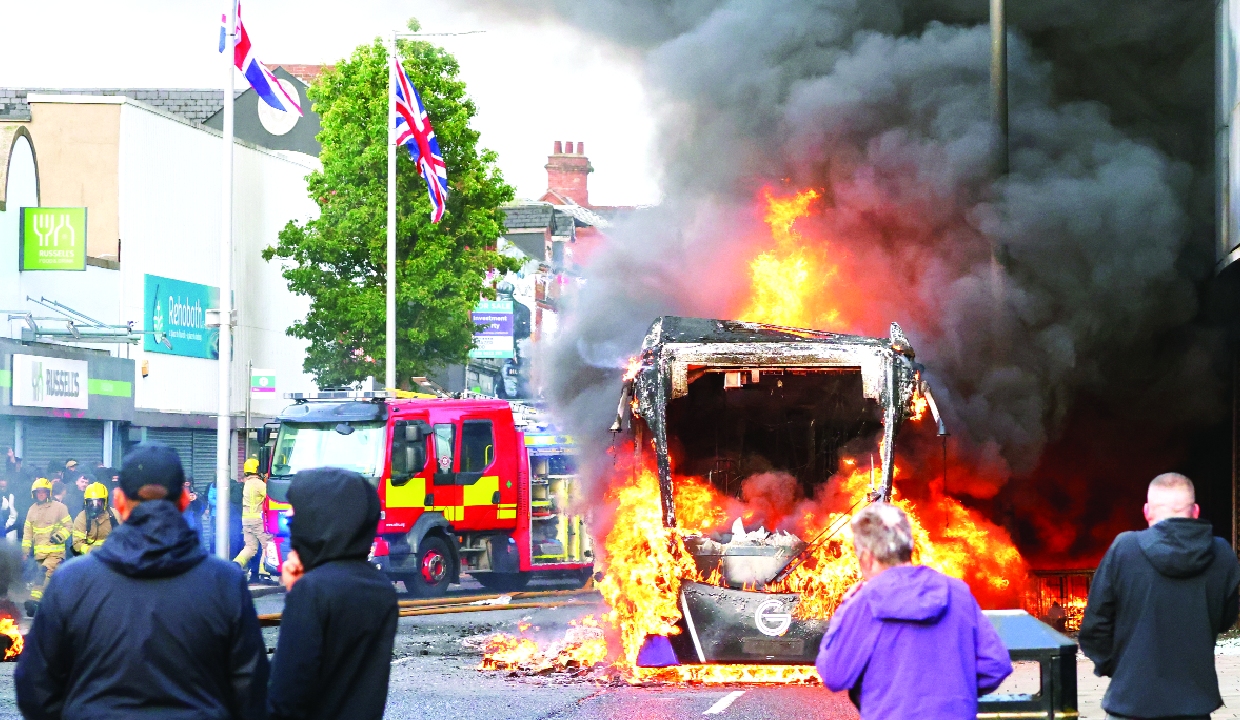
Protesters in black hoodies, some wearing masks, torched a bus in east Belfast, and cars and trash bins were set ablaze as groups gathered in other parts of the city.
At the other end of the UK, demonstrators marched in Southampton, England, where the recent sentencing of a man who killed a university student with a knife led to violent clashes with police last week.
Although the victim and convicted killer were both British, protesters stood outside a Southampton hotel that had housed asylum seekers, holding signs that said “Illegal Migration Is Destroying Our Civilisation”.
The Belfast attack sparked immediate questions about the suspect’s immigration status, including from some politicians.
Gavin Robinson, the leader of the Democratic Unionist Party, urged authorities to curb “uncontrolled immigration”. Northern Ireland’s chief constable Jon Boutcher told reporters that the suspect was living in the UK under a five-year visa granted in September 2023. Boutcher said he was believed to have travelled from Sudan to Paris and Dublin before claiming asylum in Belfast.
The suspect was not known to Northern Ireland police, he added.
When pressed on the question in Parliament, Northern Ireland Secretary Hilary Benn said he could not confirm whether the alleged attacker came to the UK illegally.
Starmer condemned the attack as “sickening” and said that he had “no tolerance for abhorrent scenes of violence like this on our streets”.
His office said “it is time for calm”, adding “it’s important that police have the time and space to investigate appropriately”.
Police and senior politicians urged people not to share the graphic images of the attack that were circulating online, or to spread disinformation about the situation.
Last week a separate case of a university student who was stabbed to death in Southampton, England in December was seized on by activists and US Vice President JD Vance, who blamed immigration for the violence.
Henry Nowak, who was white, was killed by Vickrum Digwa, a Sikh who falsely claimed to police that he was the victim of a racist assault by Nowak. When police officers arrived, they initially treated the wounded Nowak as a suspect before noticing his injury and trying to resuscitate him.
Digwa was convicted of murder for stabbing Nowak with a Sikh dagger and sentenced last week to life in prison with a minimum 21-year term. But the case has spurred heated debates about policing and race, and a protest over Nowak’s death turned violent with some attacking police with chairs and rocks. Several people were charged with violent disorder over the protest.
Suspect faces court after anti-immigrant protests in Northern Ireland
Belfast (UK): A 30-year-old man from Sudan appeared in a Belfast court Wednesday, charged with attempted murder over a stabbing attack that left a man seriously injured and triggered anti-immigrant violence in several parts of Northern Ireland.
Hadi Alodid (30), was ordered held in jail after an appearance by video in Belfast Magistrates’ Court, where a detective said he blinded Stephen Ogilvie in the left eye during the knife attack. He was also charged with possessing a knife and threatening to kill a radiographer while being treated for a hand injury after the assault.
When police arrived at the crime scene, they found Alodid on the man, armed with a kitchen knife, the detective said. Alodid later told hospital staff: “I’ve killed someone, I don’t know if they are dead,” and said, “I will kill you.” He refused legal representation through an Arabic interpreter and did not enter a plea. The court appearance followed a night of violence in which masked men set fire to several homes they believed to house immigrants, burned trash bins, torched a Belfast bus and pelted police with objects. Firefighters rescued several people from burning homes.
Anselme Shima, a Belfast resident originally from Congo, said he saw smoke from burning vehicles near his home.
“I’ve lived on my street for almost 10 years, I have a good relationship with my neighbours, but last night was a horrific one,” he said. “We don’t know what to do. I’m scared. Seeing this, I’m wondering if I’m next.”
Families, one with a baby, were rescued and taken to police stations for safety, Chief Constable Jon Boutcher told the BBC.
“These weren’t just families from ethnic minority communities, these were families from across communities that were caught up in this vile behaviour last night,” Boutcher said. “There is absolutely no excuse for it.”
Politicians from both parts of Northern Ireland’s power-sharing government condemned the violence. First Minister Michelle O’Neill of Irish nationalist party Sinn Fein said it was “thuggery.”
“Groups of masked men burning families out of their homes is nothing less than disgusting cowardice,” she said.
Deputy First Minister Emma Little-Pengelly, of the pro-British Democratic Unionist Party, said that “taking frustration at the evil actions of a person out on those who had no part in it is utterly wrong.”
The attack was caught on video
====================
Monday’s attack, caught in video footage that quickly spread on social media, was seized on by anti-immigration activists. Ogilvie, a man in his 40s, was hospitalised with deep cuts to his head, face and back.
Police said Alodid entered Northern Ireland from the neighbouring Republic of Ireland in 2023, applied for asylum and was given a 5-year permit to remain.
The Police Service of Northern Ireland said there is no information to suggest the attack was terrorism-related and they were not seeking other suspects.
The street violence erupted despite politicians’ calls for calm.
Prime Minister Keir Starmer condemned the stabbing attack as “sickening,” but said violence against people based on their background would not be tolerated.
“The scenes in Belfast last night were shocking and completely unacceptable,” Starmer said on X. “There is no justification for the violence and disorder that we saw threatening our communities, nor for those who encouraged it, online or elsewhere. It is clear that people were targeted last night because of their background and I will not tolerate it.”
Protests were encouraged online by far-right activists.
Northern Ireland Justice Minister Naomi Long said social media agitators who “yesterday would have struggled to find Belfast on a map” were “weaponising” the fears of local people.
“If you’re driving people from their homes based on nothing but the colour of their skin, you can’t dress that up any other way, it’s racism, and those bad faith actors need to take a step back,” she told the BBC.
Some raise questions about the Irish border
==============================
Some politicians said the stabbing should spark a review of the open border between Northern Ireland, which is part of the UK, and the Republic of Ireland.
The border is a highly sensitive issue. Allowing the free flow of people is a major pillar of the peace process that largely ended decades of violence known as “The Troubles.” The conflict involving Irish Republican and British Loyalist militants and UK security forces left almost 3,600 people dead before a 1998 peace accord.
Much of Tuesday’s violence took place in working-class areas where former paramilitary groups still hold considerable sway over the streets.
Last week, a separate case of a university student who was stabbed to death in Southampton, England, in December was seized on by activists and US Vice President J D Vance, who blamed immigration for the violence. Some British politicians objected to that.
Henry Nowak, who was white, was killed by Vickrum Digwa, a Sikh who falsely claimed to police that he was the victim of a racist assault by Nowak. When police officers arrived, they initially treated the wounded Nowak as a suspect before noticing his injury and trying to resuscitate him.
Digwa was convicted of murder for stabbing Nowak with a Sikh dagger and sentenced last week to life in prison with a minimum 21-year term. The case has spurred heated debates about policing and race, and a protest over Nowak’s death turned violent, with some attacking police with chairs and rocks. Several people were charged with violent disorder.