Tracing impact of CJI Gavai on Indian jurisprudence
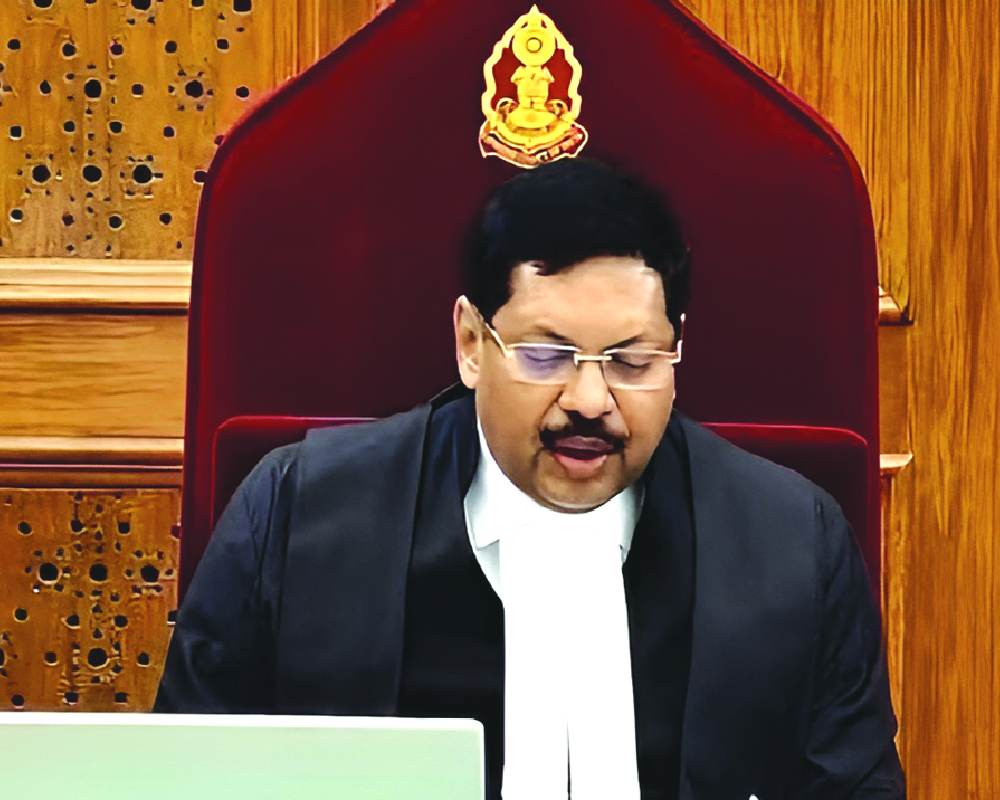
Justice Bhushan Ramkrishna Gavai’s tenure in the Supreme Court and his eventual elevation as the Chief Justice of India (CJI) have been marked by a series of significant rulings across various areas of law, placing him as a key figure in Indian jurisprudence.
His short tenure as CJI, from May 14, 2025, to November 23, 2025, was not free from controversy. Issues arose over his “Ask the Deity” remarks in court, for which he allegedly faced an attempted attack by a lawyer. His tenure also saw administrative decisions by the Collegium, headed by him, particularly its agreement with the Union Government’s objection to a proposed transfer of a High Court judge.
Before these events, the Supreme Court Collegium courted another controversy by recommending the elevation of a judge to the Supreme Court from a particular High Court despite a dissent from a member of the Collegium who had argued that such elevation would make him the third judge from the particular High Court, which some argued led to overrepresentation for that High Court compared to its sanctioned strength, while other large High Courts remained underrepresented.
Since Justice Gavai’s tenure of approximately six months as the head of the judiciary is nearing, his focus is likely on disposing of major pending matters, particularly those heard by Constitution Benches where he has presided.
The significant judgments likely to be delivered before his retirement as the 52ND CJI are primarily in the realm of Constitutional Law and most important is the Presidential Reference on Governor’s Powers.
A Constitution Bench headed by Justice Gavai has heard arguments on a Presidential Reference seeking clarity on whether fixed timelines can be imposed on Governors and the President for assenting to or otherwise dealing with bills passed by state legislatures. The judgment will have significant ramifications for the balance of power between the Union and States, particularly concerning a Governor’s discretion in legislative matters.
Justice Gavai, who is the first Chief Justice of India from the Buddhist community; second judge from the Scheduled Castes to hold the office, spoke about the policy refinement of affirmative action and in his concurring opinion in the matter concerning the sub-classification of Scheduled Castes (SC) for reservation, he argued that to achieve true equality as enshrined under Article 14, the State must identify and exclude the ‘creamy layer’ from the benefits of reservation within the SC/ST communities to ensure substantive equality, advocating for a nuanced approach to reservations.
Justice Gavai was also in the limelight for his landmark 2024 judgment regarding “Bulldozer Justice,” where he condemned the practice of demolishing the houses of accused persons without due process. He affirmed that the Executive cannot become the judge and executioner, as such actions violate the constitutional principle of separation of powers, the right to shelter (Article 21) and inflict unconstitutional “collective punishment” on innocent family members.
Co-authoring the significant decision, Justice Gavai wrote,” The chilling sight of a bulldozer demolishing a building, when authorities have failed to follow the basic principles of natural justice and due process, reminds one of a lawless state of affairs, where ‘might was right’.”
The judgment delivered on November 13, 2024, laid down pan-India guidelines to prevent the arbitrary demolition of properties, especially those belonging to accused persons, without following the proper legal procedure.
In recent times, Justice Gavai, as the CJI, pronounced an important interim judgment in the challenge to the contentious Waqf (Amendment) Act, 2025, on September 15, 2025. The Bench headed by him refused to stay the law in its entirety but put on hold the implementation of several “prima facie arbitrary” provisions till the final adjudication.
The general consensus is that the judgment in the Waqf matter was a balanced judicial intervention that upheld the principle of presumption of constitutionality for a legislative Act while simultaneously protecting fundamental rights of the citizens.
In the last six years, according to the Supreme Court Website, Justice Gavai was a part of around 700 Benches dealing with matters pertaining to a variety of subjects, including constitutional and administrative law, civil law, criminal law, commercial disputes, arbitration law, electricity law, education matters, environmental law, etc.
He has authored around 300 judgments, including Constitution Bench Judgements on various issues, upholding the rule of law and safeguarding the fundamental rights, human rights and legal rights of citizens.
Some of the other important Constitution Bench matters and politically sensitive cases, in which Justice Gavai was involved were — Abrogation of Article 370 in the erstwhile state of Jammu and Kashmir, Challenge to the Electoral Bond Scheme, Demonetisation Verdict, staying the conviction of Congress leader Rahul Gandhi in a criminal defamation case, granting bail to controversial rights activist TeestaSetalvad in a criminal case, imposing a token fine of `1 (one) on activist advocate PrashantBhushan for his tweets criticising the judiciary, etc.
In the abrogation of Article 370 matter, the judge was part of the five-judge Constitution Bench that unanimously affirmed the constitutional validity of the Presidential orders and subsequent legislative changes.
He was on the Constitution Bench that unanimously struck down the Electoral Bonds Scheme, holding it violative of citizens’ fundamental right to information under Article 19(1)(a) and compromising transparency in political funding. In the Demonetisation Verdict of 2023, he authored the majority opinion upholding the Centre’s 2016 demonetisation scheme.
Justice Gavai was part of the bench that stayed the conviction of Congress leader Rahul Gandhi in a criminal defamation case, noting that the trial judge had failed to provide cogent reasons for awarding the maximum two-year sentence, which had resulted in Gandhi’s disqualification from Parliament.
The Chief Judicial Magistrate Court (CJM) at Surat, Gujarat, on March 23, 2023, found Rahul Gandhi guilty of criminal defamation under Sections 499 and 500 of the Indian Penal Code for his “Modi surname” remark made during an election rally in 2019. The Gujarat High Court, by its July 7, 2023 judgment, refused to stay the conviction and jail term. The matter was then challenged in the Supreme Court, where the three-judge bench, including Justice Gavai, ultimately stayed the conviction on August 4, 2023, which paved the way for the reinstatement of his status as a Member of Parliament. The Supreme Court’s decision in July 2023 to grant bail to Setalvad in the case of allegedly fabricating evidence, forging documents, and tutoring witnesses to falsely implicate high-ranking officials of the Gujarat Government in the 2002 post-Godhra riots cases, by setting aside the Gujarat High Court’s order, was a significant one. The bench, led by Justice Gavai, delivered a sharp critique of the lower court’s reasoning and also found the Gujarat High Court’s order to be “totally perverse” and “contradictory.”
The Prashant Bhushan Contempt Case of 2020 was a significant legal event in which the Supreme Court initiated suomotu (on its own motion) criminal contempt proceedings against the activist advocate for two tweets criticising the judiciary.
Justice Gavai was the author of the August 14, 2020 judgment for the three-judge Bench that held Bhushan guilty of criminal contempt and imposed a token fine of `one, holding that the tweets constituted criminal contempt under the Contempt of Courts Act, 1971, on the grounds of “scandalising the court” and lowering the authority of the institution.
Now, after five years, another lawyer may face the contempt of court for allegedly throwing a shoe at Justice Gavai, who was presiding as the CJI. The not-so-popular lawyer allegedly had expressed his anguish on October 6, 2025, for Justice Gavai’s September 16, 2025, remark when he told the petitioner to “Go and ask the deity himself to do something now. If you say that you are a strong devotee of Lord Vishnu, then pray and meditate.”
Attorney General R Venkataramani has granted his approval for initiating a Contempt of Court proceeding against the errant lawyer. The Supreme Court Bar Association, which has terminated the membership of the lawyer, has supported the move, but a bench headed by Justice Surya Kant, who is to succeed Justice Gavai as the CJI, has shown some reluctance in the matter. This remark in a case concerning the restoration of a damaged idol of Lord Vishnu at a temple had triggered a massive backlash on social media, with critics accusing Justice Gavai of mocking Hindu faith and disrespecting religious sentiments. The CJI later issued a clarification in open court, stating that his comments were misinterpreted and affirming his respect for all religions and commitment to true secularism. The incident of shoe hurling, following the “Ask the Deity” controversy, was widely condemned. The CJI had shown considerable composure and directed the proceedings to continue, stating,” Do not pay attention to such things. Please carry on. If we are not perturbed, why are you? Just ignore.
Justice Gavai’s tenure as the head of the Collegium was also not free from controversy. First, questions were raised over the elevation of Gujarat High Court judge Justice Vipul Pancholi to the Supreme Court and second was the decision to agree to the Union Government’s objection to a proposed transfer of a High Court judge, Justice Atul Sreedharan, changing his transfer destination from one High Court to another.
Justice Gavai, who was elevated as a Judge of the Supreme Court on 24th May 2019, has made several notable statements, emphasising judicial ethics, access to justice and the foundational role of the Constitution, since he took over as the CJI on May 14, 2025. He publicly pledged that he would not accept any post-retirement jobs with the Government, asserting that retired judges taking such positions raises “significant ethical concerns and invites public scrutiny” and in a roundtable conference in London, he acknowledged that instances of corruption and misconduct within the judiciary damage public confidence while stressing that a swift, transparent response to such incidents is necessary to regain trust.
On the Indian Constitution and democracy, Justice Gavai, while speaking in London at an event commemorating 75 years of the Constitution, described it as a “living document” that has guided India through challenges. He stated that certain principles of the Constitution, such as the rule of law, democracy and separation of powers, are inviolable and cannot be altered.
The CJI reaffirmed Dr BR Ambedkar’s vision for an inclusive and just India, highlighting the judiciary’s role in expanding rights under Article 21 to include education, health and a clean environment. He stressed that for democracy to succeed, political liberty must be accompanied by social and economic justice. While inaugurating new facilities at the Allahabad High Court, Justice Gavai emphasised the “fundamental duty” of the judiciary and the executive to ensure justice reaches the “last citizen of this country who needs justice”.