The NCERT-judiciary tussle: Can the rule of law be taught without discussing judicial corruption?
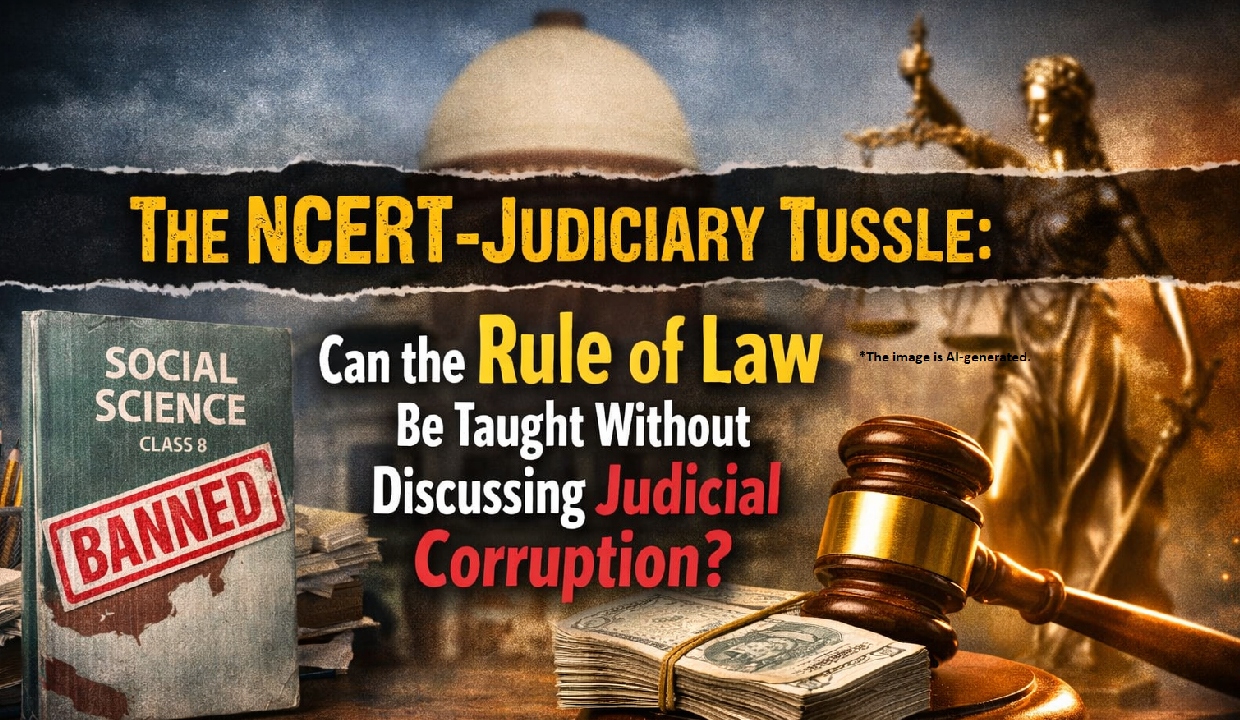
The NCERT (National Council of Educational Research and Training) has officially withdrawn its new Class 8 Social Science textbook, Exploring Society: India and Beyond (Part II), which included a section on “Corruption in the Judiciary.” This followed a blanket ban by the Supreme Court, which took suo motu cognisance of Chapter 4, titled “The Role of Judiciary in Our Society.” According to media reports, the Supreme Court orally made some scathing observations during the hearings and described the content as a “calculated move” to scandalise the institution and “pollute young minds,” noting that such portrayals could undermine the public’s faith in the rule of law.
In addition to the withdrawal, the Top Court barred the authors from all future curriculum projects, stating the text maliciously targets the institution’s reputation. It further directed the Centre, States, and Universities to “dissociate” from the three specific authors for all future publicly funded projects. The Bench, led by Chief Justice Surya Kant, cited a “lack of informed knowledge” and “deliberate misrepresentation” of the judiciary, emphasising that educational materials must maintain institutional respect while discussing systemic challenges.
The controversy came to the fore in late February 2026, following a report in the media that highlighted the inclusion of a section on judicial corruption in the new NCERT Class 8 Social Science textbook. Two prominent Senior advocates immediately brought the matter to the Supreme Court’s attention, stating the Bar was “deeply disturbed” by the selective targeting of the institution.
The Chief Justice of India (CJI), noting that High Court judges across the country had expressed their outrage to him, took suomotu cognisance of the matter, describing the text as a “calculated move” to demean the judiciary. In the ensuing hearings, the Supreme Court imposed a blanket ban on the book and ordered its immediate recall from physical and digital platforms.
The Supreme Court criticised the NCERT for a “major and unpardonable lapse,” specifically pointing out that the chapter had not been vetted by the National Syllabus and Teaching Learning Material Committee (NSTC). It also ordered a new committee, including an eminent jurist, to rewrite the curriculum to ensure a more balanced and respectful portrayal of constitutional institutions.
The developments on this issue have generated a heated debate among the legal fraternity, intellectuals, and the general public. While many in the legal community supported the Court’s stance on protecting institutional dignity, a section of activist lawyers and academicians expressed shock over the “extreme” nature of the ban and the blacklisting of scholars, raising concerns about academic freedom and judicial censorship. The public reaction also remains divided; while some see the move as a necessary check against misinformation, others argue that students should be introduced to the real-world challenges-such as backlogs and lack of transparency-those public institutions face. There has also been significant criticism by some, including former NCERT chiefs and educationists, who argue that the Council failed to defend its own publication. Critics suggest that both the NCERT leadership and the Union Education Ministry surrendered meekly to the controversy, choosing immediate capitulation and apologies over a robust defence of academic freedom and the inclusion of real-world systemic challenges in the curriculum.
While the Supreme Court has passed several major “interim” directions that have effectively ended the book’s life, the suomotu case (In Re: Social Science Textbook For Grade-8) remains on the docket for monitoring and final resolution. The matter remains open because the Supreme Court specifically stated that the three blacklisted authors “may approach the Supreme Court seeking modification of the order” after submitting their formal explanations. The Supreme Court also directed the Centre to provide details of social media handles and websites that reacted “irresponsibly” or “maliciously” to the ban. It has indicated it will take further action against these “mischief-mongers” in the upcoming hearings. Until the Supreme Court passes a final order, the legal proceedings are technically active.
However, the entire episode has re-intensified a fiery debate over the alleged prevalence of corruption in the judiciary. This is particularly significant given the March 2025 incident at Justice Yashwant Varma’s residence, where wads of burnt currency were reportedly discovered following a fire. Critics of the ban argue that such real-world events make the discussion of judicial accountability in textbooks a matter of public interest rather than “malicious targeting.”
Justice Varma has since been transferred from the Delhi High Court to his parent court, the Allahabad High Court, where the Supreme Court has directed that he not be assigned any judicial work while proceedings continue. He is currently facing a formal impeachment-related inquiry after the Speaker of the Lok Sabha admitted a motion for his removal in August 2025. Although no impeachment motion in India’s history has yet resulted in the actual removal of a judge-often due to resignations or political abstentions-the issue of corruption in the higher judiciary has consistently hogged the limelight at regular intervals. This persistent cycle of scandal and stalled accountability remains the core of the debate over whether such challenges should be addressed openly in national textbooks.
The current friction between the NCERT and the Supreme Court reminds us of an alleged judicial corruption matter that had shocked the highest judiciary in 2009. A high-profile contempt case was initiated against activist-lawyer Prashant Bhushan following an interview where he alleged that half of the previous 16 CJIs were corrupt. The controversy deepened in 2010 when his father, former Law Minister Shanti Bhushan, filed a daring affidavit in the Supreme Court. He submitted a list of the 16 CJIs in a sealed cover. This earlier case serves as a vital backdrop to the 2026 textbook row.
While the Bhushans argued that “truth is a valid defence” and that the judiciary should not use contempt powers to suppress discussions on its own integrity, the Supreme Court remained protective of its public image. After languishing for over a decade, the case was finally closed in August 2022 by a bench that ironically included Justice Surya Kant (who now leads the 2026 NCERT proceedings).
The 2022 closure was based on Bhushan’s explanation that he used the word “corruption” in a broad sense to mean a “lack of propriety” rather than just financial bribery. A similar defence was originally offered by the NCERT.
The connection between these two eras is clear: the Supreme Court’s recent “suomotu” action against the Class 8 textbook reflects a long-standing institutional sensitivity toward allegations that target the Chief Justice’s office. Critics of the 2026 ban point out that while the Court closed the Bhushan case with a degree of leniency in 2022, its reaction to the NCERT in 2026 has been significantly more punitive.
By blacklisting the authors and ordering a total recall of the books, the Court has signaled that while it may tolerate criticism from seasoned lawyers in a courtroom, it draws a strict “red line” at allowing similar discourse to reach the “impressionable minds” of the nation’s school children. Here, it would be relevant to read the August 30, 2022, final order in the Bhushan case. It reads: “The alleged acts of contempt that gave rise to this Contempt Petition are stated to have been committed on or about 5th September, 2009. The proceedings have been pending for 13 years.”
“In view of the explanation/apology tendered by the respondents, we do not deem it necessary to proceed with the contempt. Magnanimity and restraint are also facets of the majesty of this Court.” “The contempt proceedings are accordingly dropped,” the Supreme Court had said in the order.
Now coming back to the tussle between the Supreme Court and the NCERT, it is amply clear that though the Supreme Court has played a proactive role to protect the image of the judiciary from being tarnished, it has simultaneously ignited a fundamental debate over the boundaries of academic freedom and the transparency of public institutions. Besides, murmur of corruption and judicial misconduct against the judges at different levels of the judiciary has also been gaining currency.
By effectively scrubbing the mention of judicial corruption from the Class 8 curriculum, the Supreme Court has succeeded in safeguarding its immediate reputation. However, it has also left a vacuum in the discourse on constitutional accountability.
As the newly mandated committee begins the task of rewriting the chapter, the challenge remains: how to educate students on the “Rule of Law” without ignoring the very real systemic challenges that continue to test the integrity of the Indian judicial system.
Writer is a senior journalist covering legal affairs; Views presented are personal.