The black day of Partition: Tilak Raj Madan’s story of pain, faith, survival
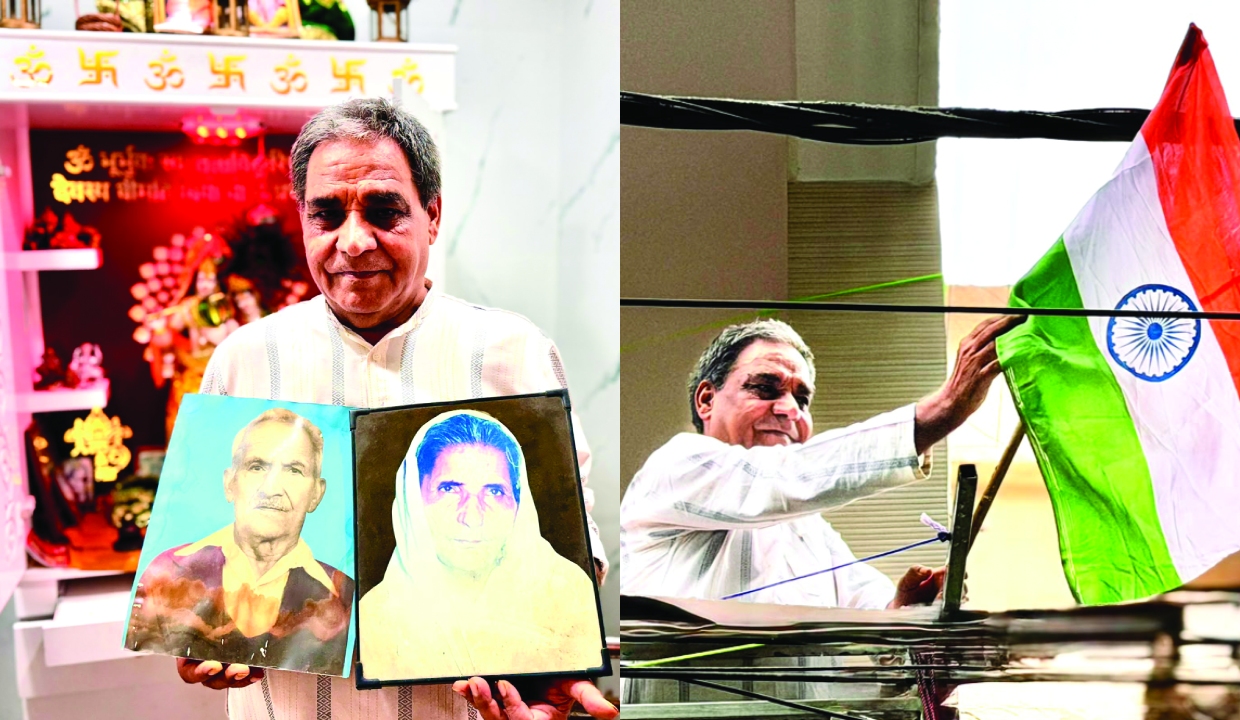
For Tilak Raj Madan, the story of Partition is not something he learned from history books. It is a story he heard from his father, Laxmi Chand, in the form of loriyan — the bedtime stories and memories that were passed down to him when he was young.
Those stories began in a refugee tent near Kalkaji Mandir in South Delhi, where the family had arrived after losing almost everything in the Partition of 1947.
What may have sounded like a story before sleep was, in reality, the painful truth of a family uprooted from its home, separated from loved ones and forced to begin life again from nothing.
Today, as India prepares to celebrate Independence Day, the national flag will rise high, patriotic songs will fill the streets and millions will remember the sacrifices behind India’s freedom. But for Tilak Raj Madan, August 14 carries another memory too.
It reminds him of 1947 — the year of freedom, but also the year of Partition, a time that brought unimaginable suffering to millions of families.
A Home Left Behind
The Madan family originally belonged to Shorkot, Khanewal, in the Jhang-Migyana district, now in Pakistan. Before Partition, theirs was a settled and respectable life.
Tilak Raj’s father, Laxmi Chand, was engaged in the cotton business and also ran a popular sweet shop. The family had a home, livelihoods, relatives and, above all, the quiet security of knowing where they belonged.
Then came 1947. The announcement of Partition transformed that certainty into fear and displacement. Almost overnight, a place that had been home for generations became a place from which the family was forced to flee.
Laxmi Chand left with his three brothers and three sisters, along with his wife, Krishnawanti. There was no time to gather everything they owned or to make plans for a new life. They had to leave behind their home, businesses, possessions, memories and the community that had shaped their lives.
Their journey to India was one of uncertainty and hardship. They travelled partly by bullock cart, partly on foot, and eventually by train, carrying with them only what they could manage. Behind them was everything they had known; ahead lay a country that was new to them and a future they could not yet imagine.
They did not leave because they wanted to start afresh. They left because they had no choice. “We had everything in our village,” Tilak Raj remembers with emotion his father told him the story of partition. “We had a popular cotton business and a sweet shop. We were a happy family. Suddenly, we lost everything.” The words are simple, but behind them lies a lifetime of grief.
The Pain of Separation
Among the deepest wounds carried by the family was the separation from one of their sisters, who remained behind in Pakistan during the migration. For those who crossed the border, the journey to India meant leaving behind not only property but people. Some separations lasted years. Some lasted forever.
For the Madan family, the loss of their sister became a permanent wound — a reminder that Partition did not merely divide a country on a map. It divided families, friendships, memories and lives. When everything else had to be left behind, a few photographs became priceless. They were a connection to the home that no longer existed in their lives.
From Everything to Nothing
Reaching India did not mean the suffering was over. The family arrived in Delhi as refugees and spent their early years around the Kalkaji Mandir area, living in a refugee camp. Seven members of the family, including their mother and three sisters, endured difficult conditions. They lived in tents and struggled for food and the basic necessities of life.
The family worked for “do waqt ki roti – two meals a day.”
The comfortable life they had known in Pakistan had disappeared. They had to begin again, almost from zero.
For a family that had once owned a home and businesses, life in a tent was a painful fall into uncertainty.
But it was also where their resilience began to show.
Rebuilding a Life in Delhi The Madan family refused to surrender to their circumstances. As Tilak Raj grew older, around the age of 15, the family slowly began rebuilding its livelihood. Eventually, they entered the catering and sweets business in the Nehru Place area to carry the legacy of his father.
There were no shortcuts. There was only hard work.
Day after day, year after year, the family rebuilt what Partition had taken away. Their story is therefore not only about loss. It is also about the extraordinary human ability to start again after everything has been destroyed. From a refugee tent to a settled life in Delhi, the journey took courage, patience and faith.
A Life Built From the Ashes Today, Tilak Raj Madan lives in South Delhi’s Kalkaji area with his daughter, two granddaughters and son-in-law. When he looks at his family, he sees something that his father could perhaps only dream of in those difficult days of 1947 — a secure home, a family together and a future.
Yet the past has never disappeared. When Tilak Raj speaks about Partition, his voice carries the sadness of someone who inherited memories of a homeland he never truly got to know.
He remembers the home his family lost.
He remembers the business that was abandoned.
He remembers the sister who was separated from the family. And he remembers the stories his father told him.
There are tears in those memories, but there is also pride.
Faith That Carried the Family
For Tilak Raj, faith has always been an important part of his family’s survival.
He expresses deep gratitude towards Mata Rani lord Maa Durga, whom he believes gave his family the strength to survive its darkest days. With folded hands, he remembers those years not only with sorrow but with gratitude for having survived them. From the pain of Partition to the pride of rebuilding a life in India, the Madan family’s journey is a powerful reminder that even after history breaks a family apart, courage, faith and hope can help rebuild what remains. And perhaps that is the most important lesson Tilak Raj carries from the stories his father once told him before sleep.
Never forget what was lost.
Never forget those who suffered.
And never take the freedom and life we have today for granted.