
When AI takes over the daily UPI payments
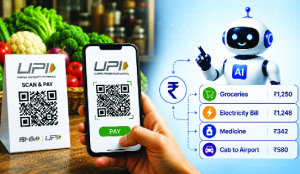
India’s UPI revolution may take another leap as AI agents handle small payments for us
For millions of Indians, paying for something has become almost an unconscious act. Buying vegetables from the neighbourhood vendor, we scan the QR code. Paying the kirana store, we scan the QR code. Taking an auto or an Uber, we pay through UPI. Visiting the chemist, restaurant or even the doctor, we reach for our phone rather than our wallet.
In less than a decade, UPI has transformed the way India pays. According to NPCI data, UPI processed a record 24.51 billion transactions worth Rs 29.82 trillion in August 2026, nearly 800 million transactions every day or 9150 transactions every second.
India has not merely embraced digital payments; it has emerged as a global pioneer in instant retail payments. UPI has made paying small amounts of Rs 50, Rs 200 or Rs 500 effortless. It is now very difficult to find smaller denomination currency notes in the market or even with bank tellers.
And now something even more significant is on the horizon.
Payments by AI Agents
A Reuters report last week said India is preparing a framework that could allow AI agents to make small UPI payments without requiring users to approve individual transactions. The initial focus is expected to be on low-value, routine purchases, with users setting rules and spending limits in advance.
This may sound like a small technological refinement. It isn’t.
UPI changed the way Indians make payments. Agentic AI could change the way Indians decide to make them.
Today, if you want to buy groceries, you open Google Pay, PhonePe or another UPI app on your mobile phone, scan the merchant’s QR code and approve the payment. Tomorrow, you might simply tell your AI agent: “Keep my weekly grocery spending below Rs 2,000 and ensure the usual household items are replenished.”
The AI could potentially identify what is needed, compare available options, place the order and make the UPI payments, all within the conditions you specified.
The same principle could apply to dozens of mundane transactions with commands like “Pay my electricity bill when it becomes due” or “Book my Uber to the airport if the fare is below Rs 600”.
How much discretion can we give AI Agents
For the consumer, the important change is not that the payment becomes faster. Rather, that the consumer no longer needs to initiate every transaction.
This could be particularly useful for small, repetitive and predictable payments. Instead of remembering bills, monitoring prices or repeatedly approving routine purchases, we could delegate these tasks to an AI agent. Elderly consumers, busy professionals and small business owners could benefit from having routine purchases handled automatically. This also changes the role of the consumer from authorising each transaction to setting the rules under which an AI agent (or a machine) can transact for us securely.
There is, however, a new question: how much financial discretion are we prepared to give the machine?
Suppose the AI orders a product that is cheaper but not the one we normally buy. Suppose it interprets “usual groceries” differently from us. Suppose an online platform manages to influence the agent into choosing a more expensive product. Or suppose the AI makes a perfectly logical decision that we simply would not have made.
And what happens if the transaction is fraudulent or the agent makes a mistake?
These are not merely technical questions. They are questions of trust, accountability and consumer protection.
Safeguards for AI Agents
The proposed framework is reportedly expected to incorporate safeguards such as spending limits, identity checks, audit trails and rule-based payments and also expected to address liability,
The objective should not be to create an AI with unrestricted access to our bank accounts. It should be to create an AI that operates within clearly defined boundaries: what it can buy, how much it can spend, when it can spend and when it must ask its (human) master.
India is particularly well placed for this next stage because the digital payment infrastructure is already in place. UPI has accustomed hundreds of millions of Indians to trusting a QR code with their money. The next step is considerably more ambitious: trusting an algorithm to decide when and how that money should be spent.
That is the real significance of agentic payments.
The future of digital payments may not be about making it easier for us to tap “Pay”. It may be about making it possible for us to say, “You take care of it.”
The challenge will be ensuring that when the machine acts on our behalf, it never forgets whose money, and whose trust, it has been given.
The author is an alumnus of IIM Ahmedabad and Professor of Practice at IILM University, Gurugram with an interest in AI, technology and strategy; Views presented are personal.