
Wangchuk warns of fresh Ladakh stir
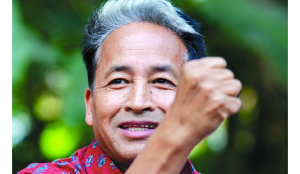
A day after discussing the broad contours of a governance model under Article 371 in the Union Territory (UT) of Ladakh, climate activist and Leh Apex Body (LAB) member Sonam Wangchuk on Thursday warned that Ladakh groups may resume their agitation if the Union Government takes major decisions affecting the UT before an elected democratic body is established.
“We will launch a fresh stir from September 19 to 24 over Ladakh issues if we don’t get any assurance from the Government,” Wangchuk told reporters in New Delhi. The Ladakh groups had travelled to Delhi expecting the Union Ministry of Home Affairs (MHA) to present a much-awaited draft outlining the structure, powers and other details of the proposed elected UT-level body. Instead, Wangchuk said, the delegation was given a list of questions to be discussed at the next meeting.
In Leh, Ladakh Chief Secretary Ashish Kundra, who was part of the Sub-Committee meeting in New Delhi on Wednesday, informed the MHA has asked the LAB and Kargil Democratic Alliance (KDA) to deliberate and reach consensus on around eight to ten key issues concerning the proposed political architecture of Ladakh before the drafting of a constitutional amendment under Article 371.
Referring to the sub-committee meeting, Wangchuk said, “We are somewhat disappointed. Although the meeting took place in a very cordial atmosphere, nothing concrete emerged from it. All that transpired was a reiteration of the decisions made four months ago. We felt that the meeting on 9 September was merely a tactic to buy time and to defer the major <padyatra></i> in Ladakh, originally scheduled on 10 September. We would wait for one week to receive an assurance that no major decisions affecting Ladakh would be taken until a democratic structure is established there. Until then, the UT administration must halt efforts to alter the very character and landscape of Ladakh, and the region’s legitimate democratic framework must be restored. They should work in collaboration with that body; if they unilaterally change everything beforehand, what role would be left for the future elected Assembly…”.
Meanwhile, in Leh, Kundra said the Union Government and Ladakh leadership had agreed to work towards a “sui generis” model that would provide an elected body with legislative, executive and financial powers. “October is not very far away. Ten days of September have already passed,” Kundra said, urging the leaders to provide their responses to the questions at the earliest so that the drafting process could move ahead.
Addressing a press conference in Leh on Thursday, he said the discussions had moved forward on the proposal to create a UT-level elected body under a special constitutional framework for Ladakh.
He said the representatives of LAB and KDA had agreed that elections to the proposed UT-level body should be held directly through constituencies rather than indirectly through the Ladakh Autonomous Hill Development Councils (LAHDCs).
He maintained the Government did not want to impose any model on Ladakh that was not acceptable to its people.
“Before preparing a document, there has to be agreement on the principles. Legal drafting of the Bill will follow once there is agreement on those principles,” he added.
The chief secretary said the ongoing dialogue was aimed at addressing the core aspirations of the people of Ladakh, including protection of land, culture, heritage, mineral resources, environment and employment.
“This is a constitutional amendment. It requires extensive legal drafting, but before that drafting can happen, agreement on the principles is necessary,” he said.
Kundra also clarified that the proposed arrangement would not amount to restoration of Statehood for Ladakh.
“Ladakh was never a State. First of all, it was part of the (erstwhile) State of Jammu and Kashmir and later became a Union Territory,” he said.
“It will not be a State, and it will not be a UT with a legislature in the conventional sense. It will be some other kind of body which will have these powers,” he said, adding that the nomenclature of the proposed body had not yet been finalised.
Kundra said the current proposal had emerged after the original demand for inclusion of Ladakh under the Sixth Schedule was discussed with the Union Government.
“It was subsequently explained that this model has its limitations. Therefore, the Union Government is willing to go ahead and offer something more. That ‘more’ is coming through Article 371,” he said.
He said constitutional safeguards under Article 371, once incorporated, would be difficult to alter without another constitutional amendment.
However, several issues relating to the powers and functioning of the proposed body remain to be settled, he said.
“There are certain questions regarding the relationship between the LAHDCs and the UT-level body, what powers will come under the jurisdiction of the LAHDCs and what powers will come under the UT-level body,” Kundra said.
He said a list of around 8-10 questions had been shared with the leaders who attended the meeting and they had been asked to deliberate on them, consult among themselves and with the people and convey their views to the Centre.”The Ministry of Home Affairs has already started working on it. As I said, we have given them a set of questions. Through you, I would request that we receive the answers to those questions as soon as possible so that we can forward them to the Ministry of Home Affairs,” Kundra said.
He said the next meeting between the centre and Ladakh representatives would be held in the first half of October, to move towards a draft after consensus was reached on the basic principles.
On the demand for a draft before the October meeting, Kundra appealed for patience, saying the Centre wanted to ensure that the final arrangement emerged through consultation.
“If we rush into something and later realise that it was not correct, changing it becomes difficult,” he said.
On the September 24 incident last year, Kundra said cases identified for withdrawal would be sent to the Lieutenant Governor, while a proposal on compensation would also be forwarded for his consideration.