
Uncertainty clouds forecast on whether wildfire smoke will affect World Cup final
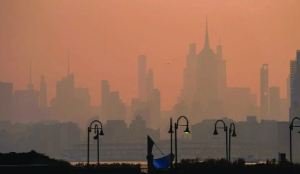
Mikel Merino can smell and see the smoke from the Canadian wildfires that are making for hazy conditions across large parts of the US, including northern New Jersey, where he and Spain are set to face Argentina in the World Cup final on Sunday. Merino is trying not to focus on it.
It remains unclear how much, if at all, the smoke will affect the final. The World Health Organization forecast calls for an improvement to “moderate” air quality in East Rutherford.
“For a game that is as important as a World Cup final, you have to be able to shut out external factors as much as possible,” Merino said Friday. “Luckily, we are being careful with every detail thanks to the federation and the organizers of the World Cup.”
Spain practiced outside in hazardous conditions in East Hanover, New Jersey, on Thursday, alarming experts who thought the team should have held the session inside instead. Messages sent to FIFA and the Spanish Football Association asking whether that was considered or possible were not returned.
Air quality improved Friday, but the uncertainty lies in what will follow what could be up to 1.25 inches (3.17 centimeters) of rain expected to fall Saturday.
“Following that, it looks like there is another smoky air mass following in behind that system, but it’s not clear right now how much or how it might reach New York or New Jersey, when it comes to actually Sunday,” said Mark Parrington, senior scientist at the Copernicus Atmosphere Monitoring Service. “If the fire intensity really picks up again through (Saturday), it’s possible it puts more smoke into the atmosphere that then might quickly follow that rain event.”
Jonathan Belles, senior meteorologist for The Weather Channel app and weather.com, expects to have improved confidence in the forecast as game time gets closer.
“The question is whether smoke behind that (rain) system reaches ground level over northern New Jersey on Sunday and, if so, how concentrated it becomes,” Belles said. “Current forecast models range from little to no ground-level smoke to levels that could become more concerning for players and fans.”
Smoke from wildfires — which are burning more of North America as Earth warms — attacks nearly every system in the body, killing tens of thousands of people a year, numerous medical studies show.
It attacks the body immediately, spiking asthma cases with increased ambulance runs within hours. Smoke can trigger inflammation in different parts of the body, often attacking a person’s weakest points, which can then cascade into different effects of an immune system trying to fight a nasty irritant, doctors and scientists say.
There could be an impact on players’ performance even if the air conditions are moderate, according to University of California, San Diego professor of medicine Chantal Darquenne. “It’s kind of a dose-dependent effect,” Darquenne said.