
Time for public audit to put land at the centre of governance
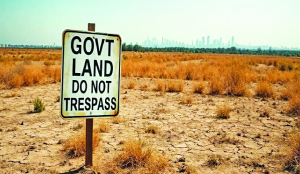
The question that public audit must increasingly ask is simple: Does the government know what land it owns, where it is located, how it is being used, whether it is encroached upon, and whether it is creating public value? This question is not technical. It goes to the heart of public accountability
Public audit in India has traditionally followed the money. It examines whether expenditure was authorised, whether procedure was followed, whether revenue was collected, and whether public funds were properly used. But one of the most valuable public assets often remains outside the centre of audit attention — land.
Land is the silent base of public governance, infrastructure, welfare delivery, urban expansion, environmental protection and economic development. Yet governments often know less about their land than about far less valuable assets. While elaborate systems exist for accounting for buildings, vehicles, machinery and financial assets, information on land is frequently fragmented, outdated or incomplete.
The question that public audit must increasingly ask is simple: Does the government know what land it owns, where it is located, how it is being used, whether it is encroached upon, and whether it is creating public value? This question is not technical. It goes to the heart of public accountability.
Weak land governance affects public finances, project delivery, citizen services, environmental protection and public trust. Acquisition delays push up costs. Weak records generate uncertainty. Encroachments erode public assets. Poorly managed land remains idle while public institutions search for space. Faulty compensation records can lead to overpayment, litigation or exclusion of rightful beneficiaries. Yet public discourse usually views land through narrow lenses like ownership disputes, acquisition controversies, mutation delays or revenue administration. These are important, but they often describe symptoms rather than causes. Land governance is not one department’s routine function. It is a connected system of maps, records, transactions, updates and ground possession. When these links do not speak to one another, the state begins to carry multiple versions of the same parcel.
A registered sale may not update revenue records. A revenue correction may not reach municipal databases. A court order may not be reflected in administrative records. A map may say one thing, a register another, and actual possession something else. For an auditor, this is not merely a clerical inconsistency. It is a risk signal. The traditional auditor asked, “Was the transaction proper?” The modern auditor asks, “Did the system work?” The future auditor must ask, “Was public value created?” Land governance is perhaps the most suitable field for this transition. Take government land, for example. In theory, it is a valuable public asset. In practice, many departments do not even have complete and updated inventories of their land holdings. Information on location, area, present use, ownership status, encroachment, litigation and valuation is often scattered. A department may lose public land not because someone formally transferred it, but because nobody knew it was its own land in the first place.
This calls for an asset-management approach to land. Government must identify, inventorise, protect, utilise and monitor public land with the same seriousness with which it manages other valuable assets. In fact, land deserves greater attention because it is finite, difficult to replace, and often appreciates over time. The same logic applies to acquisition and compensation. Many project delays are attributed to contractors, funding gaps or execution weaknesses. But quite often, the real bottleneck lies earlier, in poor planning, faulty surveys, weak consultation, unclear ownership records, repeated alignment changes and compensation disputes. Compensation administration, too, is not merely a payment process. It involves the identification of rightful beneficiaries, accurate measurement, correct valuation and timely disbursement. Errors can lead to duplicate payments, exclusion, litigation and fiscal loss.
A useful audit lens is to move beyond the lazy shorthand of “land disputes”. In public administration, many problems that reach the state as disputes are actually system failures wearing the mask of disputes. A boundary conflict may be the result of outdated spatial information. An ownership mismatch may arise from delayed record correction. A disputed compensation payment may reflect weak beneficiary identification. An encroachment may reveal not merely an enforcement failure, but the absence of a reliable public land inventory.
This distinction matters because audit is strongest when it diagnoses causes, not merely records symptoms. If every land problem is treated as a dispute, the response naturally moves towards adjudication, litigation and file-bound resolution. But if the problem is understood as a survey failure, record failure, registration failure, possession mismatch or asset-management failure, the remedy becomes more precise. The auditor’s role is not to sit in judgement over title, but to ask whether the system that records, protects, updates and verifies land is working as it should.
Digitisation has opened new possibilities, but also new risks. Online records, digital mutation workflows, registration databases and citizen portals can improve transparency and service delivery. But technology cannot cure bad data. An inaccurate paper record does not become accurate merely because it is digitised. In fact, digitisation can amplify old errors by making them more widely accessible and more quickly replicated. validation, correction mechanisms, access controls, audit trails and interoperability. If digital systems remain isolated, governments may only replace paper silos with digital silos.
The next frontier is geospatial and technological audit. GIS, satellite imagery, drone surveys, spatial databases and AI can help auditors move beyond departmental records. They can verify encroachments, land use, infrastructure progress, environmental compliance and acquisition claims through independent spatial evidence. This does not reduce the importance of documents. It strengthens audit evidence. Land governance also has a direct bearing on citizen trust. For many citizens, the state is encountered not in Parliament or the Secretariat, but in the registration office, revenue office, mutation counter, survey camp, compensation hearing or grievance forum. When records are unreliable, mutations delayed, encroachments unchecked or compensation disputed, the credibility of governance suffers.
Therefore, land audit should not be confined to revenue audit. It cuts across performance audit, compliance audit, IT audit, environmental audit, infrastructure audit and asset-management audit. A mutation backlog is not merely a service-delivery issue. A weak land inventory is not merely a departmental lapse.
A flawed acquisition process is not merely a project delay. Each is part of a larger governance risk. India’s public audit institutions have an opportunity to widen the frame. Land must be seen not only as a legal subject, revenue matter or administrative routine, but also as a strategic public asset. The test of good land governance is not merely whether files moved, records were digitised or transactions were registered. The real test is whether public assets were protected, fiscal risks reduced, citizens served, infrastructure delivered, environmental safeguards maintained and public value created.
In public finance, what is not counted is often not controlled. In land governance, what is not known is eventually lost. Public audit must, therefore, also begin to ask a basic question that governments have too often avoided: “Do we really know the land we govern?”
Land governance also has a direct bearing on citizen trust. For many citizens, the state is encountered not in Parliament or the Secretariat, but in the registration office, revenue office, mutation counter, survey camp, compensation hearing or grievance forum
The writer is an ex-IAS officer and is presently Chairman, RERA Bihar. He served as Principal Secretary, Department of Revenue and Land Reforms, Bihar; Views presented are personal.