
Despite police crackdown, protesters continue Parliament march
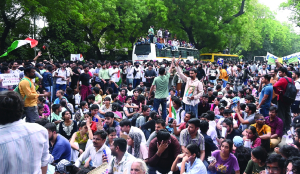
The air around Jantar Mantar on Monday carried a mix of humidity, slogans and uncertainty. Protesters, drenched in sweat and interrupted by spells of rain, wiped their faces with scarves and flags as chants demanding the resignation of Union Education Minister Dharmendra Pradhan echoed through central Delhi. As the afternoon wore on, the leadership of the Cockroach Janata Party (CJP) splintered, the planned Sansad Chalo march effectively dissolved, and negotiations began behind closed doors. Even so, the crowds on the streets showed little sign of giving up.
Rather than a single united procession towards Parliament, demonstrators gathered in smaller clusters around Janpath Metro Station Gate number 2, Jantar Mantar, and adjoining roads, raising slogans against alleged examination paper leaks and demanding sweeping education reforms from 8 am onwards. Although the day’s programme unfolded far differently from what organisers had announced, the movement’s supporters continued to occupy the area well into the afternoon.
The demonstration shifted dramatically after CJP founder Abhijeet Dipke ended his three-day hunger strike and spokespersons Ashutosh Ranka and Saurav Das met Union Health Minister and BJP senior leader JP Nadda for talks. CJP later said negotiations with the government were underway and that it had presented its demands, effectively halting the planned Parliament march.
In a separate development, AISA student leaders Neha, Ameen and Manish also ended their 23-day hunger strike after meetings with political leaders, civil society representatives and eminent personalities. Veteran actor Shabana Azmi, Rajya Sabha MP Manoj Kumar Jha and AAP leader Sanjay Singh offered them water to formally conclude their fast.
Monday morning commuters grappled with road diversions, barricades and Metro station closures, but the disruptions did little to deter those determined to register their protest. Dipke described Sunday’s gathering as one of the country’s largest public mobilisations in recent years. Among those in attendance was Amit, 24, a UPSC aspirant who said he had visited Jantar Mantar multiple times over the past month. “I’m scared of my future and don’t want what happened with the NEET students. This movement has given me hope, and there needs to be education overhauls,” he said.
Volunteers repeatedly appealed to demonstrators to remain peaceful, forming human chains to regulate entry and exit points as crowds swelled beyond expectations. However, when Delhi Police tightened barricades around the protest site to prevent marchers from advancing, the situation turned tense. Pushing and shoving broke out at several locations, and police resorted to a lathi charge to disperse sections of the crowd.
Among those caught in the chaos was Ankit, 28, from Madhya Pradesh, who had travelled to Delhi despite suffering a leg injury in a road accident 15 days ago. “I was simply finding an exit when the commotion happened, and the police struck me with the baton. I’m in pain,” he said, pointing to the bandaged leg where he claimed he had been hit.
The protest also drew many first-time participants. Unnati, a newly admitted Delhi University student, said she attended her first demonstration because of concerns about irregularities in the CUET examination. “There were delays and irregularities in our CUET examination. Fortunately, this movement is underway to hear students’ problems. My classes begin next week, but I’m here to pledge my solidarity with the CJP because I want a smooth college life,” she said.
As the afternoon progressed, the once-concentrated gathering splintered into smaller groups across the New Delhi district, moving well into Connaught Place. Although the CJP leaders did not formally lead the Sansad Chalo march following the negotiations, several protesters attempted to move towards Parliament on their own. Police responded with heavy deployment, baton charges and tear gas to prevent the marchers from advancing. Tear gas shells were also fired near Jantar Mantar as security forces dispersed the remaining crowds.
Nayan, a school student, alleged that police struck him while he was trying to leave the area. “I smelled the tear gas and started leaving when the police hit me,” he said.
Several protesters also complained that extensive road closures across central Delhi left them stranded and struggling to find transport home.
By evening, the protest site had thinned considerably, with the Delhi police dismantling CJP’s main stage, but scattered groups continued raising slogans from street corners and barricades. Although the march to Parliament may never have materialised, for many who travelled across states to be there, the demand remained unchanged: accountability for examination paper leaks and reforms, they said, could no longer be postponed.