
The Upanishadic Path to Ecological Responsibility and Sustainable Future
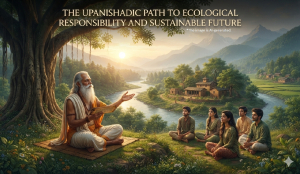
The opening verse of the Isha Upanishad (one of the eight Upanishads, which comprise the earliest Indian philosophical literature) is a proposition so profound that later commentators, from Adi Shankaracharya to Sri Aurobindo, have construed it as the essence of the text's entire philosophy:
"All this, whatsoever moves in this moving world, is enveloped by the Lord. Enjoy through renunciation; do not covet anyone's wealth."
This middle path, formulated three millennia ago, is what a resource-depleted planet needs present and future generations to adopt and follow.
Decoding and Understanding this Verse in the Context of Environment
The first word, Ishavasyam, i.e., pervaded, indwelt, enveloped by the Lord, situated within the overarching Upanishadic framework of the self (atman) and the supreme (brahman), teaches that one should partake of what is available with restraint and non-possessiveness and should not covet what belongs to another. It states that enjoyment (bhunjitha) be mediated by renunciation (tyaktena) and disciplined by the refusal to covet (ma gridhah). In the precise interpretation of tena tyaktena bhunjitha, tyaga signifies renunciation or detachment while bhunjitha carries the sense of enjoying, using or possessing.
If forests, rivers, flora and fauna and the atmosphere are not simply resources awaiting human appropriation but are themselves suffused with the sacred or the divine, then their extraction becomes a matter of restraint and reverence.
This sentiment is not unique to the Ishopanishad within the Vedic corpus. Consider this phrase from Atharvaveda's Bhumi Sukta (12.12):
"Earth is my mother; I am the son of Earth."
Articulated in the first-person pronoun, it may be taken to imply that all inhabitants of the Earth are her sons, and they all have a right on her as well as a responsibility toward her. This reinforces the belief that she belongs to all rather than any single claimant.
Ancient Dictum, Contemporary Relevance
Perceived in the wake of the ecological crisis of the 21st century, the Ishopanishadic hymn acquires an extraordinary contemporary resonance: use without abusing, harassing or exploiting; enjoy without exhausting and possess without becoming possessed by possession itself.
Sadly, this is the era of manufacture, extract, consume and discard. A light left burning in an empty room, water flowing unnecessarily from a tap, tissue paper pulled out in quantities greater than required, food discarded because more was served than could be eaten, a perfectly usable object replaced merely because a newer version has appeared - these may seem trivial in isolation. Collectively, however, such tendencies or habits express a deeper cultural disposition that nature's resources exist for immediate human consumption and abundance equals unlimited availability.
The Ishopanishadic ethic challenges this assumption. Ma gridhah (do not covet) is a caution against the psychology of endless acquisition. The environmental problem is not consumption as such. Human beings necessarily consume food, water, energy, materials and space. The question is: how much, for what purpose, at what ecological cost and with what consequences for others and those who will be born after us?
Great Minds Drawing from Tena Tyaktena Bhunjitha
Mahatma Gandhi gave this ancient morale a distinctly modern economic vocabulary. His popular observation that the Earth provides enough for everyone's needs, but not for everyone's greed, has become a touchstone of environmental thought. In Trusteeship (compiled by Ravindra Kelekar and published in 1960), he argued that taking more than one needs amounts to depriving others. His notion of non-possession, therefore, had a social as well as an ecological dimension: restraint in consumption creates room for equity, justice and human dignity.
Gandhi's thinking is particularly relevant to environmental behaviour today because it makes the question of sustainability a question of responsibility. Turning off an appliance when it is unnecessary, closing a tap while brushing, carrying a reusable bottle, avoiding needless printing, using both sides of paper, taking only as much food as one can eat, repairing rather than immediately replacing usable goods, refusing unnecessary single-use articles, segregating waste, composting organic matter, planting and caring for native trees, protecting local water bodies and avoiding litter are not insignificant gestures. They cultivate sanyam (self-restraint) and can transform an abstract environmental ethic into daily conduct and practice.
The Gandhian economist J. C. Kumarappa developed this insight into an economic philosophy in The Economy of Permanence (1945). He distinguished between exhaustible resources, such as fossil fuels and minerals, and renewable flows, such as water and growing timber, whose continued availability depends upon responsible management. His central proposition was that an economy should not merely maximise present consumption but should harmonise human activity with nature's capacity for renewal.
Kumarappa's postulate offers a bridge between Indian civilisational thought and contemporary sustainability. Nature, in his conception, is not an inert warehouse of raw materials. It is an organic and symbiotic whole of relationships in which different elements sustain one another. He cautions that an economy that destroys its ecological foundations may generate wealth and steer towards advancement and development in the short term, but it jeopardises its own existence in the long term.
Conclusion
Moderation, restraint and a control over endless consumption can inform, guide and motivate present and future generations in environmental protection, preservation, conservation and restoration ethics.
Ecological responsibility cannot be left entirely to governments, courts or institutions like the NGT. We are all equal stakeholders in the country's growth. A river is also the responsibility of the community that lives beside it; a neighbourhood tree is also the responsibility of the citizens who benefit from its shade; a local pond, forest, grazing ground or wetland survives only when people recognise a stake in its continued existence. Let's move from "use-and-discard" to "use-and-care"; from extraction to regeneration; from ownership to stewardship; from entitlement to responsibility.
Bharat's growth story need not be imagined as a choice between progress and prosperity vis-à-vis ecology. Forests must remain forests even as economies grow; rivers must remain living rivers even as cities expand; soil must remain fertile even as agriculture becomes more productive; biodiversity must flourish even as infrastructure develops. This will be possible once we all think and act along tena tyaktena bhunjitha.
RK Pachnanda, Former Chairman, Haryana Public Service Commission; Former Chairman, Haryana Electricity Regulatory Commission; Former DG-ITBP; Former DG-NDRF; Commissioner of Police. Kolkata; Director, Bharat ki Soch; Dr Abhishek Anand, Senior Research Fellow, Bharat Ki Soch; Views presented are personal.