
The cloud over Argentina’s 2026 World Cup campaign: Why perception matters
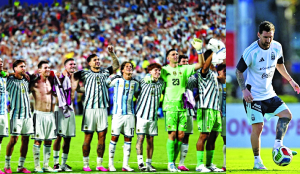
When the draw for the 2026 FIFA World Cup was made in December 2025, few disputed that defending champions Argentina had received one of the tournament’s more favourable paths. On paper, a group featuring Austria, Algeria and Jordan appeared considerably less demanding than those faced by several other contenders. Their projected knockout route also looked manageable, with possible meetings against Uruguay in the Round of 32 and the runners-up of Group G or Group D in the Round of 16, leaving Portugal as their first expected major test in the quarter-finals. By comparison, teams such as Germany, Brazil and the Netherlands faced significantly tougher routes.
There is nothing inherently wrong in receiving a favourable draw. World Cup draws are lotteries, and every nation enters the tournament knowing that luck inevitably plays a role. What has complicated Argentina’s campaign, is the growing perception that they have also benefited from favourable officiating and institutional goodwill. Whether that perception is justified or not, it has become one of the defining narratives of the tournament.
This debate has lingered since Argentina’s victorious 2022 World Cup campaign, their first in 36 years. Several high-profile refereeing decisions from Qatar remain frequent points of discussion, including the heated quarter-final against the Netherlands, the penalty awarded against Croatia in the semi-final, and the penalty given in the final against France following what looked a relatively soft challenge.
The presence of Lionel Messi inevitably amplifies this debate. Widely regarded as one of the greatest footballers in history, Messi now plays for Inter Miami and has spent the latter stages of his career based in one of the host nations of the 2026 tournament. Before lifting the World Cup in Qatar, he carried the burden of being considered perhaps the greatest player never to win football’s biggest prize. That debate ended in December 2022. Now, with Messi playing his sixth World Cup while continuing to add to his extraordinary goalscoring record, every controversial decision involving Argentina is viewed through the lens of protecting football’s biggest global icon.
Events during this tournament have only strengthened that perception. Against Algeria, Messi avoided even a booking after striking the back of an opponent’s leg. Against Austria, an Argentine goal stood despite protests over an alleged foul in the build-up. Viewed individually, each incident can be defended within the Laws of the Game. Taken together, however, they reinforce an existing narrative that Argentina consistently receive the benefit of doubt.
The Round of 16 victory over Egypt has become the focal point of that debate. Egypt led 2-0 with just 11 minutes of normal time remaining before the match turned dramatically. In the second half, Egypt had what would have been a crucial goal ruled out after the referee penalised a foul through the aid of the Video Assistant Referee (VAR). Later, Argentina scored what proved to be the decisive goal following a challenge in their own half that closely resembled the earlier incident.
If one goes by technicalities, there is a credible argument that both decisions were correct. Football, however, is often judged less by technical interpretation than by consistency. The question that football observers are asking is whether those same interpretations would have been applied had the teams been wearing the opposite shirts.
Fortune has certainly favoured Argentina in several respects. Their relatively comfortable group-stage draw was simply the product of chance, and if projected opponents such as Uruguay, the United States, Turkey or Portugal failed to stand in their path to the semi-finals, that is hardly something for which Argentina can be criticised. At the same time, narrow victories over Cape Verde, Egypt and Switzerland demonstrate that supposedly easier fixtures still demand difficult victories, with Argentina’s stronger attacking options making decisive late contributions.
Other developments have nevertheless fuelled the perception that appearances are working against FIFA. President Gianni Infantino remarked publicly that he had “suffered” while watching Argentina’s dramatic victory over Cape Verde. Although intended as an emotional observation, the comment inevitably attracted criticism given his position.
None of this diminishes Argentina’s quality. While they may be marginally weaker than the side that triumphed in 2022, particularly following Ángel Di María’s retirement from international football, they remain one of the world’s elite teams, fully capable of winning matches on their own merits. That is precisely why the perception of institutional protection is so damaging. It overshadows legitimate achievements, casts doubt over genuine victories and shifts attention away from the football itself.
Whether FIFA has actually favoured Argentina is, in many ways, less significant than the fact that a substantial number of supporters believe it has. For a tournament that prides itself on being the pinnacle of global sport, perception matters almost as much as reality. Fairness must not only exist; it must also be seen to exist. Until that confidence is fully restored, every close decision involving Argentina and Lionel Messi will continue to invite suspicion, a situation that befits neither the three-time champions nor the World Cup itself.
The writer is a sports management consultant; Views presented are personal.