
Sicily from the Water: Why One Island Feels Like Several Different Journeys
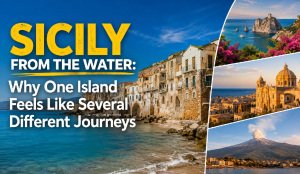
Most people plan a trip around Sicily as a road journey. They begin in Palermo, continue toward Cefalù, cross the island to Mount Etna and Taormina, then finish somewhere around Syracuse or Noto.
It is a perfectly good way to travel. It is also a route shaped by roads rather than geography.
From the water, Sicily looks different. The volcanic islands to the north form one distinct sailing region. The protected archipelago west of Trapani creates another. Palermo has its own compact coastal route, while the eastern shore combines historic cities, marine reserves and views toward Etna.
That variety is what makes Sicily more interesting than a simple week of sailing around one island. You are not choosing a single destination. You are choosing which version of Sicily you want to experience.
Sicily Is Not One Sailing Area
The first mistake is treating every Sicilian itinerary as interchangeable.
A route through the Aeolian Islands involves volcanic landscapes, meaningful passages between islands and harbours that feel surprisingly different from one another. A week around the Egadi Islands is usually more compact, with clear water, low-lying coastlines and easier opportunities to combine sailing with time ashore.
Palermo works well for shorter coastal trips, while the eastern side of the island suits travellers who want to mix sailing with stops around Taormina, Syracuse and the Ionian coast.
Sicily’s official tourism resources reflect these differences. They suggest approximately six days for a relaxed Aeolian Islands itinerary and around five days for a route through the Egadi Islands. Shorter trips are also possible from Palermo toward Mondello and Capo Gallo or from Milazzo to Vulcano.
This means the departure base should never be treated as a minor booking detail. It determines what can realistically be seen without spending most of the holiday rushing between distant points.
The Aeolian Islands Are the Classic Volcanic Route
For many sailors, the Aeolian Islands are the first place that comes to mind when Sicily is mentioned.
The archipelago lies off the island’s north-eastern coast and includes Lipari, Vulcano, Salina, Panarea, Stromboli, Filicudi and Alicudi. Together, they create a route shaped by volcanic rock, steep shorelines, small settlements and open stretches of deep blue water.
Milazzo is one of the most practical starting points. Portorosa and Capo d’Orlando are also positioned for itineraries heading toward the archipelago, with charter fleets based in each area.
Lipari is often the most convenient first or final stop. It is the largest island in the group and has the broadest range of services, restaurants and connections. The harbour feels active without losing its island character, and the old town gives crews an easy reason to spend an evening ashore.
Vulcano has a rougher visual character. Dark beaches and exposed rock make the landscape feel more dramatic, particularly after arriving from the greener Sicilian mainland. Official sailing routes from Milazzo commonly use Vulcano as the first introduction to the archipelago.
Salina feels calmer and greener. Panarea is smaller and more polished, with compact settlements and a livelier atmosphere during the summer. Stromboli provides the route with its most recognisable silhouette, while Filicudi and Alicudi appeal to travellers who prefer fewer services and a stronger feeling of distance from the mainland.
The islands are close enough to build a varied week, but trying to include all seven can make the trip unnecessarily rushed. A better approach is to choose four or five and allow enough time for swimming, walking ashore and changing the route when conditions require it.
A sailing holiday should not become a competition to collect island names.
The Egadi Islands Offer a Slower Western Route
The Egadi Islands sit west of Sicily, within easy reach of Trapani and Marsala. The three principal islands—Favignana, Levanzo and Marettimo—are close enough to combine in one itinerary, but different enough to prevent the route from feeling repetitive.
Favignana is the largest and most developed of the three. Its coastline includes shallow bays and several well-known swimming areas, while the former tuna fishery near the harbour now houses a museum devoted to the island’s fishing history. The surrounding waters form part of the Egadi Islands Marine Protected Area.
Levanzo is smaller and quieter. A stop here can be as simple as swimming near the coast, having lunch in the village and spending the evening at anchor. The scale of the island encourages a slower visit.
Marettimo feels more isolated. Its mountainous profile and sea caves create a different landscape from Favignana’s flatter coastline. It works particularly well near the middle of the itinerary, when everyone has already adjusted to the rhythm of living aboard.
An official five-day route from Trapani combines San Vito Lo Capo with Levanzo, Marettimo and Favignana, creating a journey that includes mainland coastline as well as the archipelago.
That is one of the strengths of western Sicily. The itinerary does not need to be limited to the islands. Depending on the weather and available time, the route can include the coast near San Vito Lo Capo and the Zingaro Nature Reserve before turning toward the Egadi archipelago. San Vito sits beside a long, pale beach, with the protected landscape of Zingaro beginning nearby.
Compared with the Aeolian Islands, the Egadi route often feels less dramatic. There are no smoking volcanic silhouettes dominating the horizon. The attraction is subtler: low cliffs, fishing traditions, clear water and short passages that leave more of the day free.
For families or groups who care more about swimming and relaxed stops than long sailing legs, that can be an advantage.
Palermo Is More Than an Arrival City
Palermo is usually treated as a place to visit before or after the charter. It can also be part of the sailing experience itself.
A short route can begin near the city, continue along the coast to the Capo Gallo Marine Protected Area and finish around Mondello. The journey combines rocky scenery, swimming stops and the distinctive waterfront architecture of Mondello without requiring a full week aboard.
This is a practical option for travellers who want to try sailing without building their entire holiday around it. A day or weekend on the water can be combined with Palermo’s markets, historic streets and restaurants.
Longer charters from the area can continue west toward Castellammare del Golfo or form part of a route toward San Vito Lo Capo and the Egadi Islands. Another possibility is to head east along Sicily’s northern coast, although the distances become more significant and the itinerary requires more careful planning.
Palermo also works well for mixed groups. One person may be mainly interested in sailing, another in food and history, and another simply wants time by the sea. Starting near a major city makes it easier to balance those interests.
Eastern Sicily Combines Sailing with Historic Stops
The eastern side of Sicily receives less attention as a charter region than the Aeolian or Egadi Islands, but it offers a different type of trip.
Around Giardini Naxos and Taormina, the coastline is shaped by the presence of Etna. The volcano is only a relatively short distance inland, which creates an unusual contrast between coastal towns, open water and the mountain rising behind them.
Farther south, Syracuse provides access to a coastline where archaeology and nature sit close together. The Plemmirio Marine Protected Area lies beside the city and is known for its coastal scenery and underwater environment.
This part of Sicily makes sense for travellers who want to spend more time ashore. A sailing day can be followed by an evening around Ortigia, while another stop may combine swimming with a visit to a historic town.
The route does not need to cover enormous distances. In fact, trying to connect every major eastern destination can create the same problem as an overplanned road trip. It is usually better to select one section of the coast and explore it properly.
A shorter itinerary around Syracuse, Plemmirio and the south-eastern coastline may feel more complete than an ambitious journey that attempts to include Taormina, Catania, Syracuse and the far south in a few days.
Choose the Departure Base Before Choosing the Boat
Travellers often begin by looking at yachts. They compare photographs, cabin numbers and model years before deciding where they actually want to sail.
The order should usually be reversed.
First choose the region. Then choose the departure base. Only after that should you select the boat.
Milazzo, Portorosa and Capo d’Orlando are practical for the Aeolian Islands. Trapani is better positioned for the Egadi Islands. Palermo provides access to the north-western coast, while Syracuse and Giardini Naxos open possibilities along the east.
Before booking flights or accommodation, travellers can compare these locations, boat types and charter formats through SICILY YACHT CHARTER. The available departure points include Portorosa, Capo d’Orlando, Palermo, Milazzo, Trapani, Syracuse and several other Sicilian bases.
This matters because a cheap yacht in the wrong marina may create additional transport costs and an awkward itinerary. A boat based near the intended route is often a better choice, even when the weekly charter price is slightly higher.
Match the Boat to the People On Board
A traditional monohull works well for couples, smaller groups and travellers who want the sensation of sailing to remain central to the trip. It usually offers less living space than a similarly sized catamaran, but it can provide a more direct experience under sail.
A catamaran gives the group a wider deck, more separation between cabins and greater stability at anchor. That can make a noticeable difference for families or groups spending long afternoons swimming and relaxing aboard.
Motor yachts cover distances more quickly but bring higher fuel consumption and can change the character of the holiday. Instead of moving gradually between islands, the trip may become focused on reaching more places in less time.
The number of cabins is only part of the decision. Bathrooms, ventilation, shaded outdoor seating and storage space often matter more after the second or third day.
A yacht advertised for ten guests may technically sleep ten, but that does not mean ten adults will enjoy sharing it for a full week.
The charter format matters as well. Qualified sailors may choose a bareboat rental. Less-experienced groups are generally better served by hiring a skipper, particularly in an unfamiliar region where local winds, harbour conditions and anchoring restrictions can affect the route.
A crewed charter removes more of the daily responsibility, while a skipper-only arrangement preserves greater privacy and flexibility.
The Season Is a Starting Point, Not a Guarantee
Sicily’s official tourism guidance describes May through October as the main period for enjoying the sea. The island’s Mediterranean climate creates a relatively long coastal season compared with many northern European destinations.
That broad window does not mean every week is identical.
Conditions differ between the exposed passages of the Aeolian Islands, the more compact Egadi route and the coastline around Palermo or Syracuse. Wind direction may make one anchorage comfortable and another unpleasant on the same day.
Summer also brings more activity to the popular harbours and bays. Travelling outside the busiest weeks can produce a quieter experience, but the final route should always respond to the current forecast rather than a general monthly description.
This is another reason not to reserve every restaurant, marina and shore excursion in advance. Some planning is useful. Too much removes the flexibility that makes yacht travel worthwhile.
Food Is Part of the Route
In Sicily, the evening ashore is not simply a break from sailing.
A harbour stop may lead to grilled fish, pasta with local seafood, arancini eaten while walking or a dessert that was never part of the plan. The food changes subtly between regions, reflecting the island’s long history and its connections with mainland Italy, North Africa and the wider Mediterranean.
Western Sicily is closely associated with tuna traditions and fish couscous. Around the Aeolian Islands, local ingredients such as capers appear repeatedly. Larger cities add street food and busy markets, while smaller islands may have only a handful of restaurants.
That limited choice can be part of the appeal.
Instead of spending an hour comparing ratings, you walk into the village, see what is open and sit down. Some evenings will be carefully planned. Others will involve eating something simple in the cockpit while the harbour quiets around you.
Both belong in the same trip.
Leave One Day Unplanned
A seven-day charter does not require seven days of fixed instructions.
Weather may delay the departure. A harbour may be full. Someone in the group may want another afternoon at anchor instead of visiting the next town. A bay included only as a lunch stop may turn out to be the best place on the route.
Keeping one day open makes these changes easier.
It also prevents the final part of the holiday from becoming stressful. The yacht still needs to return to its base on time, usually with enough margin for refuelling, inspection and check-out procedures. An itinerary with no spare time can become uncomfortable as soon as one passage takes longer than expected.
Flexibility is not the absence of planning. It is planning that accepts the sea will have its own opinion.
Sicily Is Better When You Choose Less
Sicily has enough coast, islands and historic towns to fill several separate sailing holidays.
That is precisely why the best first trip is rarely the one that attempts to see everything.
Choose the Aeolian Islands for volcanic scenery and island-to-island passages. Choose the Egadi Islands for a more compact western route with clear water and slower days. Stay near Palermo for a shorter combination of city and coast. Explore the east when historic towns and time ashore matter as much as the sailing itself.
The boat gives you access, but the experience comes from the pace.
You wake up in a harbour or quiet bay, swim before breakfast and watch the coastline change during the day. Towns appear gradually rather than at the end of a motorway. The journey stops being dead time between attractions.
In Sicily, it becomes the main event.