
SC rejects challenge to SIR
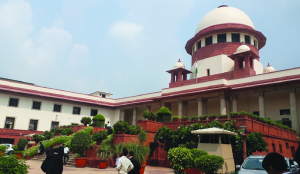
The court stressed that electoral purity matters as much as polling
The Supreme Court on Wednesday ruled that the Special Intensive Revision (SIR) of electoral rolls by the Election Commission of India (ECI) in Bihar did not violate any law or Constitutional provisions. The court observed that the “SIR is a step towards an accurate and inclusive electoral roll” and that it breathes life into Constitution.
The bench ruled that the ECI’s mandate to ensure free and fair elections is “expansive” and cannot be “extinguished” or “paralysed” by parliamentary legislation.’
“In our considered opinion, the impugned SIR does not supplant the RP Act or the 1960 Rules. It rather breathes life into the constitutional mandate of Article 324 through the precise statutory conduit provided by Section 21(3). Therefore, it cannot be said that the Commission has acted in the teeth of an express statutory prohibition,” the bench said.
The court dismissed the petitioners’ view that SIR was a surreptitious, backdoor move to conduct citizenship screening in the name of cleaning up the electoral roll. The petitions had accused the ECI of arbitrarily assuming powers to “determine citizenship” while overriding limitations clearly prescribed in laws and its own manual without providing “any good reason”.
In the 124-page judgment, the bench of Chief Justice of India Surya Kant, Justice Joymalya Bagchi and Vipul Pancholi held that SIR is essential to preserving the integrity of free and fair elections. The bench agreed with the ECI’s reasoning for the SIR that it has been more than two decades since the last intensive revision, large-scale additions and deletions over that period, rapid urbanisation, migration, and the resulting possibility of repeated or defective entries to preserve the foundational integrity of polls.
Disposing of a batch of petitions challenging the SIR exercise in Bihar, the bench rejected arguments that SIR was resorted to in the State solely for administrative convenience, saying the exercise advances the “constitutional imperative of free and fair elections”.
“We are equally satisfied that, in its object and design, the impugned SIR bears a direct nexus to the constitutional goal of a free and fair election. Free and fair elections do not rest merely upon the mechanics of polling. They equally depend upon the integrity, accuracy and purity of the electoral roll, which forms the foundation of the democratic process,” the court said.
The bench also made it clear that Aadhaar is not proof of citizenship, justifying the ECI stand to not treat it as a primary document to establish statutory eligibility for voting. The court reaffirmed its earlier order and directed the ECI to treat Aadhaar as an “additional 12th document” for identity verification in Bihar’s revised rolls.
The bench separately dealt with the validity of the documentation regime prescribed by the Commission as part of the enumeration process.’ The verdict said the ECI was entitled to classify documents on the basis of their evidentiary value in establishing statutory conditions such as residence and eligibility.’ The verdict said the choice of proposed documents for verification of electoral rolls and their evidentiary standards necessarily falls within the discretionary domain of the Commission, which may not be substituted subject to reasonableness.
The bench noted that, unlike a passport or a birth certificate, a ration card is not “conclusive proof of citizenship” and is often susceptible to misuse.
The court had framed the SIR challenge into four questions. First, whether the SIR was consistent with the constitutional and statutory mandate of the ECI? Second, if the means adopted by the ECI bear a reasonable nexus with the objectives sought to be achieved? Third, whether the measures undertaken were necessary and no other alternative existed? Fourth, whether a fair balance has been maintained between the importance of achieving the stated objective and the limitation imposed upon constitutional rights.