
Rescuers race against time at hostel collapse
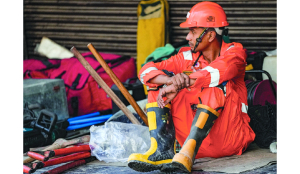
The task of saving lives for rescue personnel at the collapsed boys’ hostel in Delhi had a razor-thin margin of error-quickly plough through towering concrete slabs to reach survivors and slow down the moment a cavity is found. Every gap could potentially have a breathing person.
This is besides navigating through the cramped lanes of Satya Niketan to move in the heavy machinery required for the operation and rushing the rescued to the hospital, all the while keeping an eye on adjacent buildings whose foundation may have been weakened due to the collapse, and controlling the crowd of friends, family and political leaders gathered at the site.
After more than 27 hours since the decades-old five-storey building that housed a boys’ paying guest accommodation near Delhi University’s South Campus came crashing down around 1.30 pm on Sunday, rescuers said the operation was over. Twelve people were taken out, seven of whom have died. Officials confirmed that the operation ended at 5.10 pm on Monday. All debris has been cleared and no further casualties were found, they said.
The task for the teams for the entire duration of the rescue operation remained simple but unforgiving: clear the rubble, search every possible cavity and ensure that no possible survivor was left behind.
The first responders were Delhi Police personnel who received a PCR call about it. The immediate challenge was to establish a secure perimeter around the collapsed structure while ensuring that the adjacent building did not pose an additional structural risk. “We had to secure the area to ensure there were no structural concerns involving the adjacent building. More teams were called from different police stations to help those who were trapped. Some locals and students who were close to the area had already started removing debris from the place,” the officer said.
Officers also called the Delhi Fire Service immediately so they could start helping the police with the rescue operation. As word spread, the narrow lanes around the site quickly filled with people. Many leaders from different political parties, residents, students and curious onlookers crowded the area, forcing police personnel to expand the cordon and repeatedly push people back from the debris.
Police also had to call paramilitary forces to secure the area and to maintain law and order. The cramped surroundings added another layer of difficulty. Emergency vehicles had to negotiate congested streets, while police personnel simultaneously tried to maintain a passage for ambulances, fire tenders and rescue teams.
“We had to keep the onlookers at bay as police teams wanted to make way for ambulances and fire vehicles,” another police officer said. Once the area was secured, the rescue effort moved into a more difficult phase -- removing tonnes of concrete while trying to determine where people could be trapped.
The Delhi Fire Service rushed five vehicles to the site after receiving information about the collapse. “We arranged lights and earthmovers so that heavy concrete could be removed immediately,” a fire officer said. But heavy machinery, which could clear large quantities of debris in minutes, could not always be used.
The moment rescuers suspected that a person could be trapped beneath a section of rubble, the JCB and earthmovers had to be stopped. The operation would then shift from speed to extreme caution, with rescuers manually working through the debris to reach the trapped person without causing further collapse. “The operation becomes slow if a person is trapped. In such a situation, when a person is under debris, we cannot use earthmovers or JCB machines.
When we secure the site and the trapped person is removed, we call the JCB again, which gives pace to the operation once again,” the officer said. “We always carry oxygen cylinders with us so that we can drop them under the rubble and the trapped person can breathe easily,” the officer said.
As the hours passed and daylight disappeared, the rescue operation continued under high mast artificial lights. Machinery was brought in to clear heavy sections of the collapsed structure, while exercising caution in case someone was under the debris.