
Rajasthan’s tourism story in Japan moves beyond forts and palaces
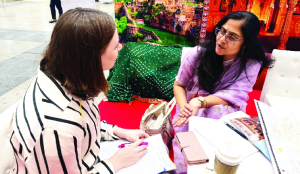
Solo travel, Palace on Wheels, wildlife and rural experiences draw interest as Japanese travellers look beyond the state’s traditional heritage circuitJaipur/Tokyo, September 30. Rajasthan’s tourism pitch in Japan is beginning to move beyond its familiar image of forts, palaces and desert landscapes. At Tourism EXPO Japan 2026, held at Tokyo Big Sight from September 24 to 27, Japanese travellers, tour operators and travel trade representatives showed interest not only in the state’s established heritage destinations but also in solo travel, Palace on Wheels, wildlife, rural life, handicrafts, local cuisine and experience-led tourism. Rajasthan Tourism’s participation was led by Tourism Secretary Shuchi Tyagi, while Joint Director (Marketing) Ajay Sharma handled interactions with visitors and the Japanese travel trade at the state pavilion, located at G-38. One of the notable trends during the four-day event was the interest among Japanese women in travelling to Rajasthan independently. Several women visitors sought information on safety and travel arrangements. The Rajasthan delegation explained the state’s tourist assistance mechanisms, police support and the availability of women police personnel. The questions reflected a broader shift in the nature of enquiries coming from the Japanese market. Interest was no longer confined to iconic monuments; travellers were also asking about how to experience Rajasthan, how to move between destinations and what kind of travel products could fit different interests. Palace on Wheels remains a strong draw. The Palace on Wheels emerged as one of the prominent attractions at the Rajasthan pavilion. Visitors sought information about the train’s royal interiors, journey experience and booking process, reflecting continued interest in combining Rajasthan’s heritage with a distinctive travel experience.
Japanese travel agents and tour operators also sought information on multi-destination itineraries covering Jaipur, Udaipur, Jodhpur, Jaisalmer, Bikaner, Ranthambore and Shekhawati. Questions ranged from road, rail and air connectivity and travel times to hotel options and overall travel costs. For Rajasthan Tourism, the conversations offered an opportunity to present the state as a destination where a single itinerary can combine heritage with wildlife, culture, rural life and local experiences. From heritage to wildlife, villages and living culture. A significant feature of Rajasthan’s presentation was the emphasis on destinations and experiences beyond the conventional tourist circuit. Alongside Jaipur, Udaipur, Jodhpur and Jaisalmer, the delegation highlighted Shekhawati, the Hadoti region and other lesser-known destinations. Wildlife, rural tourism, folk culture, handicrafts and local food were positioned as additional reasons for Japanese travellers to explore the state. Rajasthan’s Buddhist heritage also attracted attention during B2B meetings. The delegation presented information on the ancient Buddhist cave complex at Kolvi in Jhalawar district, including its rock-cut caves, stupas and large Buddha image. The site was presented as an example of the lesser-known cultural experiences Rajasthan can offer Japanese visitors. Handicrafts turn into tourism experiences. Traditional textiles and handicrafts generated strong interest on the third day of the expo. Visitors at the pavilion asked about Bandhej, Leheriya, Sanganeri and Bagru printing, as well as Jaipur Blue Pottery. The discussion went beyond finished products. Visitors were interested in the techniques, materials and traditional processes behind the crafts. Rajasthan Tourism presented the possibility of turning such encounters into tourism experiences—allowing travellers to meet artisans, observe traditional techniques and understand the cultural context behind the products. Japanese travel industry eyes future collaboration. Rajasthan Tourism also held discussions with representatives of JTB’s group travel division on opportunities to promote Rajasthan in Japan and develop cooperation with the Japanese travel industry. Several Japanese tour operators and influencers expressed interest in participating in GITB 2027, while Japanese travel media, content creators and influencers showed interest in developing video and digital content around Rajasthan. Representatives of Tokyo’s Sakura Hotel also expressed interest in establishing stronger links with Rajasthan’s hotel industry. A representative associated with the Japan Travel Agents Association visited the Rajasthan pavilion and sought information on the state’s tourism products. A market with room to grow. Japanese tourist visits to Rajasthan have increased significantly over the past few years. The figures cited by Rajasthan Tourism show 4,659 Japanese tourist visits in 2022, 16,229 in 2023, 25,748 in 2024 and 25,250 in 2025—more than five times the 2022 level. The wider India-Japan tourism relationship also includes cooperation around Buddhist tourism, student exchanges, exchanges between tourism institutions, familiarisation programmes for travel trade and media, and air connectivity. The shift visible at Tourism EXPO Japan 2026 was therefore less about replacing Rajasthan’s heritage identity than expanding it. Forts, palaces and desert remain central to the state’s appeal, but wildlife, villages, crafts, food, Buddhist heritage and local life are increasingly being presented as part of the same Rajasthan experience. For the Japanese market, the emerging proposition is clear Rajasthan is not only a place to see , it is a place to experience.