
Raahgiri Day: For three hours, Connaught Place forgot it was a traffic circle
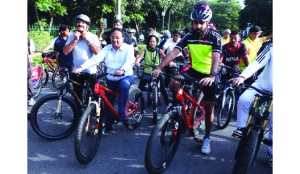
For one Sunday morning, the Inner Circle of Connaught Place belonged not to honking cars and impatient commuters, but to children on cycles, grandmothers attempting Zumba steps, and a crowd that walked where it usually squeezes past traffic. Raahgiri Day, in collaboration with Sundays on Cycle, turned Delhi’s most iconic commercial circle into a vehicle-free public space on Sunday morning. For those three hours, the city’s busiest roundabout briefly became a playground.
A cycle rally flagged off the event, led by Delhi Cabinet Minister Ashish Sood, NDMC Chairman Manoj Kumar Dwivedi and Special Commissioner of Delhi Police (Traffic) Ajay Chaudhary, alongside Raahgiri Foundation co-founder Sarika Panda Bhatt. What followed was less an official event than a city deciding, for a few hours, to behave differently with its own streets.
Sood said Raahgiri was not merely about individual fitness, but a celebration of the health and wellbeing of Delhi as a whole. By clearing Connaught Place of vehicles and opening it up to cycling, yoga, Zumba, skating, badminton and tug-of-war, he said the initiative gave citizens a weekly chance to reclaim public space for walking and healthy community activity. He pointed to cycling specifically as a tool against pollution, one the Delhi government is backing through dedicated cycling tracks across the city and its Electric Vehicle Policy.
Dwivedi said hosting Raahgiri at Connaught Place sent a strong signal for a cleaner, pollution-free Delhi, crediting the enthusiastic participation of youth for inspiring the city toward more sustainable mobility. He called it a movement toward safer roads and stronger recognition of cyclists’ and pedestrians’ rights, not just a one-off recreational morning.
Chaudhary used the platform to push road safety directly, appealing to Delhiites to follow traffic rules, avoid triple riding and driving on the wrong side, and treat pollution control as both a collective and personal responsibility.
Built around the theme “Roads are beautiful when they belong to people,” the morning unfolded as a genuine cross-section of the city at play, cycling alongside cricket, badminton next to folk dance, puppet shows drawing children while chalk art spread across the tarmac, with a dedicated fitness zone and interactive stalls threaded through it all. Families, senior citizens and children shared the same stretch of road that, on any ordinary weekday, none of them would dare walk through together.
By afternoon, the mood shifted from fitness to festival, as Euphoria Band took over Central Park with a live performance that had young participants singing and dancing their way through the final stretch of the morning, music folding fitness, recreation and community into one unbroken celebration.
The event drew together an unusually wide coalition: the Ministry of Youth Affairs and Sports, Delhi’s Urban Development Department, Fit India, Delhi Police, DDA and NDMC, alongside Raahgiri Foundation, Nagarro Foundation, the International Council on Clean Transportation, GuruJal, Walk21, its Regional Dialogues, and BYCS India Foundation, each lending a piece to a morning built entirely around the idea that a road need not always be a corridor for traffic.
What played out across Connaught Place was less a single event than a proof of concept, a glimpse of what the city’s streets could feel like if they occasionally stopped serving only vehicles. For a few hours, Delhi’s residents walked, cycled and danced through a space usually defined by its congestion, and in doing so, quietly argued that roads could belong to people too, not just for a Sunday morning, but as something worth returning to again.