
PM’s seven streams to power India’s 2047 journey
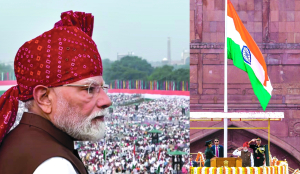
Prime Minister Narendra Modi on Saturday exhorted the youth from the ramparts of Red Fort to lead the nation to a Viksit Bharat and announced a slew of initiatives for Gen Z. They included free online coaching for competitive examinations and AI training for one crore young people.
Enhancing his outreach to them, especially after the recent protests at the Jantar Mantar, the Prime Minister also outlined a massive nationwide sports talent hunt to achieve excellence at the world level.
Modi delivered his 13th Independence Day speech. During his 75-minute address, he outlined his vision for a Developed India by 2047, introduced the Sapta Dhara (seven streams of strength) framework, and announced new plans focused on youth, technology, energy security, self-reliance, women’s participation, and national preparedness. The speech began with the full National Song, Vande Mataram, sung at the Red Fort on Independence Day for the first time since independence, marking its 150th anniversary.
Assuring the young people of the country of his support, Modi cautioned against “dimagi Naxals” and said they had to be “identified and isolated”, as these elements had embedded themselves in the corridors of power in the country.
Modi also appealed to all the political parties to rise above differences and support the Women’s Reservation Bill, saying all must venerate women’s power. This came days after a near washout of the Monsoon Session of Parliament.
In his 13th consecutive Independence Day address to the nation, next only to 17 by Jawaharlal Nehru in a row, Modi mainly focused on the young generation in a nearly 75-minute-long speech. Modi referred to the youth more than 50 times in the course of it.
Modi sought to rally parties and young Indians around his Viksit Bharat 2047 vision while laying out a roadmap for India’s economic and strategic rise through what he described as seven streams, or “Sapta Dhara”, of development.
Reaching out to the youth in a big way in his address on the 80th Independence Day, weeks after widespread student protests over paper leaks and irregularities in exams, the Prime Minister made a series of announcements — free online coaching for competitive exams, AI training for one crore youth, a sports talent hunt and a vibrant civil defence network. He also listed opportunities for them in areas ranging from manufacturing, space and nuclear to semiconductors.
Modi struck an emotive note while highlighting how coaching classes had become a burden for the poor and middle class.
“Keeping the concerns of poor and middle-class families in mind, we want to help save them the thousands of crores of rupees they spend on coaching. Our young people should be able to stay close to their families, receive their care, and avoid placing an additional financial burden on them,” he said while announcing free online coaching for competitive exams.
Modi also set a target of raising India’s nuclear power capacity to 100 GW by 2047, announced plans for more semiconductor plants and said the government would aim to create six crore “Lakhpati Didis”, doubling its earlier target.
With India looking to host the 2036 Olympics, Modi announced a nationwide talent hunt to identify promising sportspersons between the ages of five and 15 in villages, cities and schools.
PM also credited the efforts of the past 12 years for lifting 25 crore people out of poverty and transforming society. India has gone from being part of the ‘Fragile Five’ to becoming one of the world’s fastest-growing major economies. The entire railway network was electrified in the last decade, up from only 30 per cent in the previous 90 years. India also launched its first and most powerful hydrogen-powered train. The “Samudra Manthan” deep-sea project, with `85,000 crore funding, has opened almost all of India’s coastline for exploration.
He said India’s preparedness helped the country get through global crises like COVID-19 and tensions in West Asia without running out of fuel, gas, or urea, even though many expected shortages. India has also signed Free Trade Agreements with about 40 countries, creating new opportunities for small businesses, farmers, and fishermen, especially in the seafood sector. He encouraged everyone to take advantage of these agreements.
Announcements included: AI skill training for 1 crore youth over the next year so they can lead in the AI era. Free online coaching for various competitive exams to ease the financial burden on poor and middle-class families (leveraging digital infrastructure). Over `1 lakh crore innovation fund already allocated; benefits from Digital India, Skill India, Khelo India, and New Education Policy. Nationwide sports talent hunt targeting children aged 515 years to increase participation (including previously untapped categories) in the 2036 Olympics.
Modi ended his speech by urging people to let go of any lingering mentality of slavery, highlighting the strength of the Sapta Dhara, and calling on everyone to work together for a developed India. The speech focused on ongoing reforms and a greater emphasis on technology, energy independence, youth, and inclusive growth for the 2047 goal.
80TH I-Day speech shortest in 4 years
Prime Minister Narendra Modi delivered a 75-minute Independence Day speech on Saturday, the shortest in four years and his fourth shortest ever.
PM’s often-repeated phrases
Prime Minister Narendra Modi used Mere pyare deshwasiyon (My beloved fellow citizens) most often in his 13th Independence Day speech on Saturday, saying it nearly 40 times. He also used Sathiyon (friends) about 10 times.
SAPTA DHARA
- Manufacturing
- Agro-food production and food processing
- Technology and innovation
- Logistics
- Defence
- Green and blue economy
- Soft power