
NIA files 7,500-page chargesheet in Red Fort bomb attack
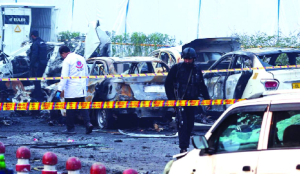
The National Investigation Agency (NIA) on Thursday submitted a voluminous 7,500-page chargesheet against 10 accused in the devastating Vehicle-Borne Improvised Explosive Device (VBIED) blast near the Red Fort that killed 11 people and injured several others on November 10 last year.
The high-intensity explosion tore through the national Capital’s historic precinct, leaving mangled vehicles, shattered glass and widespread property damage in one of the boldest terror strikes in recent years.
The NIA, which took over the case from Delhi Police, has described the attack as the chilling result of a meticulously planned ‘Jihadi Conspiracy’ by members of Ansar Ghazwat-ul-Hind (AGuH), a banned offshoot of the Al-Qaeda in the Indian Subcontinent (AQIS).
AQIS and its manifestations were declared terrorist organisations by the Ministry of Home Affairs in June 2018. All 10 accused, including the main perpetrator, Dr Umer Un Nabi, an ex-assistant professor of medicine at Al-Falah University in Faridabad, Haryana, were deeply linked to the outfit.
Dr Nabi, who died in the blast, had his charges proposed for abatement. The other nine named are: Aamir Rashid Mir, Jasir Bilal Wani, Dr Muzamil Shakeel, Dr Adeel Ahmed Rather, Dr Shaheen Saeed, Mufti Irfan Ahmad Wagay, Soyab, Dr Bilal Naseer Malla and Yasir Ahmad Dar. Several are radicalised medical professionals, the agency said. The NIA’s forensic probe exposed a sophisticated terror module spanning multiple states.
The chargesheet, filed before the NIA special court at Patiala House Courts, reveals the accused secretly reconstituted AGuH as ‘AGuH Interim’ at a clandestine Srinagar meeting in 2022 after a failed migration attempt to Afghanistan via Turkey.
They then launched “Operation Heavenly Hind” to overthrow India’s democratic Government and impose Sharia rule. Driven by this ideology, the group recruited members, propagated violent jihadi propaganda, stockpiled arms and manufactured explosives on a large scale using commercial chemicals.
The Red Fort blast used Triacetone Triperoxide (TATP), a powerful homemade explosive, which the accused produced after procuring ingredients and perfecting the mixture through repeated experiments.
The module also fabricated and tested various Improvised Explosive Devices, including rocket- and drone-mounted versions aimed at security targets in Jammu and Kashmir and elsewhere.
They illegally procured an AK-47 rifle, a Krinkov rifle and country-made pistols with live ammunition. Specialised lab equipment, such as Mixed Metal Oxide (MMO) Anodes, electrical circuits, and switches, was sourced online and offline to aid bomb-making.
Plans existed to expand operations nationwide. The probe agency said the terror module planned to expand its operations across India.
The investigation covered Jammu and Kashmir, Haryana, Uttar Pradesh, Maharashtra, Gujarat and Delhi-NCR. It rests on 588 oral testimonies, over 395 documents and more than 200 seized exhibits. Dr Nabi’s identity was confirmed via DNA fingerprinting.
Forensic analysis of blast-site evidence and linked locations, including Al-Falah University and Jammu and Kashmir hideouts, included voice analysis and other scientific tests.
The chargesheet invokes the Unlawful Activities (Prevention) Act, 1967; Bharatiya Nyaya Sanhita, 2023; Explosive Substances Act, 1908; Arms Act, 1959; and Prevention of Damage to Public Property Act, 1984. Eleven people have been arrested so far. The NIA is pursuing absconders whose roles have surfaced. The NIA said it continues to track down absconders whose involvement has come to light during the investigation.
The mammoth chargesheet highlights the rising sophistication of home-grown terror networks inspired by global jihadist groups. By dismantling ‘Operation Heavenly Hind’, the NIA has sent a clear signal that such plots will be decimated through relentless, evidence-driven investigation. Once the designated NIA court takes cognisance of the chargesheet, the trial of the Red Fort terror attack will commence.