
NEET: Technology, institutions and top brains failed again
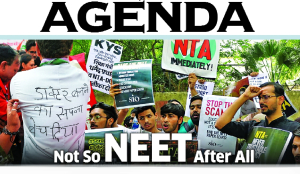
Another NEET paper leak has shattered the faith of lakhs of students who spent years preparing honestly for India's toughest medical entrance exam. This is not just an exam scandal — it is a brutal betrayal of merit, hard work, and the future of an entire generation already battling extreme pressure and uncertainty
Professor Rajeev Kumar is known as a critical policy whistleblower and the man behind the IIT-JEE reforms. Here, he shares his thoughts on the 2026 National Eligibility cum Entrance Test (NEET) cancellations and paper leak
The stakes in medical and engineering admissions in India are extraordinarily high. In a society where family prestige is often tied to the institutions where children study, many parents stretch far beyond their means to secure higher ranks for their wards in these fiercely competitive examinations. Over time, coaching institutes and admission-counseling centers have evolved into a multi-trillion-rupee industry. In such an ecosystem, even cancellations and re-examinations become commercial opportunities, generating fresh demand for crash courses and short-term programs that capitalize on students’ stress, desperation, and uncertainty.
For nearly two successive decades, India’s two most coveted gateways to professional education - NEET for medical admissions and IIT-JEE for engineering during 2006-2015 - exposed a disturbing pattern. Despite technology, powerful institutions, and the involvement of the finest academic and administrative minds, systemic vulnerabilities repeatedly enabled large-scale admission scams and examination irregularities. From organised paper leaks and impersonation rackets to incorrect cut-offs, wrong questions and answer keys, and allegations of preferential treatment benefiting the wards of the powerful, warning signals were often raised not by institutional safeguards but by whistleblowers facing retaliation. Together, these two eras expose recurring institutional failures, technological overconfidence, and the inability to build transparent, accountable, and robust examination systems.
A factual playbook of institutional failure
This article presents facts repeatedly reported in mainstream media, disclosures obtained under the Right to Information (RTI) Act, 2005, and records placed before the highest offices of the Executive, Judiciary, and other public institutions. With utmost respect for all institutions and stakeholders, the author makes no aspersions against any individual, institution, or beneficiary. Guided by the spirit of “naa kaahu se bair na kahu se dosti” — neither animosity nor closeness toward anyone — the article seeks to present a factual playbook of systemic failures through two major case studies that together reflect the central theme. At the same time, it carries a strong hope that institutions and those occupying the highest offices of responsibility will move toward genuine accountability instead of merely suppressing issues or blaming small-time operators. Too often, such exercises create the impression that “all is well,” while deeper systemic failures, embedded malice, and influential beneficiaries remain buried under the carpet, continuing in their positions without scrutiny or accountability.
Scenario one: Examination day - May 3, 2026
May 3, 2026, was a hectic day for the NTA central control room for two reasons. First, NEET 2026 was conducted across 5,500+ centers in 550 Indian cities and 14 cities abroad, with nearly 2.3 million candidates competing for about 60,000 highly prized government medical seats and many more in private colleges. Second, Union Education Minister Dharmendra Pradhan, along with the top leadership of the Education Ministry and NTA, was present in the central control room, monitoring live AI-enabled CCTV feeds from thousands of examination halls.
Ironically, the AI-enabled CCTV systems, observers, technical experts, and top officials failed to notice one striking anomaly visible across hundreds of centers — the unusually stress-free confidence, jubilation, and sparkle in the eyes of a large number of candidates appearing for one of the country’s most competitive examinations. For many, substantial portions of the paper reportedly appeared already familiar through the widely circulated “guided paper” moving across digital networks days or weeks before the examination. Yet neither the AI-driven surveillance systems nor the country’s top institutional minds sensed anything abnormal in this unusually relaxed examination atmosphere.
Scenario Two: Before D-Day - May 3, 2026
After the NEET 2024 fiasco, NTA repeatedly showcased its advanced technologies and stringent security protocols — from encrypted paper-setting and secure PDF transmission for translations to GPS-tracked movement of question papers from bank strongrooms to regional hubs and examination centers. Intelligence and cyber-security inputs from multiple national agencies were also reportedly available. Yet, despite this vast surveillance ecosystem, no alarm appears to have been triggered, while the so-called “guided paper” circulated for weeks across WhatsApp networks in India, alongside large money transactions and growing confidence among candidates and parents that the very questions being practiced would appear in the actual examination.
Scenario Three: After D-Day - May 3, 2026
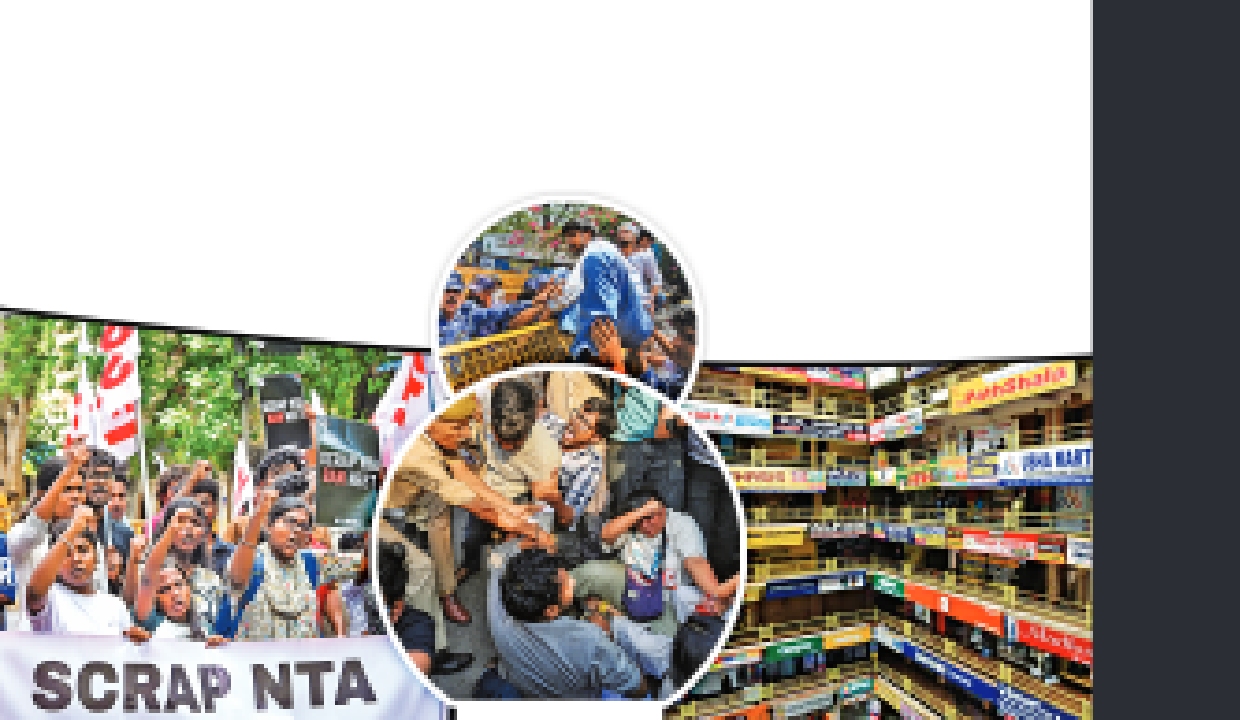
Immediately after the examination, candidates used to rush to coaching institutes and admission-counseling centers to estimate scores using OMR responses and answer keys, which were widely accessible due to the efforts of a second whistleblower discussed later in this article. Candidates could thus roughly predict their scores, ranks, and chances of securing their colleges of choice. With a significantly large number reportedly answering nearly 135 questions correctly, marks appeared unusually inflated, creating visible jubilation in many circles that the purchase of the “guided paper” had paid off. Yet, despite thousands of observers and an extensive feedback and intelligence network, no unusual pattern appears to have triggered concern within the system.
NEET 2026 Whistleblower: When the system failed
Finally, the first serious alert reportedly came not from the institutional surveillance system but from outside it. A Rajasthan-origin MBBS student studying in Kerala shared a PDF of a “guess paper” with his father in Sikar, who, with help from a coaching institute, realised that it substantially matched the actual NEET 2026 paper. The first trigger came through a whistleblower message on May 7, followed by a formal complaint to the local police and NTA.
The rest is now familiar - cancellation, re-examination, and immense stress, confusion, and heartbreak for lakhs of students, alongside another business surge for the coaching industry through fresh crash courses. As often happens, investigating agencies may eventually arrest a few small operators and declare the mystery resolved, while the deeper truth behind the alleged high-powered paper-leak mafia and its possible institutional linkages may never surface. Such networks move on to the next examination, while many leaks remain localized and go unnoticed. Similarly, the NEET 2024 fiasco was effectively buried in the 165-page report of the K Radhakrishnan Committee, which left key questions unanswered, including the recurring nature of NEET irregularities year after year.
Exposing IIT Admission Irregularities
Another major whistleblowing development in this ecosystem emerged with the institution of the Right to Information (RTI) framework in 2005. Before the RTI era, most competitive examinations, including medical and engineering entrance tests, operated in near-complete opacity. Candidates were not given question papers, official answer keys, marksheets, or even the selection criteria. In the absence of transparency, people trusted examination agencies almost unquestioningly, and the outcome was merely a “selected” or “not selected,” often without any understanding of why. During the RTI era, intervention by late Arjun Singh led IITs to issue marksheets to candidates.
From the beginning, IIT-JEE followed a balanced evaluation model requiring candidates to secure minimum qualifying marks separately in Mathematics, Physics, and Chemistry before aggregate merit was considered. A marked deviation from these subject-wise cut-offs in 2006 triggered whistleblowing by an IIT professor, opening another major chapter in the history of examination irregularities in India.
Before 2006, IIT admission processes operated with near-complete opacity and were allegedly marked by irregularities, irrationalities, and ad hoc practices. In 2006, it emerged that general-category candidates scoring as high as 279 marks were denied admission, while others with only 154 marks were admitted. IITs justified the exclusion by citing unusually high subject-wise cut-offs of {37, 48, 55} in Mathematics, Physics, and Chemistry, though they could not satisfactorily explain how such cut-offs were derived. After a whistleblower challenged the issue, these cut-offs dramatically dropped to single digits - {1, 4, 3} in 2007 and {5, 0, 3} in 2008 out of 182 marks - turning IIT-JEE into a public embarrassment, with even zero marks in Physics making unreserved candidates eligible for IIT admission.
Several other irregularities also surfaced. Errors in questions and answer keys, ambiguous instructions, and procedural loopholes enabled wide-ranging manipulations. Students were admitted to multiple institutions simultaneously, wasting national resources and leaving hundreds of seats vacant, often paving the way for backdoor admissions. Questions were also raised regarding admissions of wards of high-profile IIT professors. At the same time, some professors voluntarily stepped down from influential positions to avoid conflicts of interest when their children appeared for the IIT-JEE.
The Delhi High Court described the situation as “a proverbial situation of it being darkest beneath the lamp,” observing that if such facts became widely known, IITs could become “a laughing stock in the eyes of their clients.”
IIT-JEE Reforms Through Whistleblowing
The whistleblower’s decade-long struggle from 2006-2015, as a single-person army, led to major reforms in IIT admissions through transparency, prior decision-making, and standardized procedures. These included fixing subject-wise cut-offs a priori, allowing candidates to retain question papers, publishing and correcting answer keys through feedback, providing access to evaluated OMR/ORS sheets before results, pioneering the common engineering entrance framework through JEE (Main), and conceptualizing centralized counseling systems such as JoSAA/CSAB with multiple rounds to optimize seat allocation and prevent blocking of seats.
Most such reforms are in public use across MCQ-based competitive examinations in India, benefiting millions of students annually. Notably, NTA adopted most of these methodologies. Importantly, none of these transparency-oriented SOPs failed in later NEET or JEE controversies; the failures largely arose from logistical and operational vulnerabilities.
The “Unsung Hero” Whistleblower
The Supreme Court of India hailed the IIT whistleblower as one of the many “unsung heroes” who helped improve the system and asked IITs to thank the whistleblower appellants for bringing greater transparency and accuracy to the ranking process. IITs did thank him.
Instead, the IIT most exposed by the disclosures subjected the whistleblower to victimization through suspension, institutional marginalization, termination attempts, and endless inquiries. Later, the IIT reportedly passed the baton to another influential IITian who was controlling the whistleblower in a Central University and subsequently headed India’s higher-education regulator. The victimization has continued even after retirement, including through the alleged misappropriation of his intellectual contributions.
The Way Forward
In today’s ecosystem, the IIT whistleblower might well have been dismissed, ridiculed, or branded a cockroach for questioning powerful institutions. Yet, the Apex Court recognized that the whistleblower’s challenge to the JEE 2006 process, RTI-driven transparency efforts, and the resulting public debate helped make the merit-ranking system more transparent and accurate. The Court further observed that admission systems must be continuously upgraded.
That remains the real way forward for India’s high-stakes admission ecosystem. No technology, AI-enabled surveillance, intelligence network, or institutional hierarchy alone can substitute transparency, accountability, continuous process refinement, and the moral courage to acknowledge systemic failures. Institutions do not become weaker by admitting vulnerabilities; they become stronger by correcting them. The real challenge is not merely catching a few paper leaks or small operators after every scandal, but dismantling the deeper ecosystem of opacity, complacency, and institutional protection that allows such crises to recur year after year.
The writer is a Tech Education Policy Consultant, a former Professor of Computer Science at IIT Kharagpur, IIT Kanpur, BITS Pilani, and JNU, and a former scientist at DRDO and DST; Views presented are personal.