
Modi’s I-Day speeches: Shaping India’s future
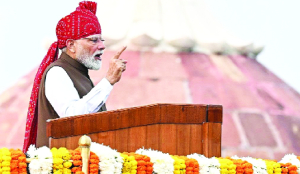
Each year on August 15, the Prime Minister of India addresses the nation from the Red Fort on the country’s goals. Since 2014, Narendra Modi has given 13 Independence Day speeches from this historic site.
In the beginning, these speeches focused on basic dignity. Over the years, they laid out a plan for India’s growth up to 2047. Modi’s speeches have launched programs to reform finance, improve sanitation, expand insurance for people in poverty, provide water and electricity, and now help young people prepare for the age of artificial intelligence.
The goal was clear: move from financial exclusion to empowerment. In 2014, when Modi became “Pradhan Sevak,” he chose not to use a bulletproof shield and instead focused on issues such as sanitation, financial inclusion, and manufacturing. The Pradhan Mantri Jan Dhan Yojana (PMJDY) aimed to give every household a bank account. The Swachh Bharat Mission worked to end open defecation. Make in India encouraged global investment in local manufacturing, while the Saansad Adarsh Gram Yojana and the Housing for All program completed the first round of reforms.
These programs addressed long-standing poverty issues. By 2026, there were over 580 million Jan Dhan accounts with more than three trillion rupees in deposits. Direct Benefit Transfers (DBT) sent welfare funds straight to people’s bank accounts.
The Swachh Bharat Mission resulted in the construction of over 120 million household toilets, and India was declared open-defecation-free. Make in India delivered strong results: electronics manufacturing grew nearly sevenfold, mobile phone production increased 35-fold, and defence production also rose. The PM Awas Yojana (PMAY) led to the construction of millions of permanent homes. Electricity reached villages for the first time. In 2015, Modi’s speech introduced Startup India and Stand Up India to support young entrepreneurs, especially women and people from Scheduled Castes and Tribes. The One Rank One Pension (OROP) scheme met a long-standing demand from the armed forces and brought pension equality. India now has over 250,000 startups, creating millions of jobs and making the country the world’s third-largest startup hub. The focus then shifted to healthcare and space.
Ayushman Bharat gave each family health coverage worth 500,000 rupees, and the Gaganyaan mission aimed to send an Indian astronaut to space by 2022. More than 450 million Ayushman cards have been issued, helping millions get free medical care. Although the Gaganyaan schedule changed, by 2026, important progress had been made with human-rated systems and uncrewed missions. In 2019, Modi’s speech focused on making water more accessible and improving military coordination.
The Jal Jeevan Mission promised to bring working tap water to every rural home, increasing coverage from 17 per cent to over 81 per cent and reaching more than 158 million homes by early 2026. Creating the Chief of Defence Staff role helped the armed services work together more effectively. The COVID pandemic years were challenging. In 2020, Modi launched the National Digital Health Mission and stressed Atmanirbhar Bharat, or self-reliant India. In 2021, the Gati Shakti plan was launched as a major infrastructure project worth 100 trillion rupees, alongside the National Hydrogen Mission. Roads, railways, and logistics grew quickly, and renewable energy expanded rapidly.
India’s renewable energy capacity grew from 76.38 GW in 2014 to 288.58 GW by June 2026, nearly fourfold. Solar power saw the biggest increase, rising from about 2.8 GW to 162.15 GW, then to around 164.6 GW. Wind power went from about 21 GW to 57.44 GW. Hydropower reached 57.24 GW, and bio-power was at 11.75 GW. By July 2026, non-fossil fuel sources made up over 300 GW, or more than 54 per cent of all installed power capacity. Clean energy output more than doubled, from 191 billion units in 2014-15 to nearly 478 billion units in 2025-26.
Foreign Direct Investment (FDI) in the sector reached 45.72 billion dollars, and domestic institutions invested 12.32 lakh crore rupees. From 2022, the focus moved to long-term goals for 2047. The Panch Pran pledges called for a developed India free from colonial mindsets. In 2023, Modi set a goal to create two crore “Lakhpati Didis.” By 2026, more than 20 million women earned over 100,000 rupees a year through self-help groups. In 2024, the PM Surya Ghar Muft Bijli Yojana helped families install rooftop solar panels by giving up to 80,000 rupees per household. The program reached over 5 million households, adding almost 15 GW of rooftop solar capacity. Nearly 1.9 million families now pay nothing for electricity, and many sell extra power to earn more.
Adding 75,000 medical seats over five years began to address the doctor shortage. In 2025, Modi announced the Pradhan Mantri Viksit Bharat Rozgar Yojana, a one-trillion-rupee plan to create 35 million jobs. Mission Sudarshan Chakra set a 2035 deadline for a new air-defence system. India also made progress in producing its own semiconductors, with the first homegrown chips reaching the market. GST reforms were announced as a Diwali gift.
In 2026, on the 80th Independence Day and during his thirteenth consecutive speech, Modi introduced ‘Sapta Dhara ‘, or seven pillars of national strength: manufacturing, agriculture and food processing, technology and innovation, Gati Shakti, defence, the green and blue economy, and soft power. He announced AI skill training for ten million young people in a year, free online coaching for competitive exams, plans for seven or eight new semiconductor plants, a 100 GW nuclear energy goal by 2047 with five new reactors this decade, a national sports talent search for children aged five to fifteen, a modern civil-defence network, and a proposal for 33 per cent women’s reservation. Modi pointed out the increase in solar capacity from 2 GW to 160 GW and the Surya Ghar program reaching five million homes. These changes are clear and measurable. Financial inclusion reached even the most remote areas.
Better sanitation improved people’s dignity. Tap water and solar power became common. Health coverage protected those most at risk. Startups and self-help groups created jobs. Infrastructure and defence production grew significantly. India’s digital systems became models for the world. Renewable energy grew fourfold, solar power increased 57-fold, and rooftop solar changed how households use energy, making energy security possible.
Over thirteen Independence Day speeches from the Red Fort, Modi used the event to launch new policies. Early speeches focused on basic needs, while later ones highlighted self-reliance, technology, and making the most of India’s young people. The announced initiatives have promoted financial inclusion. They have improved sanitation, expanded insurance, and increased access to electricity.
Now, these efforts are helping the next generation prepare for a future shaped by artificial intelligence. India is no longer just trying to catch up.