
Marvels of India - MAURYAN CIVIL SERVICE
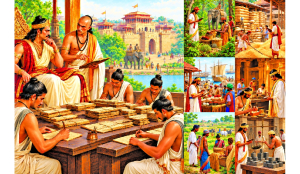
Departmentalised Bureaucracy
Kautilya's Arthashastra describes an elaborate, extensive and efficient civil service organised around 27 adhyakshas (superintendents), each heading a specialised department such as agriculture, land, mines, customs and tolls, weights and measures, trade and commerce, shipping, etc., assisted and supported by clerks and accountants. This functional division let a vast empire (c. 321-185 BCE), stretching from the northwestern frontier to the Deccan, be administered with the best governance model.
Built-in Accountability
Uniquely, the Arthashastra prescribes qualifications - honesty, loyalty, intelligence and administrative capability - for appointees, alongside an espionage network to detect corrupt officials and other suspicious activities, predating the present-day civil service ideals of merit and oversight.
Corroborated Evidence, Not Concocted
Megasthenes, the Greek envoy at Chandragupta's court, refers to six committees of five members each governing Pataliputra. At the same time, Ashoka's rock and pillar edicts allude to officials called mahamattas carrying out welfare functions. Hence, the textual, epigraphic and foreign travelogue testimony converge on one picture.
Centralised Governance
Ancient Indian historians note that this centralised structure gave Mauryan Bharat its first authentic administrative uniformity. However, they also observe that acute centralisation later made the system vulnerable once weaker successors held the throne: a caution embedded in its own success.