
LG confers lifetime awards on 5 artists
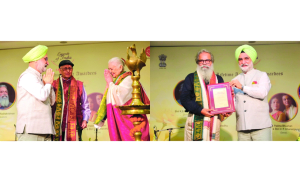
India’s classical arts and cultural traditions epitomise that patience and perseverance are prerequisites for achieving the pinnacle of glory, and this is an important message for the younger generation.
Underlining this crucial point, Delhi Lt Governor (LG) TS Sandhu also called for stronger links to be built between young people and the country’s cultural traditions through lectures, performances, workshops, and opportunities to learn directly from practitioners.
He made these remarks here on Saturday after conferring Legends of India Lifetime Achievement Awards 2026 on five distinguished artists, honouring their lifetime contribution to India’s classical arts and cultural traditions.
The awardees included Guru Shri VP Dhananjayan and Guru Shanta Dhananjayan for their contribution to Bharatanatyam, Ustad Shahid Parvez Khan for his mastery of the sitar and Hindustani classical music, TH Vinayakram for Carnatic classical music, Margi Madhu for his contribution to India’s theatrical traditions, and KS Radhakrishnan for his contribution to Indian sculpture.
The ceremony was attended by Chairman, Festivals Awards, Legends of India, Ambassador Lalit Mansingh, Founder Chairman, Legends of India, Dipayan Mazumdar and guests.
Addressing the gathering, Sandhu said the occasion was not merely to honour individual artists, but to recognise the civilisational inheritance they represent and the living traditions they have sustained through a lifetime of discipline, imagination, and devotion.
Quoting Prime Minister Narendra Modi’s remark that “culture is a sublime expression of a people, and the foundations of a society,” he said India’s classical music, dance, theatre, and visual arts are repositories of the nation’s history, imagination, and collective memory, and serve as powerful instruments of social and cultural dialogue that transcend differences of language and background.
The LG said preserving these traditions has become even more important at a time when technology is changing how people communicate and consume information, but stressed that preservation cannot mean keeping culture frozen in the past. It must instead mean creating conditions in which tradition remains relevant, while giving the next generation opportunities to experience, learn, and reinterpret it, Sandhu said.
He connected this idea to the Shakti ki Saptdhara vision, particularly its emphasis on knowledge and cultural strength, saying India’s rise must be accompanied by a confident cultural identity, rooted in heritage yet open to the world, one that can serve as a bridge between India and the global community and strengthen the country’s soft power.
Speaking about the awardees, the LG said each represents a different tradition, but a common thread connects them: decades of discipline, dedication, and unwavering commitment to their craft, built through patience, practice, and mentorship. The LG said this holds an important lesson for the younger generation, that in a rapidly changing world, new skills are essential, but so are perseverance, depth, and dedication to one’s craft, and called for stronger links to be built between young people and cultural traditions through lectures, performances, workshops, and opportunities to learn directly from practitioners.
Sandhu stressed that the preservation of culture cannot be left to artists and cultural institutions alone, and that families, educational institutions of Delhi, civil society, and the corporate sector all have a role to play in making India’s heritage more accessible.
He said the greatest tribute to a cultural legend lies not simply in honouring past achievements, but in ensuring that their knowledge, discipline, and artistic traditions continue to inspire the next generation.