
Kautilya and the War for the “Mindscapes”
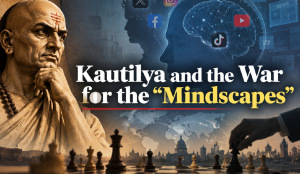
We once measured war through geography: coordinates, formations, borders, and territory won or lost. That physical certainty has thinned. A video crosses a frontier in the time it takes to press "share"; a doctored image earns credibility through repetition; a rumor moves a population before a government can check the facts. None of it requires a soldier to cross a line on a map.
The consequential shift is not merely from physical to digital warfare, but from territorial battle spaces to borderless mindscapes. A mindscape is not contained by sovereignty. It has no checkpoint, Line of Actual Control, or international boundary. It is constituted by memories, fears, prejudices, aspirations, and identities, all of which are reached, measured, and manipulated through devices sitting in millions of homes.
India carries the weight of this shift acutely. With nearly a billion wireless internet subscribers, India's telecommunications system describes something larger than a market; it functions as a national nervous system. Villages, cities, armed forces, universities, and political communities are connected to a single information environment where local events become national conversations within minutes.
What happens when the target of an attack is not a state's capacity to fight, but its willingness to fight, its judgment, its social cohesion, and its grip on truth?
The oldest answer is among the most precise. In the Arthasastra, Kautilya places war (vigraha) among the six instruments of statecraft (sadgunya) and defines it simply as apakara, meaning the doing of injury, rather than physical annihilation. He separates open war (prakasayuddha) from two quieter forms: kutayuddha (the war of concealment and deceit) and tusnimyuddha (silent war waged through covert means). Not every war begins with an explosion; some begin by altering the conditions under which an adversary thinks and decides.
Kautilya was candid about where the real wound is inflicted:
"An arrow loosed by an archer may kill one man, or none; but intellect, rightly aimed, can destroy even the unborn." (Arthasastra 10.6.51)
Read with a screen in mind, the aphorism loses its metaphorical distance. The arrow represents kinetic force, whereas the aimed intellect is the crafted narrative, the manipulated image, or the carefully timed rumor.
Kautilya's framework directs attention away from the message alone and toward the condition of the target.
He opens his discussion of kutayuddha not simply with deception, but with vyasana, referring to the internal calamities, grievances, and weaknesses afflicting the state. A divided military, an alienated population, or declining confidence in leadership are attack surfaces of the national mindscape.
Reducing cognitive warfare to "disinformation" misses this dynamic. A falsehood requires a receptive environment. The strategic objective is often not to make a population believe a specific lie but to render them uncertain about every competing account of reality. Persuading citizens that nothing is true causes cognitive exhaustion, societal fragmentation, and strategic paralysis. Research on cognitive warfare echoes this reality: the objective is not merely to change what people think but how they think and act, ultimately fracturing the collective will to resist.
India has already glimpsed this environment. AI-generated deepfakes of prominent figures during general elections demonstrate how technology has lowered the cost of personalised persuasion at scale. The primary danger is an asymmetry of speed: a synthetic video takes minutes to produce, hours to verify, days to correct, and years to repair the damaged trust. During military confrontations, fabricated statements or manipulated media influence not just public sentiment but also the rapid calculations of commanders and diplomats.
Because digital narratives lack logistical range limits, foreign influence can easily loop through global platforms to appear as independent local opinion. A case in point is the fabricated narrative spread by Pakistan with the help of collaborators and a web of bots in different countries, during and after Operation Sindoor.
Kautilya's concept of bheda (division) becomes vital here. An adversary rarely needs to invent new conflicts; it merely identifies existing fault lines (such as caste, region, language, ideology, or economic anxiety) and widens them. Combined, tusnimyuddha and kutayuddha form a modern ecosystem of botnets, synthetic media, and algorithms that industrialises covert influence. Generative AI accelerates this shift from mass propaganda to mass-personalised persuasion, targeting the individual who acts simultaneously as consumer, validator, and amplifier.
This reality reveals why cognitive resilience differs fundamentally from cybersecurity. A firewall blocks a data packet, but a citizen cannot be firewalled from an idea. A platform can remove an account, but it cannot remove the underlying grievance that gave it an audience. Fact-checks clarify reality, but they do not automatically restore eroded institutional trust.
India is moving beyond content moderation toward structural cognitive resilience.
This requires anticipating informational vulnerabilities before crises occur, establishing rapid channels for authoritative truth, fostering media literacy, and integrating the information domain directly into defence and diplomatic
planning.
Above all, it requires strengthening the core social conditions that render manipulation ineffective. Kautilya's statecraft emphasised evaluating prakrti (the constituent elements of the state) and prioritising mantrasakti, which is the power of counsel, deliberation, and intellect over mere material force. In an era of abundant information but scarce clarity, the challenge is maintaining the capacity to distinguish signal from noise, evidence from assertion, and deliberate manipulation from honest debate.
The contest over mindscapes is ultimately a contest over agency. Who determines what a society fears, notices, or believes? Who decides which version of an event is credible, and whether citizens can trust one another when narratives clash?
India is continously patrolling its land borders, maritime routes, and digital networks. But alongside them exists an invisible, continuous battlespace where perception moves faster than armies. For an open democracy, building an impermeable wall around the national mind is not an option, nor is it something India aspires to. Instead, India's resilience relies on an informed citizenry and cohesive public discourse that naturally neutralises divisive influence. Kautilya understood that the most efficient victory compels an adversary to weaken itself. As the frontier shifts from physical lines to human perception, defending the mindscape becomes the ultimate strategic imperative.