
Jharkhand students demand justice
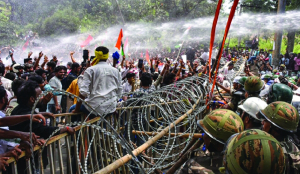
Jharkhand’s prolonged student agitation is no longer merely a protest over examination irregularities. What began with anger over alleged leaks and discrepancies in recruitment examinations has evolved into a broader expression of frustration over jobs, education, transparency and political representation
In recent years, Jharkhand has seen a rise in student activism driven by a growing awareness of social issues and the need for better representation. The student protests, which followed the rise of the Cockroach Janata Party (CJP) at the all-India level, marked a turning point in Jharkhand’s socio-political narrative. Students recently organised protests after the unexpected rise of the Cockroach Janata Party (CJP). These protests targeted issues in the education system, including the leak of question papers in NEET and other exams. The current political situation has encouraged young people to speak out about their frustrations and demands regarding the state’s social and economic problems.
The student protests followed the rise of the Cockroach Janata Party (CJP) and mark a significant moment in Jharkhand’s social and political landscape. This student group is not just asking for better education and job opportunities; they want to be heard in the political conversation. They are fighting for a future where their voices matter, and their rights are respected.
Since July 25, protesters have gathered at a stadium in Ranchi, Jharkhand. Many have been sleeping outside, and some have begun hunger strikes. Many have been sleeping outside, and some have initiated hunger strikes. Protesters are committed to continuing until all their demands are met. Their anger stems from a preliminary civil service exam held by the Jharkhand Public Service Commission (JPSC) in April. After the results were announced in July, candidates said leaked answer sheets on social media showed that some successful applicants answered fewer questions than expected. The CJP ended its five-week protest on July 25 with the resignation of Education Minister Dharmendra Pradhan.
The CJP’s achievements energised students, giving them a chance to voice their concerns about education, jobs, and social justice in Jharkhand—issues that the CJP highlighted. By pushing for transparency, accountability, and local involvement, the CJP resonated with students eager for change.
During the protests, students expressed their frustration with the declining quality of education in Jharkhand’s institutions. Many protested against overcrowded classrooms, a lack of resources, and insufficient faculty, demanding immediate reforms to create a better educational environment.
Amid economic uncertainty, students pointed out the high unemployment rate, especially among graduates. They urged the government to create job opportunities and asked the CJP to prioritise youth employment.
The protests attracted a diverse group of students from various colleges and universities across Jharkhand. They used social media to organise rallies, marches, and awareness campaigns. Students have actively participated in demonstrations for more than two weeks, advocating for comprehensive reforms to the government examination system in Jharkhand. This newly energised student body is not only demanding better educational and job opportunities but is also asserting its place in the state’s political discourse. They are advocating for a future where their voices are heard, and their rights are respected.
The immediate cause of their anger is a preliminary civil service exam held by the Jharkhand Public Service Commission (JPSC) in April. After the results were announced in July, candidates alleged that leaked answer sheets shared on social media indicated that some successful applicants had answered significantly fewer questions than expected.
The success of the CJP catalysed student mobilisation in Jharkhand also, allowing them to express their concerns over critical issues of education, employment, and social justice in Jharkhand—issues that the CJP had notably addressed. By advocating for transparency, accountability, and grassroots participation, the CJP resonated with students and young people eager for change.
During the protests, students voiced their dissatisfaction with the declining quality of education in institutions across Jharkhand. Many protested against overcrowded classrooms, a lack of resources, and insufficient faculty, demanding immediate reforms to ensure a better educational environment.
Amid economic uncertainty, students highlighted the alarming rate of unemployment, particularly among graduates. They called for government intervention to create job opportunities and urged the CJP to prioritise youth employment in its agenda. Students demanded greater representation and involvement in the political process, expressing that the voices of the youth were often marginalised in decision-making. They advocated for platforms that encourage youth participation and ensure their concerns are addressed.
The protests attracted a diverse group of students from various colleges and universities across Jharkhand. Utilising social media as an effective tool for organisation, they coordinated rallies, marches, and awareness campaigns. This visibility was crucial in amplifying their demands and bringing their issues to the forefront of public discourse.
As Jharkhand student agitation enters Day 20, job aspirants demand a CBI probe and the total cancellation of JPSC and JSSC recruitment exams. Protesting students, including Devendra Mahto and Manoj Yadav, have threatened to demonstrate before the Chief Minister’s residence after August 15th. An FIR has been registered against 100 named individuals and 500 unidentified protesters.
Meanwhile, ABVP, the student wing, has said it would stage demonstrations at over 1,200 universities and in every district across the country. Expanding the scope of the protests. The ABVP will resort to a phase-wise agitation across the country if a CBI probe into the job exam irregularities is not held. While the CJP movement is called Gen Z protest, the Jharkhand movement has a significant presence of an older generation of aspirants—millennials and others. It is not only youthful impatience. It is accumulated frustration. At Jantar Mantar, students were protesting against a BJP-led government at the Centre. The movement became increasingly confrontational and the police response became an important part of the story.
In Jharkhand, the political equation is different and a non-BJP government is facing the students. A new twist is (CJP) has joined the ongoing student agitation in Jharkhand, with a party delegation reaching the protest site in Ranchi.
They declared “complete solidarity” with Jharkhand students. With the government holding talks but protesters refusing to call off their demonstrations, the coming days are likely to determine whether negotiations can break the deadlock.
For now, the students continue to demand accountability and corrective action over the recruitment examination process, while the state government says it will consider the issues raised by the protesting groups.
The immediate cause of their anger is a preliminary civil service exam held by the Jharkhand Public Service Commission (JPSC) in April. After the results were announced in July, candidates alleged that leaked answer sheets shared on social media indicated that some successful applicants had answered significantly fewer questions than expected
The writer is a popular columnist; Views presented are personal.