
Japan rejects China’s militarism charge, questions Beijing’s military build-up
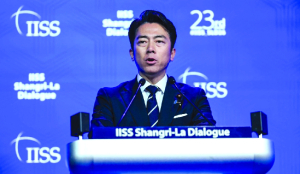
Japan on Sunday dismissed China’s charge of “new militarism”, with Defence Minister Shinjiro Koizumi questioning Beijing’s own military expansion, including its nuclear arsenal, strategic bombers and rising defence spending.
Addressing the Shangri-La Dialogue security forum in Singapore, Koizumi defended Japan’s ongoing defence modernisation and stressed that Tokyo remained committed to its post-war pacifist principles while adapting to an increasingly complex security environment in the Indo-Pacific.
“Some of you may have heard the term ‘new militarism’, but nothing (could be) further from the truth.”
“Think about it. There is a country that has a huge arsenal of nuclear weapons and strategic bombers. Japan has neither of such weapons, and yet Japan is labelled ‘new militarism’,” he said in an apparent reference to China.
Koizumi said Japan’s reputation as a peace-loving nation, built since the end of World War II, would not be undermined by what he described as “false claims”.
“Opaque military build-ups and action without clear intentions will be the cause of distrust and miscalculation,” he warned, adding that Japan will implement its defence reforms “with a high degree of transparency”, according to Japan’s Kyodo News agency.
Japan’s defence modernisation includes a planned revision of key national security documents and investments in areas such as artificial intelligence, unmanned systems, cyber capabilities and space.
China has repeatedly criticised Japan’s military modernisation, describing it as a “dangerous rupture” of post-war pacifist tradition.
Responding to a question from a Chinese delegate, Koizumi said Japan’s defence policy and military build-up are not aimed at any specific country and are not intended to lead to military confrontation. “That said, China continues to increase its defence spending at a high level and is rapidly expanding its military capabilities across a broad range of areas without sufficient transparency,” he said.
China this year increased its defence budget by 7.2 per cent to about USD 245 billion, continuing its long-term military modernisation drive.
Beijing’s actual military expenditure is believed by several international analysts to be significantly higher than officially disclosed figures.
Koizumi said China’s military activities and growing external assertiveness are matters of “serious concern” for Japan and the broader international community, according to the Hong Kong-based South China Morning Post.
Relations between Asia’s two largest economies have deteriorated in recent years amid disputes over the East China Sea, China’s military activities around Taiwan, and growing strategic competition in the Indo-Pacific.
Tensions further escalated after Japanese Prime Minister Sanae Takaichi suggested last year that Japan could respond in the event of a Chinese attack on Taiwan, the self-governed island that Beijing claims as part of its territory and has vowed to reunify with the mainland, by force if necessary.
Despite the differences, Koizumi said Tokyo remained committed to maintaining dialogue with Beijing.
He also expressed disappointment over the absence of Chinese Defence Minister Dong Jun at the Shangri-La Dialogue. Dong skipped the annual security forum for the second consecutive year, with China sending a lower-level delegation instead.
Highlighting what Tokyo sees as rising risks in the Taiwan Strait and the South China Sea, Koizumi said Japan is assuming a larger role in regional security, including expanding defence cooperation and equipment transfers with partner countries.
He underlined that Japan is stepping into a “new role” as a primary defence equipment supplier for the region.
The Indo-Pacific, the minister said, is facing “attempts to unilaterally change the status quo by force or coercion,” along with growing “economic coercion” and the “weaponisation of everything”.
Arguing that the line between peacetime and contingency is becoming “increasingly unclear”, he outlined Japan’s strategic rationale for strengthening defence capabilities, including cyber, space and unmanned systems.
The intent, Koizumi said, is not escalation but adaptation.
“It is only natural that every country is working to update its own defence capabilities in order to respond to these new challenges,” he said.