
IADB chief pitches rare earth mining potential to Pope Leo
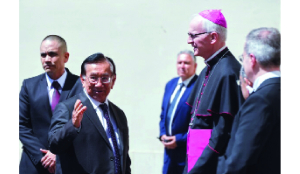
The head of Latin America’s top development bank made a pitch to Pope Leo XIV this week in the face of the Vatican’s call to divest from the mining industry: that the mistakes of the past can be avoided in extracting rare earth minerals to supply a global tech boom.
Ilan Goldfajn, head of the Inter-American Development Bank (IADB), met privately with the pope on Friday and asserted the potential of rare earth mining, saying it could be a boon to Latin America provided there are safeguards and value is added locally. It’s probably not an easy sell. The Vatican for years has taken a firm stand against multinational mining corporations, especially in Latin America and in favour of the Indigenous peoples, whose lands and livelihoods are often ravaged when mining projects come to town. Goldfajn’s visit, which followed one earlier this year by mining executives, suggests that he recognises the weight of the pope’s words in the majority-Catholic region, and a desire to sensitise him to the possibility of a better way of doing business.
Whether Leo can be swayed is another matter, given his own experience in the region and criticism of the often-corrupt deals mining companies ink with Governments in the developing world. Countries have identified dozens of minerals, including copper, cobalt, lithium and nickel, as critical because they are essential for new technologies. The 17 rare earth elements are a subset of them. They’re used in a wide range of products, including smartphones, semiconductors, electric vehicles and jet engines.
“It’s a unique opportunity for the region, but you need to do it in the right way with the standards, the labour conditions, with the environmental conditions, the governance,” Goldfajn said in an interview in Rome on June 18, one day before his meeting. “We have exactly the tools to do that,” he added, noting the IADB has a roughly USD 4 billion pipeline of critical mineral projects in the region, mostly in Chile, Argentina and Brazil, and three-quarters of that amount with private companies. He had just delivered a presentation on rare earth minerals at a finance conference, with an eye on potential European investors.
Mining has a checkered, centuries-long history in Latin America, from forced labour and displacement of Indigenous peoples to deforestation, poisoning of waterways and deadly dam collapses. Foreign companies withdrew much of the wealth from the earth without enriching local populations. In colonial times, silver and gold made its way across the ocean to adorn Catholic churches.