
How the Jantar Mantar protest dissolved the divide between the millennials and Gen Z
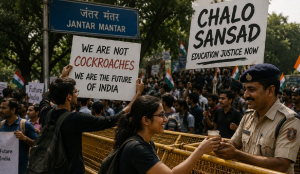
What began as a student movement over alleged examination irregularities evolved into something larger: an unlikely meeting point where two generations, often caricatured as opposites, found common ground in a shared cause.
New Delhi: The student-led protest at Jantar Mantar over alleged irregularities in the NEET-UG examination became more than a demand for political accountability. It also became an unexpected meeting point for two generations that had long defined themselves by their differences.
For years, millennials criticised Gen Z as overly sensitive, detached and deeply rooted in their digital lives. Meanwhile, Gen Z mocked millennials for making work their identity and clinging to more traditional, reserved ways of thinking. At Jantar Mantar, however, those stereotypes seemed to fade as both generations stood together behind a common cause.
From satire to movement
The movement was led by the Cockroach Janta Party (CJP), a youth organisation founded by Boston University alumnus Abhijeet Dipke.
What began as satire, after unemployed youth were allegedly referred to as "cockroaches" by the Chief Justice of India, evolved into a nationwide campaign demanding the resignation of Union Education Minister Dharmendra Pradhan following alleged examination irregularities, including the NEET-UG paper leak, which disrupted the futures of thousands of students.
The protest gathered momentum after educationist Sonam Wangchuk joined it with an indefinite hunger strike. On July 20, thousands marched towards Parliament during the "Chalo Sansad" campaign. Protesters were met with tear gas and a lathi charge, but the demonstrations continued.
Five days later, Pradhan resigned, and Jantar Mantar erupted in celebration as crowds sang the national anthem and distributed sweets. While the resignation became the headline, the protest's lasting significance may lie elsewhere: in how a shared purpose dissolved long-standing generational stereotypes.
Also read: The real outrage wasn't the girl's profanity but what it distracted us from
Two generations, one protest
As a member of Gen Z, I had known Jantar Mantar mainly as a landmark from history books. This protest felt different because it was led by people my own age. It soon grew into a movement embraced by parents, professionals and older generations, who chose to support rather than dismiss young voices.
For many millennials, a protest carried weight and fear: standing up to the state, risking being branded anti-national, facing a lathi charge or worse. Many in Gen Z, however, appeared to approach it differently. They turned insults and intimidation into memes, joked in the middle of tear gas, and refused to let official disapproval intimidate them.
The same phones that millennials once mocked became the tools that brought students together from across the country. They documented the lathi charges, kept the movement visible and helped sustain it online. What older generations often dismissed as a lack of seriousness turned out, for many, to be fearlessness expressed through humour rather than caution. In time, many millennials came to see it that way too.
The stories that connected hearts
One journalist at the protest watched a young woman, perhaps 19 or 20, weave through the crowd carrying a flask of tea, pouring cups for anyone who wanted one.
When she reached a police barricade, she smiled at an officer and asked, "Uncle, aap ko bhi chahiye?"
He replied, "Haan, de do."
She asked whether he wanted sugar.
"Uncle, cheeni wali ya bina cheeni ki?"
He chose sugar.
"Cheeni wali de do."
She grinned and teased him anyway.
"Arey uncle, aap ke aane se pehle toh aapka pet aa jata hai. Aap bina cheeni wali piyo. Aunty khush hongi."
The officer laughed and accepted the sugar-free tea instead.
Asked later whether he had been offended, the officer said his youngest daughter was about the same age as the young woman. She had wanted to attend the protest too, but he had asked her not to because he was unsure how the day would unfold. Even so, he said, these were children fighting for his daughter's future as much as for their own.
The tea exchange was not an isolated incident. Protesters handed roses to police personnel at the barricades moments after being pushed back. Students dragged barricades aside and rode them like makeshift carts. In Bihar, protesters reportedly asked police officers whether water cannons or tear gas would be used that day, treating it almost like casual conversation. When the water cannons were eventually switched on, many danced in the spray instead.
It was this fearlessness, laced with humour, that many millennials gradually came to understand.
What actually changed
The tea exchange was only one of many small acts that built mutual respect. Protesters shared food with strangers, volunteers ran first-aid stations, and people across the country ordered meals for students they would never meet. None of it was centrally organised. It emerged organically from a movement sustained by ordinary people.
The legacy of Jantar Mantar may therefore be more than political. For a brief period, millennials and Gen Z stopped debating their differences and discovered something more enduring: respect, trust and the belief that meaningful change is strongest when generations stand together.