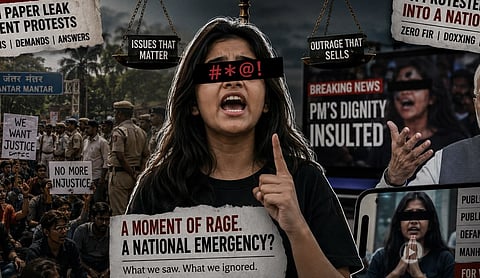

The controversy over a protester's abusive remarks eclipsed the issue that brought hundreds to the streets. That shift in focus deserves closer scrutiny than the words themselves.
Can a protester's profane language become a national emergency? The country today seems to be grappling with precisely that question. All thanks to one self-proclaimed teenager, her unparliamentary language at a student protest, the Prime Minister's seemingly indulgent admonition, and an apology video that surfaced within hours of his appeal to the nation to "guide the misguided youth".
It took six days to turn one protester's profane language into a national story about the Prime Minister's dignity, but almost no time at all to forget the protest's original purpose.
So here's what actually happened before the story was taken away from her.
On July 23, at the CJP protest in Jantar Mantar, a "25-year-old" Noida salon worker named Ruchika Singh swore at the Prime Minister on camera. The video went viral. Six days later, a Zero FIR was reportedly registered against her for public insult, public mischief and defamation under Sections 352, 353(1) and 356(1) of the Bharatiya Nyaya Sanhita (BNS). She has reportedly gone underground. Reporters have camped outside her former salon, questioning former colleagues as though she had committed a violent crime.
I'm not defending the language. In fact, I actively condemn it. The words were crude, disrespectful and exactly the kind of thing that makes an already polarised public discourse even uglier. I would not defend a single word.
However, the question that baffles me is this: What, precisely, did the nation suffer?
Also read: How the Jantar Mantar protest dissolved the divide between the millennials and Gen Z
No one was hurt, no property was damaged. A woman said something ugly to a crowd, and the crowd clapped and a video spread. That’s the entire offence. It's rude, beneath the dignity of public debate and clearly not a threat to the Republic of India. Treating it as such – public mischief, defamation and a manhunt – tells you more about who’s in charge of the story than about what actually happened at Jantar Mantar.
Then there’s Ruchika’s apology video. A folded-hands video appeared, a girl or woman – depending on who you ask, since the only source for "15" is that same clip, never independently confirmed– saying sorry to the entire country. She was ashamed, influenced by the crowd around her and asked for forgiveness. It surfaced within hours of the Prime Minister’s own video forgiving the “misguided children.” Maybe that’s a coincidence, but it doesn't read like one. An apology recorded under the threat of an FIR, doxxing and a media stakeout isn't really a confession. It's a hostage tape with better lighting.
But what troubles me is not her words. It is the patronising response that followed, presented as grace.
The Prime Minister's response came in the form of what many described as the "cultural shock" video. He said he forgave the protesters, recalling that not only he but even his late mother had been abused. He urged people to guide these "misguided children" back to the "right path". It was a powerful portrayal of a wounded yet magnanimous grandfatherly figure familiar to many Indian families.
Yet the country's leader was not the one who had suffered direct harm. Neither he nor his office was physically threatened. For weeks, the news cycle had been dominated by protests over an examination paper leak and the deaths of students. Then the narrative shifted. Headlines and prime-time debates became less about the protest and more about the image of a compassionate leader forgiving a young protester's offensive remarks.
That shift is worth paying attention to.
It is easier to shift the conversation from uncomfortable questions about the protest to the Prime Minister's magnanimity. Those questions included why police detained protesters, including minors, in the days before the clip surfaced. One narrative raises uncomfortable questions about institutional power; the other centres on a single woman's offensive words. Which is more likely to dominate TRP-hungry prime-time television?
I'm not asking anyone to applaud the profanity.
I'm asking why a sentence of abuse came to occupy more public attention than the paper leak that sparked the protest. And why forgiveness offered from a position of immense power is so readily accepted at the end of the conversation.
Disclaimer: The views expressed in this opinion piece are solely those of the author and do not necessarily reflect the views of the organisation or publication.